People
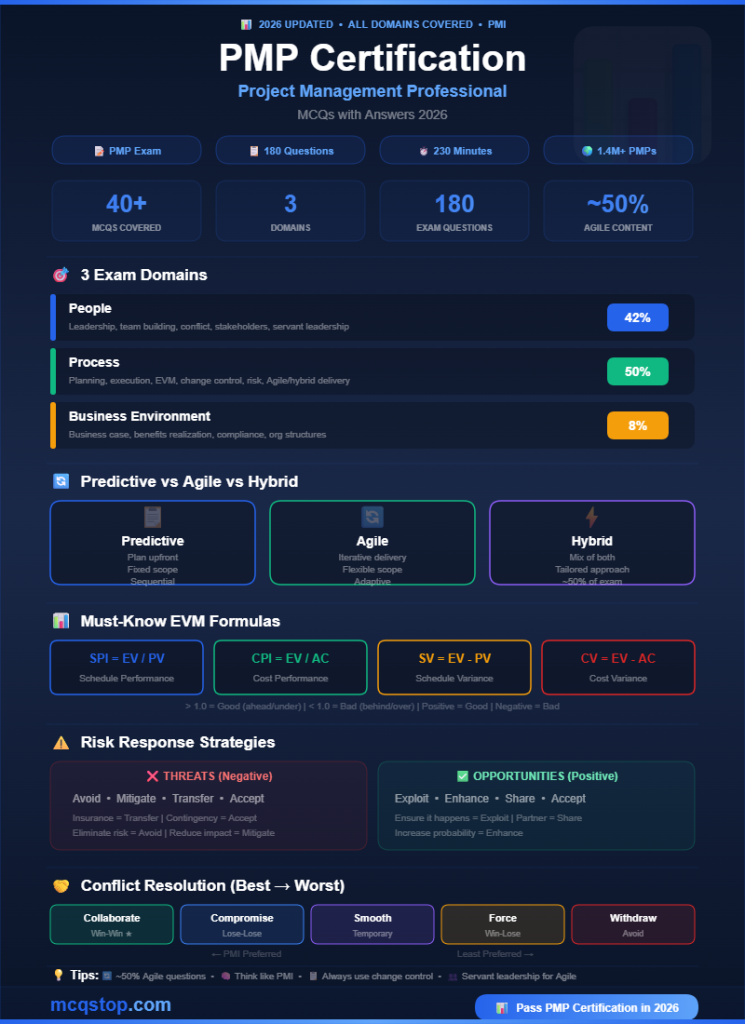
Domain 1 — 42% of Exam
Question 01
A project manager notices that two team members have a conflict about the technical approach to a deliverable. What is the BEST conflict resolution technique to use when a long-term solution is needed and both parties must be satisfied?
AForcing / Directing
BCompromising / Reconciling
CCollaborating / Problem-Solving ✅
DSmoothing / Accommodating
💡 Explanation: Collaborating (problem-solving) is the BEST technique when you need a long-term, win-win solution. Both parties work together to find a solution that fully satisfies everyone. The five conflict resolution techniques are: Collaborating (win-win), Compromising (lose-lose, partial satisfaction), Forcing (win-lose), Smoothing (temporary fix), and Withdrawing (avoiding). PMI considers collaborating the ideal approach for most situations.
Question 02
A project manager is leading a team that is newly formed and team members are uncertain about their roles. According to Tuckman’s model, which stage is the team currently in?
AForming ✅
BStorming
CNorming
DPerforming
💡 Explanation: Tuckman’s team development model has five stages: Forming (team assembles, uncertain), Storming (conflicts arise, power struggles), Norming (team establishes norms, trust builds), Performing (high productivity, self-managing), and Adjourning (project ends, team disbands). Newly formed teams with role uncertainty are in the Forming stage. The PM should provide direction and clarity during this stage.
Question 03
A project manager on an Agile project wants to empower the team to make decisions about how to accomplish the sprint work. Which leadership style is MOST appropriate?
AAutocratic
BTransactional
CServant leadership ✅
DLaissez-faire
💡 Explanation: Servant leadership is the preferred style in Agile environments. The leader focuses on serving the team — removing impediments, facilitating collaboration, and empowering self-organization. This aligns with the Scrum Master role and PMI’s emphasis on team empowerment. Autocratic = top-down decisions, Transactional = reward/punishment, Laissez-faire = hands-off (too little guidance). The PMP exam heavily favors servant leadership for Agile questions.
Question 04
A stakeholder is unhappy with the project direction and frequently expresses concerns during meetings. What should the project manager do FIRST?
AEscalate to the project sponsor
BActively listen to the stakeholder’s concerns and understand their expectations ✅
CRemove the stakeholder from the communication plan
DIgnore the concerns and continue with the plan
💡 Explanation: The PMP exam consistently emphasizes proactive stakeholder engagement. When a stakeholder has concerns, the FIRST step is always to actively listen, understand their perspective, and identify the root cause. Then work collaboratively on a resolution. Escalation is appropriate only after attempting to resolve directly. Never ignore concerns or exclude stakeholders — that increases project risk. Emotional intelligence and active listening are key PMP themes.
Question 05
Which tool helps a project manager assess stakeholder influence, interest, and engagement levels to develop an appropriate engagement strategy?
ARACI matrix
BPower/Interest grid (Stakeholder engagement assessment matrix) ✅
CWork Breakdown Structure
DGantt chart
💡 Explanation: The Power/Interest grid (also called the Stakeholder Engagement Assessment Matrix) classifies stakeholders based on their power (influence) and interest (involvement) levels. This helps determine the engagement strategy: High power/High interest = Manage closely, High power/Low interest = Keep satisfied, Low power/High interest = Keep informed, Low power/Low interest = Monitor. RACI defines roles, WBS breaks down scope, and Gantt shows schedules.
2
Process
Domain 2 — 50% of Exam
Question 06
Which document formally authorizes the existence of a project and gives the project manager authority to apply organizational resources to project activities?
AProject Charter ✅
BProject Management Plan
CScope Statement
DBusiness Case
💡 Explanation: The Project Charter formally authorizes the project, names the project manager, and gives them authority to use resources. It is issued by the project sponsor (not the PM). The charter includes: project purpose, high-level requirements, objectives, assumptions, constraints, and the PM’s authority level. The Business Case justifies the project (before the charter). The Project Management Plan details how the project will be executed.
Question 07
A project is using an Agile approach. The team completes each iteration and presents working functionality to stakeholders. What is this iterative delivery called?
APhase gate review
BIncremental delivery ✅
CRolling wave planning
DProgressive elaboration
💡 Explanation: Incremental delivery means delivering usable functionality in small, valuable increments — each iteration produces a potentially shippable product increment. This is core to Agile/Scrum. Phase gate reviews are for predictive (waterfall) projects. Rolling wave planning is progressively detailing near-term work. Progressive elaboration is gradually refining project details as more information becomes available. The PMP exam is ~50% Agile — know these distinctions.
Question 08
A project’s Schedule Performance Index (SPI) is 0.85 and Cost Performance Index (CPI) is 1.10. What does this indicate?
AThe project is ahead of schedule and over budget
BThe project is behind schedule and under budget ✅
CThe project is on schedule and on budget
DThe project is behind schedule and over budget
💡 Explanation: SPI and CPI are Earned Value Management (EVM) metrics. Values > 1.0 are good, < 1.0 are bad. SPI = 0.85 means the project is completing only 85% of planned work (behind schedule). CPI = 1.10 means the project is getting $1.10 of work for every $1 spent (under budget). Remember: SPI = EV/PV (schedule efficiency), CPI = EV/AC (cost efficiency). EVM questions appear on almost every PMP exam.
Question 09
In an Agile project, the team uses a board with columns showing “To Do,” “In Progress,” and “Done” to visualize work and limit work in progress. What is this tool called?
ABurndown chart
BKanban board ✅
CGantt chart
DNetwork diagram
💡 Explanation: A Kanban board visualizes workflow with columns representing stages (To Do, In Progress, Done). Key feature: WIP (Work in Progress) limits prevent multitasking and bottlenecks. Kanban focuses on flow and continuous delivery without fixed iterations. A burndown chart shows remaining work over time. Gantt charts display schedule with task bars. Network diagrams show task dependencies (Critical Path Method).
Question 10
A risk has been identified that could delay a critical deliverable. The project team decides to purchase insurance to cover the potential financial loss. Which risk response strategy is this?
AAvoid
BMitigate
CTransfer ✅
DAccept
💡 Explanation: Transfer shifts the financial impact of a risk to a third party — insurance, warranties, performance bonds, and fixed-price contracts are all examples. Avoid eliminates the risk entirely (change scope/plan). Mitigate reduces probability or impact. Accept acknowledges the risk without action (passive) or sets aside contingency (active). For negative risks: Avoid, Mitigate, Transfer, Accept. For positive risks (opportunities): Exploit, Enhance, Share, Accept.
Question 11
A stakeholder requests a change to the project scope during execution. What should the project manager do FIRST?
AImplement the change immediately to keep the stakeholder happy
BEvaluate the impact of the change and submit it through the Integrated Change Control process ✅
CReject the change to protect the project scope
DAdd it to the risk register
💡 Explanation: ALL changes must go through Integrated Change Control — never implement changes without evaluation. The process: (1) Receive change request, (2) Assess impact on scope, schedule, cost, quality, risk, (3) Submit to the Change Control Board (CCB) for approval/rejection, (4) Update project documents if approved. The PM doesn’t unilaterally accept or reject changes. This is one of the most tested PMP concepts.
3
Business Environment
Domain 3 — 8% of Exam
Question 12
Which document provides the justification for the project by outlining the expected business benefits, costs, and strategic alignment?
AProject Charter
BBusiness Case ✅
CBenefits Management Plan
DProject Management Plan
💡 Explanation: The Business Case is created BEFORE the project is approved and provides the justification for the investment. It includes: business need, cost-benefit analysis, expected ROI, strategic alignment, and alternatives considered. The project sponsor owns the business case. The PM should reference it throughout the project to ensure the project continues to deliver expected value. If the business case is no longer valid, the project may be cancelled.
Question 13
A project manager discovers that a team member is asked to work on conflicting priorities from two different functional managers. What type of organizational structure creates this situation?
AProjectized
BMatrix ✅
CFunctional
DOrganic
💡 Explanation: In a Matrix organization, team members report to both a functional manager and a project manager — creating dual reporting and potential conflicts. Matrix types: Weak (functional manager has more power), Balanced (equal power), Strong (PM has more power). In Projectized organizations, the PM has full authority. In Functional organizations, the functional manager controls resources. Matrix is the most common and most tested structure.
Question 14
Which concept ensures that the project’s deliverables continue to provide value after the project is completed?
AQuality Management
BBenefits Realization ✅
CProcurement Management
DLessons Learned
💡 Explanation: Benefits Realization ensures that the business benefits outlined in the business case are actually achieved — both during and after the project. The Benefits Management Plan tracks expected benefits, assigns ownership, and defines metrics for measuring success. Projects exist to create value — simply delivering scope on time and budget is not enough if the intended business benefits are never realized. This is a key PMP 2021 exam concept.
How hard is the PMP exam? The PMP is considered a challenging exam. It has 180 questions (multiple choice, multiple response, matching, hotspot, fill-in-the-blank) with a 230-minute time limit split across two sections with a 10-minute break. PMI doesn’t publish a specific passing score — they use a psychometric model. Most candidates need 2-4 months of dedicated preparation. The situational, scenario-based format makes it harder than pure knowledge-based exams.
What are the PMP eligibility requirements? You need either: (1) Four-year degree + 36 months leading projects + 35 hours of PM education, OR (2) High school diploma/associate’s degree + 60 months leading projects + 35 hours of PM education. The 35 hours of PM education can come from PMI-authorized training providers, online courses, or university programs. PMI audits approximately 10% of applications.
How much does the PMP exam cost? The PMP exam costs $555 USD for PMI members or $405 for the exam + $139 annual membership (total $544, which includes the PMBOK Guide free). Non-members pay $555. PMI membership also provides discounts on retakes and other exams. The exam can be taken at a Pearson VUE testing center or online from home.
Does the PMP certification expire? Yes — PMP is valid for 3 years. To maintain it, earn 60 Professional Development Units (PDUs) across three talent triangle categories: Ways of Working (min 8), Power Skills (min 8), and Business Acumen (min 8). PDUs can be earned through courses, webinars, reading, volunteering, or working as a PM. PMI membership includes free PDU opportunities.



Leave a Comment