Manage Azure Identities & Governance
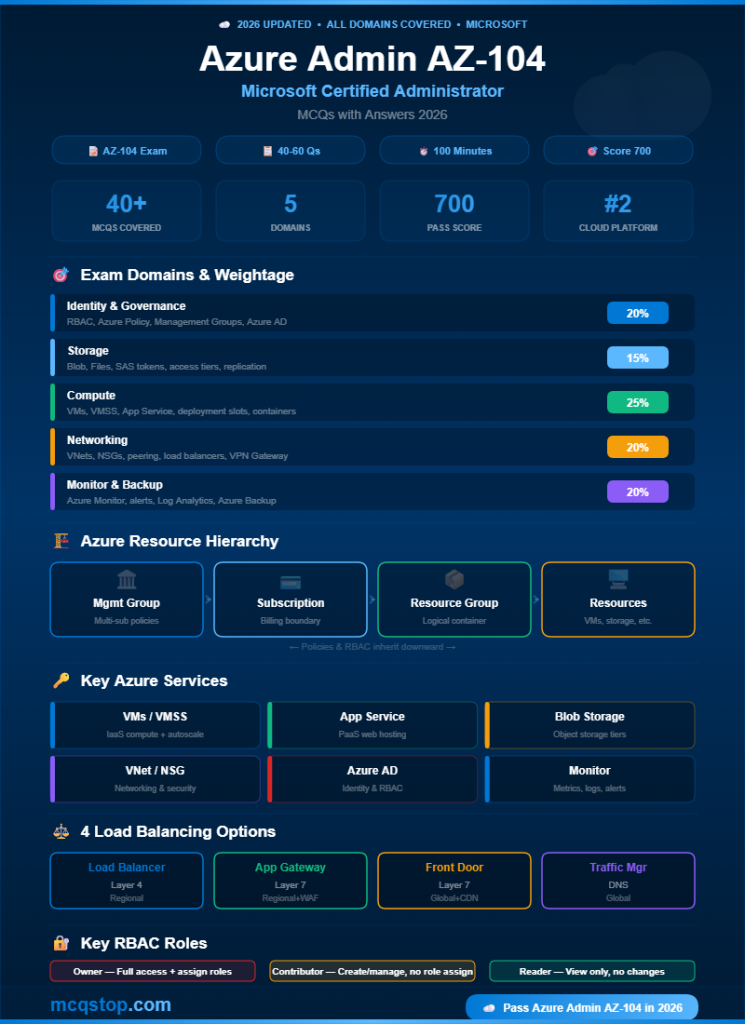
Domain 1 — 20% of Exam
Question 01
Which Azure feature allows you to enforce organizational standards and assess compliance at scale by creating policies that deny, audit, or auto-remediate non-compliant resources?
AAzure Policy ✅
BAzure Blueprints
CManagement Groups
DAzure Monitor
💡 Explanation: Azure Policy evaluates resources and enforces rules. Effects include: Deny (prevent non-compliant creation), Audit (log but allow), DeployIfNotExists (auto-remediate), and Modify (add tags). Policies can be assigned at management group, subscription, or resource group scope. Azure Blueprints package policies, role assignments, and ARM templates together. Management Groups organize subscriptions hierarchically.
Question 02
An Azure administrator needs to grant a developer the ability to create and manage virtual machines in a specific resource group, but NOT access other resource groups. Which feature should they use?
AAzure RBAC — assign the Virtual Machine Contributor role at the resource group scope ✅
BAzure Policy with a deny rule
CAzure AD Conditional Access
DNetwork Security Group
💡 Explanation: Azure RBAC (Role-Based Access Control) grants permissions at specific scopes: management group → subscription → resource group → resource. Assigning “Virtual Machine Contributor” at the resource group level gives VM management permissions only within that group. Key built-in roles: Owner (full access), Contributor (create/manage but not assign roles), Reader (view only). RBAC is the most tested AZ-104 concept.
Question 03
Which Azure resource hierarchy level allows you to manage policies and RBAC across multiple subscriptions?
AManagement Group ✅
BResource Group
CTenant
DAvailability Zone
💡 Explanation: The Azure resource hierarchy from top to bottom: Tenant → Management Groups → Subscriptions → Resource Groups → Resources. Management Groups sit above subscriptions and allow you to apply policies and RBAC across multiple subscriptions at once. They support up to 6 levels of depth. This hierarchy and inheritance model is heavily tested on AZ-104.
2
Implement & Manage Storage
Domain 2 — 15% of Exam
Question 04
Which Azure Storage service provides massively scalable object storage for unstructured data like images, videos, documents, and backups?
AAzure Blob Storage ✅
BAzure Files
CAzure Table Storage
DAzure Queue Storage
💡 Explanation: Azure Blob Storage stores unstructured data as binary large objects (blobs). Three blob types: Block blobs (files up to 190.7 TB), Append blobs (logging data), and Page blobs (VHD disks). Access tiers: Hot (frequent access), Cool (infrequent, 30+ days), Cold (rare, 90+ days), Archive (offline, 180+ days). Azure Files provides SMB/NFS file shares. Table Storage is NoSQL key-value. Queue Storage handles messaging.
Question 05
An admin needs to grant temporary, time-limited access to a specific blob in Azure Storage without sharing the storage account key. What should they generate?
AShared Access Signature (SAS) token ✅
BAccess Key
CAzure AD token
DManaged identity
💡 Explanation: A Shared Access Signature (SAS) provides granular, time-limited access to storage resources. You specify: permissions (read, write, delete), resource scope (account, container, blob), start/expiry time, and allowed IP addresses. SAS types: Account SAS, Service SAS, and User Delegation SAS (most secure, uses Azure AD). Access keys provide full access — never share them. SAS is the standard for secure temporary access.
3
Deploy & Manage Compute Resources
Domain 3 — 25% of Exam (Highest Weight)
Question 06
Which Azure service allows you to deploy a group of identical VMs that can automatically scale in and out based on demand or a schedule?
AAvailability Set
BVirtual Machine Scale Set (VMSS) ✅
CAzure Kubernetes Service
DAzure Batch
💡 Explanation: Virtual Machine Scale Sets (VMSS) deploy and manage a set of identical, auto-scaling VMs. They support metric-based autoscaling (CPU > 75% = add VMs) and schedule-based scaling (scale up during business hours). VMSS works with Azure Load Balancer or Application Gateway. Availability Sets protect against hardware failures within a datacenter (fault domains + update domains). AKS is for container orchestration.
Question 07
Which Azure compute service is a fully managed platform for building, deploying, and scaling web applications without managing the underlying infrastructure?
AAzure App Service ✅
BAzure Virtual Machines
CAzure Container Instances
DAzure Functions
💡 Explanation: Azure App Service is a PaaS offering for hosting web apps, REST APIs, and mobile backends. It supports .NET, Java, Node.js, Python, PHP, and Ruby. Features include custom domains, SSL, autoscaling, deployment slots (staging/production swap), and CI/CD integration. VMs are IaaS (you manage the OS). Container Instances run containers without orchestration. Functions are serverless event-driven compute.
Question 08
An admin wants to deploy a new version of a web app for testing before making it live. Which Azure App Service feature allows testing in a separate environment and swapping to production with zero downtime?
ADeployment slots ✅
BAzure DevOps pipeline
CTraffic Manager
DAzure CDN
💡 Explanation: Deployment slots in Azure App Service allow you to create a separate instance (e.g., “staging”) with its own URL. Deploy your new version to the staging slot, test it, then swap staging ↔ production instantly with zero downtime. If issues arise, swap back immediately. Slots share the same App Service plan. You can also route a percentage of traffic to a slot for A/B testing. Available on Standard tier and above.
4
Configure & Manage Virtual Networking
Domain 4 — 20% of Exam
Question 09
Which Azure networking feature allows two virtual networks to communicate directly with each other as if they were on the same network, using Microsoft’s backbone network?
AVNet Peering ✅
BVPN Gateway
CExpressRoute
DAzure Firewall
💡 Explanation: VNet Peering connects two Azure virtual networks via Microsoft’s backbone — traffic never touches the public internet. Two types: Regional peering (same region) and Global peering (cross-region). Peering is non-transitive — if VNet A peers with VNet B, and VNet B peers with VNet C, A cannot reach C unless directly peered. VPN Gateway connects Azure to on-premises or other cloud networks. ExpressRoute provides private, dedicated connectivity.
Question 10
Which Azure resource controls inbound and outbound network traffic to Azure resources using security rules based on source/destination IP, port, and protocol?
ANetwork Security Group (NSG) ✅
BAzure Firewall
CApplication Gateway
DAzure DDoS Protection
💡 Explanation: NSGs contain security rules that allow or deny inbound/outbound traffic. Each rule specifies: priority (100-4096, lower = higher priority), source/destination (IP, service tag, ASG), port, protocol (TCP/UDP/Any), and action (Allow/Deny). NSGs can be associated with subnets or individual NICs. Azure Firewall is a managed, stateful firewall-as-a-service with FQDN filtering. Application Gateway is a Layer 7 load balancer with WAF.
Question 11
Which Azure load balancing service operates at Layer 7 (HTTP/HTTPS) and supports URL-based routing, SSL termination, and Web Application Firewall (WAF)?
AAzure Load Balancer
BAzure Application Gateway ✅
CAzure Front Door
DTraffic Manager
💡 Explanation: Application Gateway is a regional Layer 7 (HTTP/HTTPS) load balancer with URL path-based routing, SSL termination, cookie-based session affinity, and optional WAF. Azure Load Balancer is Layer 4 (TCP/UDP) — faster but no URL routing. Front Door is a global Layer 7 load balancer with CDN. Traffic Manager is DNS-based global load balancing. Know the differences between all four for AZ-104.
5
Monitor & Maintain Azure Resources
Domain 5 — 20% of Exam
Question 12
Which Azure service provides a centralized platform for collecting, analyzing, and acting on telemetry data from Azure resources — including metrics, logs, and alerts?
AAzure Monitor ✅
BAzure Advisor
CAzure Service Health
DAzure Activity Log
💡 Explanation: Azure Monitor is the comprehensive monitoring platform. It collects: Metrics (numerical performance data), Logs (structured event data sent to Log Analytics workspace), and Activity Logs (control-plane operations). Features: Alerts (notify on conditions), Dashboards (visualize), Workbooks (interactive reports), and Insights (pre-built monitoring for VMs, containers, apps). Azure Advisor gives best-practice recommendations. Service Health tracks Azure outages.
Question 13
Which Azure service provides backup and disaster recovery for Azure VMs, SQL databases, file shares, and on-premises workloads?
AAzure Backup (Recovery Services vault) ✅
BAzure Site Recovery
CAzure Blob Snapshots
DAzure Storage replication
💡 Explanation: Azure Backup uses a Recovery Services vault to store backups of VMs, SQL databases, Azure Files, and on-premises machines. It supports scheduled backups, retention policies, geo-redundant storage, and point-in-time restore. Azure Site Recovery (ASR) is for disaster recovery — it replicates VMs to a secondary region for failover. Know the difference: Backup = data protection, Site Recovery = business continuity (DR).
Question 14
An administrator wants to automate the deployment of Azure resources in a repeatable, consistent manner using JSON-based template files. Which approach should they use?
AARM templates (or Bicep) ✅
BAzure CLI only
CAzure Portal manually
DAzure Advisor
💡 Explanation: ARM (Azure Resource Manager) templates are JSON files that define the infrastructure and configuration declaratively — similar to Terraform but Azure-native. Bicep is a newer, simpler DSL that compiles to ARM JSON. Benefits: idempotent deployments, version control, modular design, and what-if previews. Azure CLI/PowerShell can deploy resources imperatively but aren’t template-based. ARM templates are the Azure-native IaC standard.



Leave a Comment