
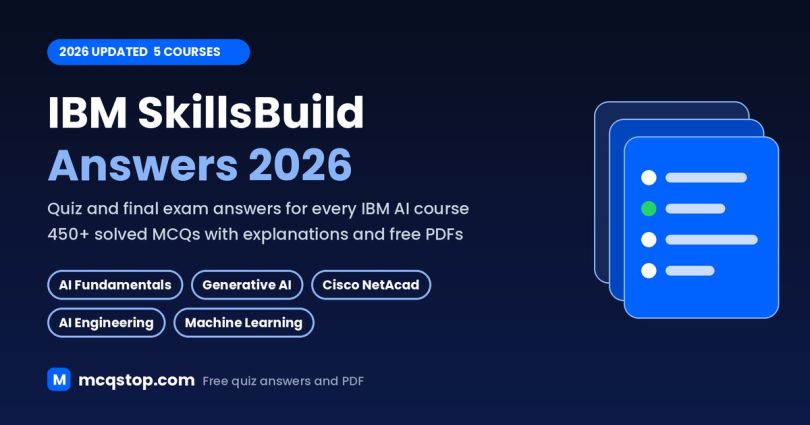
Find your IBM course
🤖 IBM AI Fundamentals150+ MCQs by module: intro to AI, ML and deep learning, NLP, computer vision, Watson, AI ethics, careersSkillsBuild badge · beginner · about 10 hoursOpen answers →
✨ IBM Generative AI Fundamentals75+ MCQs: foundation models, LLMs, prompt engineering, use cases, risks, watsonxSkillsBuild badge · beginnerOpen answers →
🌐 AI Fundamentals with IBM SkillsBuild (Cisco NetAcad)Module-by-module quiz answers and final exam practice for the Cisco Networking Academy versionNetAcad course · same IBM badgeOpen answers →
🛠️ IBM AI Engineering Professional Certificate100+ MCQs: ML with Python, Keras, TensorFlow, PyTorch, LLMs, fine-tuning, RAG and LangChainCoursera · 13 courses · intermediateOpen answers →
📈 IBM Machine Learning Professional Certificate90+ MCQs: EDA, regression, classification, clustering, PCA, deep learning, reinforcement learningCoursera · 6 courses · intermediateOpen answers →
In preparation:
How IBM SkillsBuild quizzes and the final assessment work
- Each module ends with a short multiple-choice quiz; the course ends with a longer final assessment drawn from all modules.
- Questions are shown from a pool, so two learners may see different questions and a different order. That is why these pages cover every topic instead of one fixed list.
- You can retake quizzes and the final assessment; the pass mark is shown on the assessment’s start screen and differs between courses.
- Passing the final assessment issues a digital badge through Credly, which you can add to LinkedIn.
- The ethics module is the most heavily tested: learn IBM’s three principles and five pillars (they are in the mixed questions below).
30 questions that appear across IBM AI courses
A quick check before you open your course page. Five questions per area.
AI basics
Which statement best describes ‘narrow AI’?
Which three ingredients drove the recent progress in AI?
An image-labelled dataset used to train a classifier is an example of:
Which IBM system beat human champions at Jeopardy! in 2011?
Unstructured data includes:
Machine learning and deep learning
Which learning type uses rewards and penalties?
Grouping customers by behaviour without labels is:
A neural network with many hidden layers is called:
A model that performs well on training data but poorly on new data is:
A large model pre-trained on broad data and adapted to many tasks is a:
NLP, vision and generative AI
Which field lets computers understand human language?
Which network type is most associated with image recognition?
A prompt that includes several worked examples is called:
When a generative model states something false with confidence, it is called:
Supplying retrieved documents to a model so its answer is grounded is called:
IBM tools
Which watsonx component is the studio for foundation models and ML?
Which watsonx component monitors bias, drift and compliance?
Which tool builds chatbots and virtual agents?
Which Watson Studio feature builds ML pipelines automatically?
Which IBM open-source toolkit detects bias in ML models?
AI ethics
How many pillars of trustworthy AI does IBM define?
According to IBM, the purpose of AI is to:
According to IBM, data and insights belong to:
Which pillar is about resisting attacks and handling unexpected inputs?
Keeping a person able to review and override AI decisions is called:
Careers and the badge
IBM SkillsBuild digital badges are issued through:
Which is a new role created by generative AI?
Which tasks are most easily automated by AI?
Learning new skills to keep pace with change is called:
IBM SkillsBuild courses are:
⚖️ IBM AI ethics in one box
Three principles: AI augments human intelligence · data and insights belong to their creator · AI must be transparent and explainable.
Five pillars: Explainability · Fairness · Robustness · Transparency · Privacy.
🎯 Other AI certification answers
Same format, updated regularly
Frequently Asked Question
On our IBM AI Fundamentals page, which has 150+ solved MCQs organised by the course’s modules, including the ethics questions most often asked in the final assessment. The link is in the course list at the top of this page.
Yes. SkillsBuild courses and their Credly badges are free. The IBM professional certificates on Coursera can usually be audited free, but graded quizzes and the certificate need a subscription or financial aid.
Start with AI Fundamentals if you are new. Take Generative AI Fundamentals next. The Machine Learning and AI Engineering professional certificates assume Python and are for those who want to build models.
Each course page listed above has its own free PDF with all questions, answers and explanations.
IBM draws each quiz from a question pool, so learners see different questions. These pages cover every topic the pool tests instead of one fixed list. If you meet a question that is missing, leave it in the comments.


Leave a Comment