AI Fundamentals with IBM SkillsBuild is the version of IBM’s AI Fundamentals course that you take through
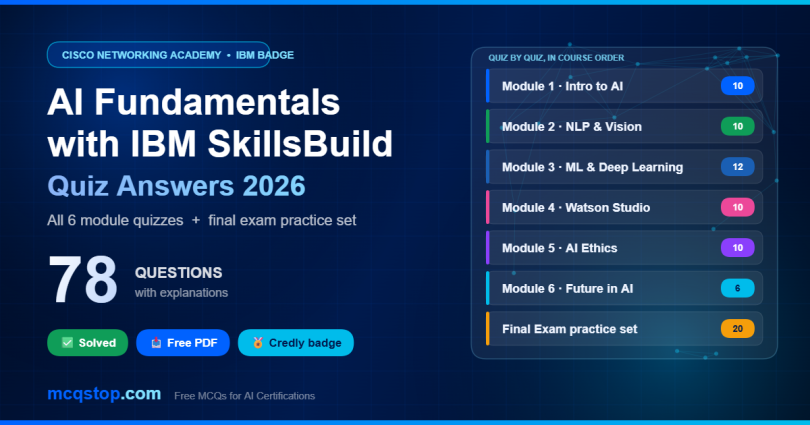
Cisco Networking Academy (netacad.com). It has the same six modules, each ending in a module quiz, and a final exam at the end. This page is organised
quiz by quiz, in the order you meet them, so you can check your answers after each module and then run the 20-question final exam practice set before the real one. Every question has the correct option marked and a short explanation. If you want to revise a topic in depth, each module links to the matching topic on our main
IBM AI Fundamentals MCQs page (159+ questions). A
free PDF of this page is at the end.
🔁 How the Cisco NetAcad version differs from IBM SkillsBuild
🎓 Enrolment
Through netacad.com with a Cisco NetAcad account, often via a school or college, instead of skillsbuild.org directly.
🏅 Badge
Issued by IBM through Credly — the same “AI Fundamentals” badge as the SkillsBuild version, not a Cisco badge.
📝 Assessment
Six module quizzes plus the same final assessment; the quizzes are taken inside the NetAcad learning platform.
⏱ Time
About 10 hours self-paced; the hands-on Watson Studio lab in Module 4 takes the longest.
🤖
Module 1 Quiz — Introduction to AI (Questions 1–10)
What AI is, its history, narrow vs general AI, data types and where AI shows up in daily life
Question 01
A system that can understand a spoken request, work out what the user wants and respond is demonstrating:
AFaster hardware
BArtificial intelligence ✅
CA spreadsheet macro
DA larger database
💡 ExplanationUnderstanding language, reasoning about intent and responding are tasks that normally need human intelligence, which is the course’s working definition of AI.
Question 02
The 1956 summer workshop regarded as the founding event of AI as a field took place at:
AMIT
BDartmouth College ✅
CStanford
DCambridge
💡 ExplanationJohn McCarthy organised the Dartmouth Summer Research Project and used the term “artificial intelligence” in its proposal.
Question 03
“Weak AI” is another name for:
ANarrow AI, built for one specific task ✅
BAI that runs on low-power devices
CAI with low accuracy
DArtificial general intelligence
💡 ExplanationWeak or narrow AI does one job well. Strong AI, or AGI, would reason across any domain and does not yet exist.
Question 04
Which of the following would NOT be classed as narrow AI?
AA translation app
BA chess engine
CA machine that can learn and reason about any subject the way a person can ✅
DA credit-card fraud detector
💡 ExplanationOption C describes general AI. The other three each do a single task, which is the definition of narrow AI.
Question 05
IBM prefers the phrase “augmented intelligence” because it emphasises that AI should:
AWork without any human input
BExtend and support human judgement rather than replace it ✅
CBe used only in virtual reality
DRun on more powerful chips
💡 ExplanationThis is also IBM’s first Principle for Trust and Transparency: the purpose of AI is to augment human intelligence.
Question 06
A hospital stores patient ages in a table and also keeps voice recordings of consultations. Which of these is unstructured data?
AThe patient-age table
BThe voice recordings ✅
CBoth are structured
DNeither is data
💡 ExplanationAudio, images, video and free text have no fixed rows and columns, so they are unstructured and need AI to interpret.
Question 07
Which combination of three things does the course credit for the rapid progress of AI in the last decade?
ACheaper laptops, faster internet, social media
BHuge datasets, powerful computing (GPUs) and better algorithms ✅
CNew programming languages, bigger screens, cloud storage
DGovernment funding, patents, robots
💡 ExplanationData to learn from, compute to train on and algorithms such as deep learning are the three ingredients behind the current AI boom.
Question 08
A machine is said to pass the Turing Test when:
AIt solves a maths problem faster than a person
BA human judge cannot reliably tell its text replies from a person’s ✅
CIt wins a game of chess
DIt recognises its own reflection
💡 ExplanationAlan Turing proposed the “imitation game” in 1950 as a practical test of machine intelligence based on conversation.
Question 09
In 2011, Jeopardy! champions Ken Jennings and Brad Rutter were beaten by which IBM system?
ADeep Blue
BWatson ✅
CGranite
DTD-Gammon
💡 ExplanationWatson’s win showed a machine could parse natural-language clues; Deep Blue was the 1997 chess system.
Question 10
Which everyday experience is powered by AI?
AA calculator adding two numbers
BA navigation app predicting your arrival time from live traffic ✅
CA light switch
DA printed timetable
💡 ExplanationArrival-time prediction learns from historical and live traffic data; a calculator just follows fixed rules.
Next: Module 2 Quiz →
💬
Module 2 Quiz — Natural Language Processing and Computer Vision (Questions 11–20)
How machines read text and speech, and how they see images and video
Question 11
Before a sentence can be analysed, an NLP system usually splits it into words or sub-words. This step is called:
ATranslation
BTokenization ✅
CSummarisation
DEncryption
💡 ExplanationTokenization is the first step of nearly every text pipeline; the tokens are then cleaned, normalised and turned into numbers.
Question 12
A customer types “I need to change my delivery address” and the chatbot classifies this as update_address. The chatbot has recognised the:
AEntity
BIntent ✅
CSentiment
DStop word
💡 ExplanationThe intent is the goal behind the message. If the user had typed a new postcode, that postcode would be an entity.
Question 13
A call centre wants written transcripts of every phone call. Which Watson service does the job?
AWatson Speech to Text ✅
BWatson Text to Speech
CWatson Discovery
Dwatsonx.data
💡 ExplanationSpeech to Text converts audio into text; Text to Speech is the reverse and would be used to read a reply aloud.
Question 14
A brand scans thousands of tweets about its new phone to see whether people are happy or angry. This is:
AMachine translation
BSentiment analysis ✅
COptical character recognition
DSpeech synthesis
💡 ExplanationSentiment analysis labels text as positive, negative or neutral; Watson Natural Language Understanding offers it as a feature.
Question 15
In the sentence “IBM opened a lab in Nairobi on Monday”, an NLP tool tags IBM, Nairobi and Monday. The technique is:
AStemming
BBag of words
CNamed entity recognition ✅
DStop-word removal
💡 ExplanationNER finds organisations, places, dates and people in text so the information can be stored in a structured form.
Question 16
A security camera draws a rectangle around every person who walks through a gate. This computer-vision task is:
AImage classification
BObject detection ✅
CImage generation
DData augmentation
💡 ExplanationDetection answers “what and where” with bounding boxes; classification only answers “what” for the whole image.
Question 17
In a convolutional neural network, the early layers tend to pick out simple edges and the later layers combine them into shapes and objects. This is an example of:
ALearning features in a hierarchy ✅
BOverfitting
CReinforcement learning
DTokenization
💡 ExplanationEach CNN layer builds on the one before, from pixels to edges to textures to whole objects.
Question 18
A farmer photographs leaves with a phone and an app tells her which crop disease is present. Which AI field is being used?
ANatural language processing
BComputer vision ✅
CSpeech synthesis
DRobotics
💡 ExplanationClassifying a photo of a leaf is image classification, a core computer-vision task used widely in agriculture.
Question 19
A radiology tool colours every pixel that belongs to a tumour so the exact outline is visible. This is:
AObject detection
BImage segmentation ✅
CPose estimation
DImage compression
💡 ExplanationSegmentation labels each pixel; detection would only draw a box around the region.
Question 20
You photograph a paper receipt and the app turns the printed numbers into editable text. The technology is:
AOptical character recognition (OCR) ✅
BText to speech
CFacial recognition
DClustering
💡 ExplanationOCR combines computer vision (finding the characters) with text processing (reading them).
Next: Module 3 Quiz →
🧠
Module 3 Quiz — Machine Learning and Deep Learning (Questions 21–32)
Supervised, unsupervised and reinforcement learning, training and testing, neural networks, foundation models
Question 21
A bank gives a model 50,000 past loans, each marked “repaid” or “defaulted”, and asks it to learn the pattern. This is:
ASupervised learning ✅
BUnsupervised learning
CReinforcement learning
DRule-based programming
💡 ExplanationThe examples carry the correct answer (the label), which is what makes the learning “supervised”.
Question 22
Which of these is a regression task?
ADeciding whether a tumour is benign or malignant
BEstimating next month’s electricity bill in rupees ✅
CGrouping shoppers into segments
DSorting photos into “cat” or “dog”
💡 ExplanationRegression predicts a continuous number. A and D are classification; C is clustering.
Question 23
A supermarket has purchase histories for a million customers but no labels. It wants to discover natural groups of similar shoppers. The method is:
AClassification
BClustering (unsupervised learning) ✅
CRegression
DReinforcement learning
💡 ExplanationNo labels plus a need for structure points to unsupervised learning; k-means is the typical clustering algorithm.
Question 24
An agent, an environment, actions and a reward signal are the ingredients of:
ASupervised learning
BClustering
CReinforcement learning ✅
DTransfer learning
💡 ExplanationThe agent tries actions, receives rewards or penalties, and learns a strategy that maximises long-term reward.
Question 25
A data scientist keeps 20 percent of the records aside and never shows them to the model during training. Why?
ATo reduce the file size
BTo measure how well the model performs on data it has never seen ✅
CBecause the records are low quality
DTo speed up the GPU
💡 ExplanationThe held-out test set shows whether the model generalises or has just memorised the training data.
Question 26
A model scores 99 percent on the training data but only 60 percent on new data. The most likely problem is:
AUnderfitting
BOverfitting ✅
CToo little training
DA slow network
💡 ExplanationA big gap between training and test accuracy means the model learned noise in the training set instead of the real pattern.
Question 27
The individual processing units that make up the layers of an artificial neural network are called:
APixels
BNodes, or artificial neurons ✅
CTokens
DServers
💡 ExplanationEach neuron receives weighted inputs, applies a function and passes the result on, loosely modelled on neurons in the brain.
Question 28
The word “deep” in deep learning refers to:
AHow long training takes
BThe many hidden layers between input and output ✅
CThe size of the hard drive
DThe difficulty of the maths
💡 ExplanationStacking many hidden layers lets the network learn increasingly abstract features from raw data.
Question 29
A manager needs a model whose decisions can be explained step by step to auditors. Which algorithm fits best?
ADecision tree ✅
BA 100-layer deep neural network
CA GAN
DA large language model
💡 ExplanationA decision tree is a readable sequence of if-then splits, which makes it one of the most interpretable models.
Question 30
Why are GPUs, originally made for graphics, so important for training neural networks?
AThey have bigger screens
BThey perform thousands of simple calculations in parallel, which is what matrix maths needs ✅
CThey use less electricity than CPUs
DThey store the training data
💡 ExplanationNeural-network training is mostly multiplying large matrices, a job GPUs do far faster than general-purpose CPUs.
Question 31
One complete pass of the whole training dataset through the network is called:
AA token
BAn epoch ✅
CA pipeline
DA deployment
💡 ExplanationModels are usually trained for many epochs, with the weights adjusted by backpropagation after each batch.
Question 32
A company takes a general-purpose foundation model and trains it further on 2,000 of its own support tickets. This process is:
APre-training
BFine-tuning ✅
CClustering
DData augmentation
💡 ExplanationFine-tuning adapts a pre-trained model to a specific domain with a small dataset, which is how watsonx.ai customises Granite.
Next: Module 4 Quiz →
🔬
Module 4 Quiz — Run AI Models with IBM Watson Studio (Questions 33–42)
The hands-on lab: projects, AutoAI, pipelines, deployment and testing a model
Question 33
In the Watson Studio lab, what is the first thing you create before you can upload data or run AutoAI?
AA chatbot
BA project ✅
CA virtual machine
DA website
💡 ExplanationA Watson Studio project is the workspace that holds your data assets, AutoAI experiments, notebooks and models.
Question 34
In what format is the sample dataset uploaded to the project in the lab?
AA CSV file ✅
BA PowerPoint deck
CAn MP4 video
DA ZIP of images
💡 ExplanationAutoAI works on structured tabular data, so the lab uses a CSV with one row per record and one column per feature.
Question 35
When you set up an AutoAI experiment, the column you tell it to predict is called the:
AIndex column
BPrediction column (the target or label) ✅
CPrimary key
DHeader row
💡 ExplanationAutoAI reads the prediction column, decides whether the task is classification or regression, and uses the other columns as features.
Question 36
Which of these does AutoAI handle for you automatically?
ACollecting the raw data from customers
BData preparation, algorithm selection and hyperparameter tuning ✅
CWriting the business report
DDeciding what question the business should ask
💡 ExplanationAutoAI automates the technical middle of the workflow; defining the problem and using the results stay with people.
Question 37
When an AutoAI experiment finishes, the results are shown as:
AA single model with no alternatives
BA ranked leaderboard of candidate pipelines ✅
CA PDF report emailed to you
DA chatbot you can talk to
💡 ExplanationEach pipeline is a combination of preprocessing, algorithm and tuned settings, ranked by the chosen metric.
Question 38
For a classification experiment, which metric would you typically see used to rank the pipelines?
AAccuracy ✅
BFile size
CNumber of columns
DUpload speed
💡 ExplanationAccuracy is the share of correct predictions; AutoAI also offers precision, recall and other metrics for imbalanced data.
Question 39
After you save the best pipeline as a model, what do you do so an application can send it new data and get predictions back?
APrint the model
BDeploy it as an online deployment (an endpoint) ✅
CDelete the project
DRe-upload the CSV
💡 ExplanationDeployment publishes the model to a deployment space with a REST endpoint that apps can call.
Question 40
Which IBM service must be associated with the project so that models can be trained and deployed?
AWatson Text to Speech
BWatson Machine Learning ✅
CWatson Discovery
DWatson Assistant
💡 ExplanationWatson Machine Learning provides the compute for AutoAI runs and hosts the deployed models.
Question 41
A deployment space in Watson Studio is:
AThe folder where raw CSV files are kept
BThe area where deployed models and their endpoints are managed ✅
CA physical server room
DThe AutoAI settings page
💡 ExplanationYou promote a model from the project to a deployment space, then create the deployment inside that space.
Question 42
How does the lab test the deployed model at the end?
ABy retraining it from scratch
BBy entering new input values in the Test tab (or calling the API) and reading the prediction returned ✅
CBy emailing IBM support
DBy deleting the deployment
💡 ExplanationThe Test tab lets you type or paste a row of feature values and see the model’s prediction and confidence instantly.
Next: Module 5 Quiz →
⚖️
Module 5 Quiz — AI Ethics (Questions 43–52)
IBM’s principles, the five pillars of trust, bias, privacy, governance and the human role
Question 43
How many pillars does IBM use to describe trustworthy AI?
AThree
BFive ✅
CSeven
DTen
💡 ExplanationExplainability, fairness, robustness, transparency and privacy. Do not confuse them with the three Principles for Trust and Transparency.
Question 44
A recruitment model trained on ten years of past hires keeps rejecting female applicants. Which pillar is being violated?
ARobustness
BFairness ✅
CPrivacy
DTransparency
💡 ExplanationHistorical bias in the training data has produced discriminatory outcomes, which is a fairness failure.
Question 45
A customer whose loan was refused asks the bank which factors led to the decision, and the bank can show them. This illustrates:
AExplainability ✅
BRobustness
CData minimisation
DModel drift
💡 ExplanationExplainability means humans can understand why a model produced a given output, which regulators increasingly require.
Question 46
Publishing a “model card” that describes what data a model was trained on and how it was evaluated supports which pillar?
APrivacy
BTransparency ✅
CRobustness
DProfitability
💡 ExplanationTransparency is openness about how a system is built and what it does; documentation is its main tool.
Question 47
An attacker adds tiny, invisible changes to a stop-sign image so the self-driving car reads it as a speed-limit sign. The pillar designed to prevent this is:
AFairness
BRobustness ✅
CExplainability
DPrivacy
💡 ExplanationThis is an adversarial attack; a robust model resists manipulation and handles unexpected inputs safely.
Question 48
Complying with GDPR when collecting and using personal data for an AI system relates most directly to:
AExplainability
BRobustness
CPrivacy ✅
DAccuracy
💡 ExplanationThe privacy pillar covers consent, data protection and respecting people’s rights over their data across the AI lifecycle.
Question 49
Which statement matches IBM’s second Principle for Trust and Transparency?
AIBM may use any client data to improve its models
BData and the insights derived from it belong to the organisation that created them ✅
CAll AI must be open source
DAI should replace human decision-makers
💡 ExplanationThe three principles: AI augments humans; data belongs to its creator; AI must be transparent and explainable.
Question 50
The body inside IBM that reviews AI projects against the company’s ethics principles is the:
ASales team
BAI Ethics Board ✅
CCloud operations
DMarketing department
💡 ExplanationThe AI Ethics Board is part of IBM’s governance; tools such as watsonx.governance and AI Fairness 360 support its work.
Question 51
A team wants an open-source library to measure and reduce bias in its model before release. IBM’s toolkit for this is:
AWatson Discovery
BAI Fairness 360 ✅
CCloud Pak for Data
DGranite
💡 ExplanationAIF360 provides fairness metrics and mitigation algorithms; its sibling AI Explainability 360 covers explanations.
Question 52
A hospital lets its AI flag likely cases, but a doctor must confirm every diagnosis before treatment. This design is called:
AFull automation
BHuman-in-the-loop ✅
CModel drift
DTransfer learning
💡 ExplanationKeeping a person in the loop for high-stakes decisions preserves accountability and catches model errors.
Next: Module 6 Quiz →
🚀
Module 6 Quiz — Your Future in AI (Questions 53–58)
AI roles, durable skills, automation and the badge you earn
Question 53
Which job is mainly responsible for putting trained models into production systems and keeping them running reliably?
AData analyst
BMachine learning engineer ✅
CUX designer
DProject manager
💡 ExplanationML engineers sit between data science and software engineering, handling deployment, monitoring and scaling.
Question 54
Which skill does the course describe as “durable” because AI cannot easily replace it?
AFast data entry
BCommunication, creativity and critical thinking ✅
CMemorising product codes
DKnowing one version of one tool
💡 ExplanationHuman skills complement AI; routine and rule-based tasks are the ones most likely to be automated.
Question 55
Of these four tasks in an office, which is the most likely to be automated by AI first?
ANegotiating a contract with a new supplier
BCopying invoice totals into a spreadsheet every day ✅
CCoaching a struggling team member
DDesigning a new product strategy
💡 ExplanationRepetitive, rule-based work with clear inputs and outputs is the easiest to automate; judgement and relationships are not.
Question 56
A business user with no coding background builds a working prediction model using AutoAI. The course calls this person a:
AResearch scientist
BCitizen data scientist ✅
CDatabase administrator
DPrompt engineer
💡 ExplanationLow-code tools let non-specialists do data science work that used to require programming.
Question 57
When you pass the final assessment, how is your AI Fundamentals credential delivered?
AA paper certificate posted to you
BA digital badge issued by IBM through Credly ✅
CA Cisco CCNA certificate
DA university credit
💡 ExplanationEven on the Cisco NetAcad version, the badge is IBM’s, so it is identical to the SkillsBuild badge and shareable on LinkedIn.
Question 58
The course’s closing advice for staying employable as AI spreads is to:
AAvoid using AI tools so your skills stay pure
BKeep learning, build AI literacy and develop skills that work alongside AI ✅
CSpecialise in one software version for life
DWait until AI settles down before learning anything
💡 ExplanationLifelong learning and adaptability are the theme of Module 6, and SkillsBuild’s free courses are offered as the next step.
Next: Final Exam practice set →
🏁
Final Exam Practice Set — 20 Mixed Questions (Questions 59–78)
All six modules mixed, in the style of the final assessment. Time yourself: aim for 20 minutes without looking at the explanations.
Question 59
Which of the following best illustrates generative AI rather than predictive AI?
AForecasting next week’s sales
BWriting a product description from a few bullet points ✅
CFlagging a suspicious transaction
DRanking job applicants by fit score
💡 ExplanationOnly option B creates new content; the others predict or classify.
Question 60
Which item is structured data?
AA folder of security-camera clips
BCustomer complaint emails
CA sales table with date, product and amount columns ✅
DPodcast recordings
💡 ExplanationStructured data fits into fixed rows and columns; video, free text and audio do not.
Question 61
An email filter was trained on messages that humans had already marked “junk” or “safe”. It is an example of:
ASupervised classification ✅
BUnsupervised clustering
CReinforcement learning
DRegression
💡 ExplanationLabelled examples plus a category output equals supervised classification.
Question 62
The k-means algorithm is most closely associated with:
APredicting house prices
BGrouping unlabelled data into clusters ✅
CTranslating languages
DPlaying board games
💡 Explanationk-means places k centroids and assigns each point to the nearest one, which is unsupervised clustering.
Question 63
A robot vacuum learns the fastest route around a flat by being “rewarded” when it covers more floor per minute. This is:
ASupervised learning
BReinforcement learning ✅
CClustering
DComputer vision
💡 ExplanationLearning from rewards through trial and error is the signature of reinforcement learning.
Question 64
In a neural network, the layer that receives the raw data is the:
AInput layer ✅
BOutput layer
CHidden layer
DDeployment layer
💡 ExplanationData enters at the input layer, is transformed by hidden layers, and the output layer gives the prediction.
Question 65
During training, the process that works backwards from the error to adjust the connection weights is:
ATokenization
BBackpropagation ✅
CSegmentation
DDeployment
💡 ExplanationBackpropagation with gradient descent is how nearly all neural networks are trained.
Question 66
Reducing “playing”, “played” and “plays” to the root “play” before analysis is called:
ASentiment analysis
BStemming ✅
CNamed entity recognition
DSpeech synthesis
💡 ExplanationStemming and lemmatization normalise word forms so the model treats variants as one term.
Question 67
Words such as “the”, “and” and “of” that are often removed before text analysis are called:
AEntities
BTokens
CStop words ✅
DIntents
💡 ExplanationStop words carry little meaning on their own, so dropping them reduces noise in bag-of-words models.
Question 68
Which neural-network type would you choose to classify X-ray images?
AConvolutional neural network ✅
BA bag-of-words model
CA decision tree on raw pixels
DLinear regression
💡 ExplanationCNNs use sliding filters to learn visual features, which makes them the standard for medical imaging.
Question 69
Creating rotated and flipped copies of training images to enlarge a small dataset is called:
AOverfitting
BData augmentation ✅
CModel drift
DPose estimation
💡 ExplanationAugmentation gives the model more varied examples and helps prevent overfitting when real images are scarce.
Question 70
Which IBM platform, launched in 2023, combines a model studio, a data store and governance tools?
ADeep Blue
Bwatsonx ✅
CSkillsBuild
DCredly
💡 Explanationwatsonx.ai, watsonx.data and watsonx.governance are the three parts of the watsonx platform.
Question 71
Which Watson Studio feature lets a non-programmer build and compare several machine-learning models from one CSV file?
AJupyter notebooks
BAutoAI ✅
CWatson Assistant
DSpeech to Text
💡 ExplanationAutoAI is the no-code route used in the Module 4 lab; notebooks are the code route for data scientists.
Question 72
A deployed model was accurate at launch but has become less reliable over six months as customer behaviour changed. This is:
AUnderfitting
BModel drift ✅
CTokenization
DTransfer learning
💡 ExplanationDrift happens when live data stops matching the training data; watsonx.governance monitors for it and triggers retraining.
Question 73
Which option is NOT one of IBM’s five pillars of trustworthy AI?
AExplainability
BEfficiency ✅
CRobustness
DPrivacy
💡 ExplanationThe five are explainability, fairness, robustness, transparency and privacy; speed, cost and efficiency are never pillars.
Question 74
A video of a politician saying something they never said, generated by AI, is an example of a:
AHidden layer
BDeepfake ✅
CFoundation model
DDecision tree
💡 ExplanationDeepfakes are a misinformation and consent risk that the ethics module highlights.
Question 75
The European regulation that classifies AI systems by risk level and sets obligations for high-risk ones is the:
AGDPR
BEU AI Act ✅
CISO 9001
DHIPAA
💡 ExplanationGDPR covers personal data; the AI Act is the first comprehensive AI-specific law.
Question 76
IBM’s conversational-AI product for building customer-service virtual agents is:
AWatson Studio
Bwatsonx Assistant ✅
Cwatsonx.data
DAI Fairness 360
💡 Explanationwatsonx Assistant (formerly Watson Assistant) uses intents and entities to handle conversations across channels.
Question 77
Giving an LLM three worked examples in the prompt before asking it to do the same task is called:
AZero-shot prompting
BFew-shot prompting ✅
CFine-tuning
DBackpropagation
💡 ExplanationFew-shot prompting guides the model with examples at run time, with no training involved.
Question 78
According to IBM, the primary purpose of artificial intelligence is to:
ACut staff numbers
BAugment human intelligence ✅
CAchieve consciousness
DReplace all software
💡 ExplanationThis is the first of IBM’s three Principles for Trust and Transparency and the single most repeated final-exam question.
🏁 Final exam quick reference – the five things to know cold
1. Three principles: AI augments humans · data belongs to its creator · AI must be transparent and explainable.
2. Five pillars: Explainability · Fairness · Robustness · Transparency · Privacy.
3. Three ML types: Supervised (labels) · Unsupervised (clusters) · Reinforcement (rewards).
4. watsonx parts: .ai (build) · .data (store) · .governance (monitor). Watson Studio + AutoAI is the lab tool.
5. Dates: Turing Test 1950 · Dartmouth 1956 · Deep Blue 1997 · Watson on Jeopardy! 2011 · watsonx 2023.
💡 Tips for the Cisco NetAcad version
📋
Do the quiz after each module
NetAcad lets you retake module quizzes; use them to learn, not just to pass
🔬
Actually run the Module 4 lab
Questions about projects, AutoAI pipelines and deployment are easy if you clicked through it once
🏅
Claim the badge on Credly
After passing, accept the IBM badge email from Credly and add it to LinkedIn
📥 Download all 78 module-quiz and final-exam answers as PDF (free)
🎯 More IBM and AI certification MCQs
Question banks updated regularly to match the latest course content





Leave a Comment