The
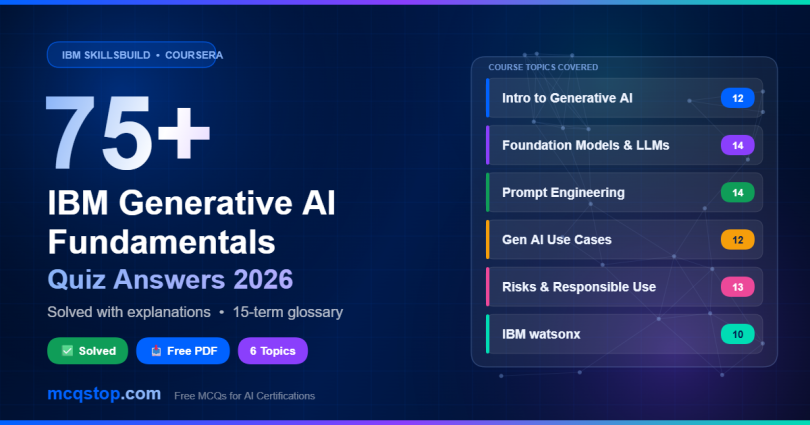
IBM Generative AI Fundamentals course on IBM SkillsBuild (also offered as a Coursera specialization) is a free credential covering what generative AI is, foundation models and large language models, prompt engineering, business use cases, the risks of generative AI, and IBM watsonx. It is a
different course and badge from
IBM AI Fundamentals, so the quizzes test different material. The 75+ solved MCQs below follow the course topic by topic, with the correct option marked and a short explanation under every question, so you can revise before each quiz and the final assessment. A 15-term glossary and a
free PDF of the full set are at the end of the page.
✨
Topic 1 — Introduction to Generative AI (Questions 1–12)
What generative AI is, how it differs from traditional AI, and the history from GANs to transformers and diffusion
Question 01
What is generative AI?
AAI that classifies existing data into categories
BAI that creates new content such as text, images, code or audio ✅
CAI that only retrieves stored documents
DAI that controls physical robots
💡 ExplanationGenerative AI produces new outputs by learning the patterns of its training data, rather than only labelling or predicting from existing data.
Question 02
How does generative AI differ from traditional (discriminative) AI?
ATraditional AI predicts labels or values; generative AI produces new content ✅
BGenerative AI needs no training data
CTraditional AI is always more accurate
DThere is no difference
💡 ExplanationDiscriminative models decide (spam or not spam); generative models create (write the email). Both learn from data.
Question 03
Which of these is an example of generative AI output?
AFlagging an email as spam
BPredicting tomorrow’s temperature
CWriting a paragraph from a short prompt ✅
DDetecting a face in a photo
💡 ExplanationThe other three options are classification or regression tasks: they label or predict, they do not create.
Question 04
What does GAN stand for?
AGeneral Attention Network
BGenerative Adversarial Network ✅
CGradient Augmented Node
DGuided Analysis Network
💡 ExplanationIntroduced by Ian Goodfellow in 2014, a GAN pits a generator against a discriminator so each improves the other.
Question 05
In a GAN, what is the role of the discriminator?
ATo generate new samples
BTo judge whether a sample is real or generated ✅
CTo store the training data
DTo tokenize the input
💡 ExplanationThe generator keeps improving by trying to fool the discriminator, until its fakes are hard to tell from real data.
Question 06
Which architecture, introduced in the 2017 paper “Attention Is All You Need”, underpins most modern LLMs?
AConvolutional neural network
BRecurrent neural network
CTransformer ✅
DDecision tree
💡 ExplanationTransformers use self-attention to process a whole sequence in parallel, which made training very large language models practical.
Question 07
What is the key mechanism inside a transformer that lets it weigh the importance of different words?
APooling
BSelf-attention ✅
CBackpropagation
DDropout
💡 ExplanationSelf-attention relates every token to every other token in the sequence, so the model can use context from far away in the text.
Question 08
Which model type generates images by gradually removing noise from a random starting point?
ADiffusion model ✅
BDecision tree
CLogistic regression
Dk-means
💡 ExplanationDiffusion models learn to reverse a noising process; they power tools such as Stable Diffusion and DALL·E 3.
Question 09
What is a Variational Autoencoder (VAE) used for in generative AI?
ACompressing data into a latent space and generating new samples from it ✅
BSorting data alphabetically
CEncrypting model weights
DLabelling training data
💡 ExplanationA VAE learns a compressed representation of the data and can decode variations of it, which makes it an early generative technique.
Question 10
Generative AI is a subset of which broader field?
ARobotics
BDeep learning within machine learning ✅
CDatabase management
DComputer networking
💡 ExplanationGenerative models are deep neural networks trained on very large datasets, so they sit inside deep learning, inside machine learning, inside AI.
Question 11
Which event in late 2022 brought generative AI to mainstream public attention?
ALaunch of the first smartphone
BPublic release of ChatGPT ✅
CInvention of the transistor
DRelease of Windows 11
💡 ExplanationChatGPT launched on 30 November 2022 and reached about 100 million users within two months.
Question 12
What does “multimodal” generative AI mean?
AA model that runs on multiple servers
BA model that can work with more than one type of data, such as text and images ✅
CA model trained in multiple countries
DA model with multiple owners
💡 ExplanationMultimodal models can describe a picture in words or generate an image from text, because they accept and produce several data types.
Next: Foundation Models and LLMs →
🧠
Topic 2 — Foundation Models and LLMs (Questions 13–26)
Pre-training, parameters, tokens, context windows, IBM Granite, open vs closed models
Question 13
What is a foundation model?
AA small model built for one task only
BA large model pre-trained on broad data that can be adapted to many downstream tasks ✅
CA rule-based expert system
DA database of labelled images
💡 ExplanationOne pre-trained base serves many applications through prompting or tuning, which is why IBM calls them “foundation” models.
Question 14
What does LLM stand for?
ALinear Learning Machine
BLarge Language Model ✅
CLogical Layer Module
DLow-Latency Memory
💡 ExplanationLLMs are foundation models trained mainly on text to predict the next token; GPT, Llama and IBM Granite are examples.
Question 15
What is “pre-training” of a foundation model?
ATesting the model before release
BThe initial large-scale training on general data before any task-specific adaptation ✅
CWriting the prompt before the model answers
DInstalling the model on a server
💡 ExplanationPre-training builds general language ability over weeks on thousands of GPUs; fine-tuning later specialises the model cheaply.
Question 16
What are “parameters” in an LLM?
AThe questions users ask
BThe learned weights inside the network that are adjusted during training ✅
CThe number of GPUs used
DThe length of the output
💡 ExplanationParameter counts such as 7B or 70B indicate a model’s size and capacity; more parameters usually mean more capability and more cost.
Question 17
What is a token in the context of an LLM?
AA password for API access
BA small unit of text, a word or part of a word, that the model reads and writes ✅
CA hardware chip
DA unit of currency for AI usage
💡 ExplanationRoughly 1,000 tokens equal about 750 English words. Models are priced and limited by tokens, not words.
Question 18
What is the “context window” of a model?
AThe time the model takes to respond
BThe maximum number of tokens the model can consider at once, including prompt and output ✅
CThe model’s user interface
DThe number of users served simultaneously
💡 ExplanationAnything beyond the context window is simply not seen by the model, which is why long documents are chunked or summarised.
Question 19
How does an LLM generate text?
ABy copying sentences from a database
BBy predicting the most likely next token repeatedly ✅
CBy running a search engine
DBy translating from a fixed template
💡 ExplanationEach new token is sampled from a probability distribution and appended to the text; this is why outputs can vary between runs.
Question 20
What is IBM Granite?
AIBM’s cloud storage service
BIBM’s family of foundation models for enterprise use ✅
CA quantum computer
DA database engine
💡 ExplanationGranite models are trained on curated, documented data and offered through watsonx.ai; IBM also releases open-weight Granite versions.
Question 21
What is the main difference between open and closed (proprietary) models?
AOpen models are always smaller
BOpen models publish their weights for download and modification; closed models are accessed only through the vendor’s API ✅
CClosed models are free
DOpen models cannot be fine-tuned
💡 ExplanationLlama and open Granite are open-weight; GPT-4 is closed. Open models give more control, closed models give less operational work.
Question 22
What is fine-tuning?
AAdjusting the screen brightness of an AI app
BFurther training a pre-trained model on a smaller task-specific dataset ✅
CWriting longer prompts
DDeleting unused parameters
💡 ExplanationFine-tuning adapts a general model to a domain, style or task using a few hundred to a few thousand labelled examples.
Question 23
What is an embedding?
AA numeric vector that represents the meaning of text so similar content sits close together ✅
BA hidden advertisement in model output
CA type of GPU
DA compressed image file
💡 ExplanationEmbeddings power semantic search and retrieval-augmented generation, because similar meanings produce similar vectors.
Question 24
What is “inference” in generative AI?
ATraining the model from scratch
BUsing a trained model to produce an output from a new input ✅
CCollecting training data
DEvaluating bias in the dataset
💡 ExplanationEvery chat response is an inference run. Training happens once; inference happens millions of times, so it drives the ongoing cost.
Question 25
Why do larger models generally cost more to run?
AThey need more compute and memory for every inference ✅
BThey are taxed by governments
CThey require more users
DThey use more internet bandwidth only
💡 ExplanationMore parameters mean more calculations per token generated, so smaller task-fit models are often the better business choice.
Question 26
What is a “knowledge cutoff”?
AA limit on daily questions
BThe date after which the model’s training data contains no information ✅
CThe end of a user session
DA content filter
💡 ExplanationEvents after the cutoff need retrieval (RAG) or web access to be answered correctly; otherwise the model may guess.
Next: Prompt Engineering →
✍️
Topic 3 — Prompt Engineering (Questions 27–40)
Zero/one/few-shot, chain-of-thought, prompt structure, temperature and RAG basics
Question 27
What is prompt engineering?
ABuilding the hardware that runs a model
BDesigning inputs so a model produces the desired output ✅
CTraining a model from scratch
DEncrypting prompts
💡 ExplanationBetter prompts change the result without changing the model, which makes prompt engineering the cheapest way to improve output.
Question 28
What is zero-shot prompting?
AAsking the model to do a task with no examples in the prompt ✅
BSending an empty prompt
CPrompting with zero tokens
DPrompting a model that has not been trained
💡 ExplanationThe model relies only on what it learned in pre-training; this works for common tasks like summarising or translating.
Question 29
What is one-shot prompting?
APrompting once per day
BGiving exactly one example of the task in the prompt ✅
CA prompt with one word
DUsing one model only
💡 ExplanationOne worked example shows the format or pattern you want, which is often enough for structured outputs.
Question 30
What is few-shot prompting?
AUsing several short prompts in a row
BIncluding a small number of examples (typically 2–5) in the prompt to guide the output ✅
CLimiting the model to a few answers
DPrompting a few users at once
💡 ExplanationExamples in the prompt improve accuracy on structured or unusual tasks without any training; watsonx Prompt Lab supports this directly.
Question 31
What is chain-of-thought prompting?
ALinking several chatbots together
BAsking the model to reason step by step before giving the final answer ✅
CRepeating the same prompt
DSending prompts in a group chat
💡 ExplanationPhrases like “think step by step” improve results on maths, logic and multi-step planning tasks.
Question 32
Which element of a well-structured prompt sets the persona the model should adopt?
ARole (e.g. “You are a financial analyst”) ✅
BTemperature
CToken limit
DModel version
💡 ExplanationA clear prompt usually has five parts: role, task, context, output format and constraints.
Question 33
What does the “temperature” setting control?
AThe speed of the GPU
BHow random or creative the model’s word choices are ✅
CThe length of the prompt
DThe model’s training date
💡 ExplanationLow temperature gives consistent, factual output; high temperature gives more variety, which suits brainstorming.
Question 34
For a task that needs a precise, repeatable answer (for example extracting a date), which temperature is most appropriate?
AClose to 0 ✅
B1.0
C1.5
DThe maximum
💡 ExplanationLow temperature makes the model pick the most probable tokens, so the same input gives the same output.
Question 35
What does RAG stand for?
ARandom Access Generation
BRetrieval-Augmented Generation ✅
CRecursive Attention Gate
DRapid AI Grounding
💡 ExplanationRAG retrieves relevant documents, usually by embedding search, and adds them to the prompt before the model generates its answer.
Question 36
What is the main benefit of RAG over relying on the model’s training data alone?
AIt makes the model smaller
BIt grounds answers in current or private data and reduces hallucination ✅
CIt removes the need for a prompt
DIt speeds up training
💡 ExplanationThe model answers from supplied documents instead of memory, and can cite them, which enterprises need for trust.
Question 37
What is a system prompt?
AThe error message shown when a model fails
BBackground instructions that set the model’s behaviour before the user’s message ✅
CThe model’s first answer
DA prompt sent by the operating system
💡 ExplanationDevelopers use system prompts to fix tone, rules, allowed topics and output format for every conversation.
Question 38
What is prompt chaining?
ALocking prompts with a password
BBreaking a complex task into steps where each output feeds the next prompt ✅
CSending prompts to several models at once
DCopying prompts from the internet
💡 ExplanationChaining gives more control and easier debugging than one very long prompt; it is the basis of agent workflows.
Question 39
Which prompt is most likely to produce a useful result?
A“Write something about sales.”
B“Summarise the attached Q3 sales report in five bullet points for the CFO, under 100 words.” ✅
C“Sales?”
D“Do your best.”
💡 ExplanationIt states the task, the source, the audience, the format and the length — everything the model needs.
Question 40
What is “prompt injection”?
AAdding examples to a prompt
BAn attack where malicious text in the input tries to override the model’s instructions ✅
CSpeeding up prompt delivery
DTranslating a prompt
💡 ExplanationGuardrails and input filtering defend against prompt injection; it is one of the top security risks for LLM applications.
Next: Generative AI Use Cases →
💼
Topic 4 — Generative AI Use Cases (Questions 41–52)
Text, code, image and audio generation; customer service, content and business applications
Question 41
Which of these is a text-generation use case?
ADrafting a customer email reply ✅
BDetecting fraud in transactions
CSorting images by colour
DMeasuring server uptime
💡 ExplanationDrafting, summarising, translating and rewriting are the core text use cases; the other options are analytics or monitoring tasks.
Question 42
How do developers commonly use generative AI for code?
ATo replace version control
BTo generate, explain, complete and debug code from natural-language descriptions ✅
CTo buy servers
DTo design office layouts
💡 ExplanationCode assistants such as IBM watsonx Code Assistant work this way, including translating legacy COBOL to Java.
Question 43
“Text-to-image” generation means:
AReading text aloud
BCreating a picture from a written description ✅
CExtracting text from a scanned image
DCaptioning a photo
💡 ExplanationExtracting text from an image is OCR and captioning is image-to-text; both go in the opposite direction.
Question 44
Which is an audio use case of generative AI?
AGenerating a voice-over from a script ✅
BCompressing a video file
CCounting words in a document
DResizing a photo
💡 ExplanationText-to-speech, voice cloning and music generation are the main audio generative tasks.
Question 45
In customer service, generative AI is most often used to:
AReplace all human agents immediately
BPower conversational assistants and draft agent responses grounded in company knowledge ✅
CManage payroll
DDesign logos
💡 ExplanationAssistants handle routine queries and suggest replies; humans handle complex and sensitive cases. This is IBM’s “augment, not replace” view.
Question 46
What is “summarisation” as a generative AI task?
ACondensing a long document into its key points ✅
BTranslating a document
CCounting its pages
DChecking its spelling
💡 ExplanationMeeting notes, report summaries and call transcripts are common enterprise examples of summarisation.
Question 47
Which marketing task is a typical generative AI use case?
ADrafting product descriptions and ad variations for human review ✅
BApproving the annual budget
CPrinting brochures
DHiring staff
💡 ExplanationGenerative AI speeds up first drafts and A/B variations; people still approve what is published.
Question 48
What is “synthetic data”?
AData stolen from competitors
BArtificially generated data that mimics real data, used for training or testing when real data is scarce or sensitive ✅
CData stored on plastic media
DEncrypted customer records
💡 ExplanationSynthetic data is valuable in healthcare and finance where real records are private; IBM uses it to train Granite models too.
Question 49
A company wants to let employees ask questions about internal HR policies. Which approach fits best?
AA RAG-based assistant over the policy documents ✅
BA text-to-image model
CA GAN
DRetraining a model from scratch on the internet
💡 ExplanationRAG keeps answers tied to the actual policy text and updates instantly when the policy changes, with no retraining.
Question 50
Which is an example of generative AI in software testing?
AGenerating unit tests and test data from code ✅
BMeasuring CPU temperature
CInstalling updates
DReplacing the operating system
💡 ExplanationTest generation is one of the highest-adoption developer use cases because tests are repetitive to write and easy to check.
Question 51
What is a “copilot” in the generative AI sense?
AA second pilot on an aircraft
BAn AI assistant embedded in a tool that helps a human complete tasks faster ✅
CA backup server
DA type of GPU
💡 ExplanationThe human stays in control and the AI assists, which is the augmented-intelligence model IBM promotes.
Question 52
Which business benefit is most directly linked to generative AI adoption?
AEliminating all errors
BFaster content and code production with humans reviewing output ✅
CZero IT costs
DGuaranteed market share
💡 ExplanationProductivity gains, not error-free automation, are the realistic promise; any option that says “all”, “zero” or “guaranteed” is wrong.
Next: Risks and Responsible Use →
⚠️
Topic 5 — Risks and Responsible Use (Questions 53–65)
Hallucination, bias, copyright, deepfakes, data privacy, and IBM’s trust pillars applied to generative AI
Question 53
What is a hallucination in generative AI?
AA visual glitch in an image
BConfident output that is false or fabricated ✅
CA model refusing to answer
DA slow response
💡 ExplanationHallucinations happen because models predict plausible text, not verified facts; invented citations are a classic example.
Question 54
Which practice best reduces hallucination in a business application?
ARaising the temperature
BGrounding answers with RAG and keeping a human in the loop ✅
CUsing a longer prompt only
DHiding the model’s sources
💡 ExplanationGrounding plus review catches errors before they reach customers; raising temperature makes hallucination more likely.
Question 55
Where does bias in a generative model usually come from?
AThe GPU manufacturer
BPatterns and imbalances in the training data ✅
CThe user’s keyboard
DInternet speed
💡 ExplanationModels reproduce what they were trained on, including stereotypes; curated data and bias testing reduce the risk.
Question 56
What is a deepfake?
AA very deep neural network
BSynthetic audio, image or video that realistically imitates a real person ✅
CA compressed data file
DA failed training run
💡 ExplanationDeepfakes raise fraud, misinformation and consent concerns, which is why watermarking and detection tools are growing.
Question 57
Why is copyright a concern with generative AI?
AModels cannot read books
BTraining data may include protected works and outputs may closely reproduce them ✅
CAI output is always public domain
DCopyright does not apply online
💡 ExplanationIBM addresses this with curated training data and intellectual-property indemnity for its Granite models.
Question 58
What is the data-privacy risk of pasting customer records into a public AI chatbot?
AThere is none
BThe data may be stored, used for training or exposed, breaching privacy law and company policy ✅
CThe chatbot will slow down
DThe records will be deleted automatically
💡 ExplanationUse enterprise tools with data-handling guarantees for sensitive data; IBM’s principle is that client data belongs to the client.
Question 59
Which of these is one of IBM’s pillars of trustworthy AI?
AProfitability
BExplainability ✅
CSpeed
DPopularity
💡 ExplanationIBM’s five pillars are explainability, fairness, robustness, transparency and privacy. They apply to generative AI exactly as to any AI.
Question 60
“Transparency” in generative AI means:
AThe model’s code is deleted after use
BUsers know they are interacting with AI and can learn how the model was built and trained ✅
CThe model is invisible to users
DOutputs are shown in clear fonts
💡 ExplanationModel cards and training-data documentation support transparency; IBM publishes these for Granite.
Question 61
What is “robustness” as a trust principle for generative AI?
AThe model has a large parameter count
BThe model performs reliably and resists manipulation such as adversarial inputs and prompt injection ✅
CThe model runs on robust hardware only
DThe model never updates
💡 ExplanationRobust systems degrade gracefully, handle edge cases and resist attacks; guardrails are part of making a generative system robust.
Question 62
Who is accountable for decisions made with the help of generative AI in an organisation?
AThe model vendor only
BThe humans and organisation that deploy and use the system ✅
CThe AI itself
DNobody
💡 ExplanationAccountability stays with people; AI is a tool. This is the same answer as in the AI Fundamentals course.
Question 63
What are “guardrails” in a generative AI application?
APhysical barriers around servers
BControls that filter harmful inputs and outputs and keep the model within allowed topics ✅
CRules for pricing
DBackup copies of prompts
💡 ExplanationGuardrails block toxic content, PII leaks and off-topic answers; IBM’s Granite Guardian models are built for this.
Question 64
What is the environmental concern with large generative models?
AThey produce paper waste
BTraining and running them consumes significant energy and water for cooling ✅
CThey emit radio waves
DThere is none
💡 ExplanationChoosing smaller, task-fit models reduces the footprint, which is one reason IBM offers Granite in several sizes.
Question 65
Before publishing AI-generated content, the responsible step is to:
APublish immediately to save time
BReview it for accuracy, bias and rights, and disclose AI use where appropriate ✅
CDelete the prompt
DIncrease the temperature
💡 ExplanationHuman review is the last line of defence against hallucination, bias and copyright problems.
Next: IBM watsonx for Generative AI →
🔬
Topic 6 — IBM watsonx for Generative AI (Questions 66–75)
watsonx.ai Prompt Lab, Tuning Studio, governance, Granite and model selection
Question 66
What is IBM watsonx?
AA chatbot for consumers
BIBM’s enterprise AI and data platform with watsonx.ai, watsonx.data and watsonx.governance ✅
CA video game
DA smartphone
💡 ExplanationAnnounced in 2023 to build, deploy and govern AI at enterprise scale; the three components appear in almost every quiz.
Question 67
Which watsonx component is the studio for building and tuning generative AI models?
Awatsonx.data
Bwatsonx.governance
Cwatsonx.ai ✅
Dwatsonx Orchestrate
💡 Explanationwatsonx.ai hosts foundation models and the tools to work with them; data lives in watsonx.data, oversight in watsonx.governance.
Question 68
What is Prompt Lab in watsonx.ai?
AA physics laboratory
BA workspace to write, test and compare prompts against foundation models and adjust parameters ✅
CA data warehouse
DA billing dashboard
💡 ExplanationPrompt Lab lets you try zero-shot and few-shot prompts, set temperature and token limits, and save prompts as reusable assets.
Question 69
What does Tuning Studio in watsonx.ai allow you to do?
AChange the colour theme
BAdapt a foundation model to your task with labelled examples, including prompt tuning ✅
CTune audio files
DRename projects
💡 ExplanationPrompt tuning trains a small set of extra parameters rather than the whole model, so it is cheap and fast.
Question 70
What is the purpose of watsonx.governance?
ATo host websites
BTo monitor, manage risk, track lineage and keep AI models compliant across their lifecycle ✅
CTo generate images
DTo store passwords
💡 ExplanationGovernance covers bias, drift, explainability and regulatory reporting such as the EU AI Act.
Question 71
What is the role of watsonx.data?
AA data store and lakehouse to prepare and manage the data that AI models use ✅
BA text editor
CA printer driver
DA game engine
💡 ExplanationGood generative AI depends on well-governed data; watsonx.data is where RAG documents and tuning data are managed.
Question 72
Besides IBM Granite, watsonx.ai offers access to:
AOnly IBM models
BSelected third-party and open-source models such as Llama and Mistral ✅
CNo other models
DHardware only
💡 ExplanationModel choice lets teams pick the best fit for cost, task and licence instead of being locked to one vendor.
Question 73
When selecting a model in watsonx.ai, which factor is LEAST relevant?
ATask fit and accuracy
BCost and latency
CLicence and data provenance
DThe model’s logo colour ✅
💡 ExplanationChoose on performance, cost, context length and licensing. The course stresses matching model size to the task.
Question 74
Why does IBM emphasise the training-data transparency of Granite models?
ATo make the models slower
BSo enterprises can trust the data sources and reduce copyright and compliance risk ✅
CTo hide the model size
DFor marketing only
💡 ExplanationTransparent, curated data is central to enterprise-grade AI and links directly to the transparency and privacy pillars.
Question 75
A team needs an assistant that answers from the company’s product manuals with traceable sources. Which watsonx features fit?
AA text-to-image model with high temperature
BRAG over the manuals in watsonx.ai, with watsonx.governance monitoring the deployment ✅
CDeleting the manuals
DA GAN
💡 ExplanationGrounded generation plus governance is the standard enterprise pattern the course builds toward.
📖 Generative AI Glossary – 15 terms the quizzes use
Token
The smallest unit of text a model processes; about 1,000 tokens ≈ 750 words.
Parameter
A learned weight inside the model; 7B or 70B indicates size and capacity.
Foundation model
A large model pre-trained on broad data and adaptable to many tasks.
LLM
Large Language Model: a foundation model trained mainly on text to predict the next token.
Transformer
The self-attention architecture (2017) behind modern LLMs.
Context window
The maximum tokens a model can consider at once, prompt plus output.
Hallucination
Confident output that is false or fabricated.
Prompt engineering
Designing inputs (role, task, context, format, examples) to get the desired output.
Few-shot prompting
Including a few worked examples in the prompt to guide the model.
Chain-of-thought
Asking the model to reason step by step before answering.
Temperature
Controls randomness: low for consistent answers, high for creative ones.
RAG
Retrieval-Augmented Generation: fetching documents and adding them to the prompt so answers are grounded.
Embedding
A numeric vector representing meaning; similar content sits close together.
Fine-tuning
Further training a pre-trained model on a smaller, task-specific dataset.
Guardrails
Controls that filter harmful inputs and outputs and keep a model within allowed topics.
🔬 watsonx – what the quizzes ask
Three components: watsonx.ai (build, tune, deploy models · Prompt Lab · Tuning Studio) · watsonx.data (lakehouse data store) · watsonx.governance (bias, drift, lineage, compliance).
IBM Granite: IBM’s own family of foundation models, trained on curated data with transparency and IP indemnity, offered alongside open models such as Llama and Mistral.
💡 Top Tips to Pass IBM Generative AI Fundamentals in 2026
🆓
Free on IBM SkillsBuild
The course, quizzes and badge are free; Coursera can be audited free too
✍️
Know the prompting terms
Zero/one/few-shot, chain-of-thought, temperature and RAG are the most repeated questions
🔬
Map the watsonx parts
Match .ai / .data / .governance to their job; Topic 6 covers them all
📥 Download all 75+ IBM Generative AI Fundamentals quiz answers as PDF (free)
🎯 More AI certification MCQs
Question banks updated regularly to match the latest course content





Leave a Comment