🤖
Domain 1 — Fundamentals of AI and ML
Core AI concepts, ML types, deep learning, and neural networks
Question 01
What is the key difference between supervised and unsupervised learning?
ASupervised learning uses labeled training data while unsupervised learning finds patterns in unlabeled data ✅
BSupervised learning is faster than unsupervised learning
CUnsupervised learning requires more computing power than supervised learning
DSupervised learning can only be used for image recognition tasks
💡 ExplanationIn supervised learning the model trains on labeled data where inputs and correct outputs are paired together. In unsupervised learning the model discovers hidden patterns or groupings in data that has no predefined labels.
Question 02
What is deep learning?
AA type of database management system for AI
BA method for storing large amounts of training data
CA subset of machine learning that uses multi-layered neural networks to learn complex patterns from large datasets ✅
DA programming technique used exclusively for robotics
💡 ExplanationDeep learning uses artificial neural networks with many layers — similar to how the human brain processes information. It excels at tasks like image recognition, speech processing, and natural language understanding that require learning from massive datasets.
Question 03
Which of the following best describes a “training dataset” in machine learning?
AThe final output produced by a trained model
BThe data used to teach a machine learning model to recognize patterns and make predictions ✅
CA dataset used only to evaluate the final performance of a model
DA cloud storage bucket containing raw business data
💡 ExplanationA training dataset is the collection of examples used to teach the ML model. The model learns by finding patterns within this data. Separately a validation set tunes performance and a test set measures final accuracy on unseen data.
Question 04
Which metric is used to measure how accurately a classification model performs?
ARMSE (Root Mean Square Error)
BMAE (Mean Absolute Error)
CAccuracy — the percentage of correct predictions out of total predictions ✅
DLatency — the speed at which the model generates predictions
💡 ExplanationAccuracy measures classification model performance as the ratio of correct predictions to total predictions. RMSE and MAE are used for regression models predicting numeric values. Precision, recall, and F1-score provide deeper classification insights.
🧠
Domain 2 — Machine Learning on AWS
Amazon SageMaker, data preparation, model training and deployment
Question 05
What is Amazon SageMaker primarily used for?
AHosting static websites on the AWS cloud
BBuilding, training, and deploying machine learning models at scale on AWS ✅
CManaging databases and SQL queries in the cloud
DMonitoring network security and firewall rules
💡 ExplanationAmazon SageMaker is AWS’s fully managed ML platform that covers the entire ML workflow — from data labeling and model training to optimization, deployment, and monitoring — all in one integrated environment.
Question 06
What does Amazon SageMaker Autopilot do?
AAutomatically backs up your SageMaker notebooks to S3
BAutomatically builds, trains, and tunes the best ML model for your dataset with minimal human input ✅
CAutomatically scales EC2 instances during training jobs
DAutomatically generates synthetic training data for models
💡 ExplanationSageMaker Autopilot is AWS’s AutoML solution. You simply provide a dataset and specify the target column and Autopilot automatically explores multiple algorithms, selects the best model, and explains every choice it makes.
Question 07
Which AWS service is used to label training data for machine learning models?
AAmazon Rekognition
BAWS Glue
CAmazon SageMaker Ground Truth ✅
DAWS Data Exchange
💡 ExplanationAmazon SageMaker Ground Truth helps you build high-quality training datasets by providing tools and a workforce to label raw data including images, text, video, and 3D point clouds efficiently and at scale.
Question 08
What is model inference in the context of AWS machine learning?
AThe process of collecting and cleaning training data
BThe process of selecting the best algorithm for a task
CThe process of training a model on historical data
DThe process of using a trained model to generate predictions on new real-world data ✅
💡 ExplanationInference is the deployment phase — where your trained model is put to work generating real-time or batch predictions on new incoming data. SageMaker provides real-time endpoints and batch transform jobs for inference at scale.
✨
Domain 3 — Generative AI & Amazon Bedrock
Foundation models, Amazon Bedrock, RAG, and prompt engineering on AWS
Question 09
What is Amazon Bedrock?
AAn AWS database service for storing unstructured data
BA fully managed AWS service that provides access to leading foundation models from multiple AI companies via a single API ✅
CAn AWS networking service for building secure VPCs
DA monitoring tool that tracks model performance in production
💡 ExplanationAmazon Bedrock gives developers serverless access to high-performance foundation models from providers like Anthropic (Claude), Meta (Llama), Mistral, Stability AI, and Amazon’s own Titan models — all through a single unified AWS API.
Question 10
What is Retrieval Augmented Generation (RAG) in AWS generative AI?
AA technique for reducing the file size of AI models
BA method for training foundation models from scratch using custom data
CA technique that enhances AI responses by retrieving relevant information from an external knowledge base before generating an answer ✅
DAn AWS tool for automatically generating synthetic data for ML training
💡 ExplanationRAG combines the power of a generative model with real-time retrieval from a knowledge base. The model first searches relevant documents then uses that retrieved context to generate accurate, grounded, up-to-date responses rather than relying only on its training data.
Question 11
What is “fine-tuning” a foundation model?
AFurther training a pre-trained foundation model on a smaller domain-specific dataset to customize its behavior ✅
BDeleting unnecessary parameters from a model to reduce its size
CAdjusting the user interface settings of a foundation model
DConnecting a model to external APIs for real-time data access
💡 ExplanationFine-tuning takes a large pre-trained model and continues training it on a smaller task-specific dataset. This adapts the model’s knowledge and behavior to a particular domain — such as medical terminology, legal documents, or company-specific data.
🛠️
Domain 4 — AWS AI Services
Amazon Rekognition, Comprehend, Transcribe, Forecast, and more
Question 12
Which AWS service analyzes images and videos to detect objects, faces, and text?
AAmazon Rekognition ✅
BAmazon Comprehend
CAmazon Transcribe
DAmazon Forecast
💡 ExplanationAmazon Rekognition is AWS’s computer vision service. It detects objects, scenes, faces, text, and activities in images and video. It is used in content moderation, identity verification, and media analysis applications.
Question 13
Which AWS service converts speech to text and is used for transcribing audio files?
AAmazon Polly
BAmazon Lex
CAmazon Transcribe ✅
DAmazon Comprehend
💡 ExplanationAmazon Transcribe uses deep learning to convert speech to text automatically. It supports multiple languages, custom vocabularies, and speaker identification. Note: Amazon Polly does the reverse — it converts text into lifelike speech.
Question 14
Which AWS service is used to build conversational chatbots and voice interfaces?
AAmazon Rekognition
BAmazon Lex ✅
CAmazon Forecast
DAmazon Comprehend
💡 ExplanationAmazon Lex uses the same deep learning technology that powers Amazon Alexa. It provides automatic speech recognition and natural language understanding to build sophisticated conversational chatbots for websites, mobile apps, and contact centers.
🛡️
Domain 5 — Security, Compliance & Responsible AI
AWS AI security, bias detection, model explainability, and governance
Question 15
Which AWS tool helps detect bias in machine learning models and explains model predictions?
AAWS CloudTrail
BAmazon GuardDuty
CAmazon SageMaker Clarify ✅
DAWS Config
💡 ExplanationAmazon SageMaker Clarify detects statistical bias in training data and model predictions. It also provides model explainability reports showing which features influenced each prediction — essential for building transparent and trustworthy AI systems.
Question 16
What is Amazon Bedrock Guardrails used for?
AEncrypting model weights for secure storage in S3
BLimiting the number of API calls to a foundation model
CMonitoring the cost of foundation model usage per account
DImplementing safety controls to filter harmful content, block denied topics, and prevent sensitive data leakage in AI applications ✅
💡 ExplanationAmazon Bedrock Guardrails lets developers set policies that filter harmful content, block off-topic conversations, redact personally identifiable information, and prevent prompt injection attacks — ensuring generative AI applications behave safely and responsibly.
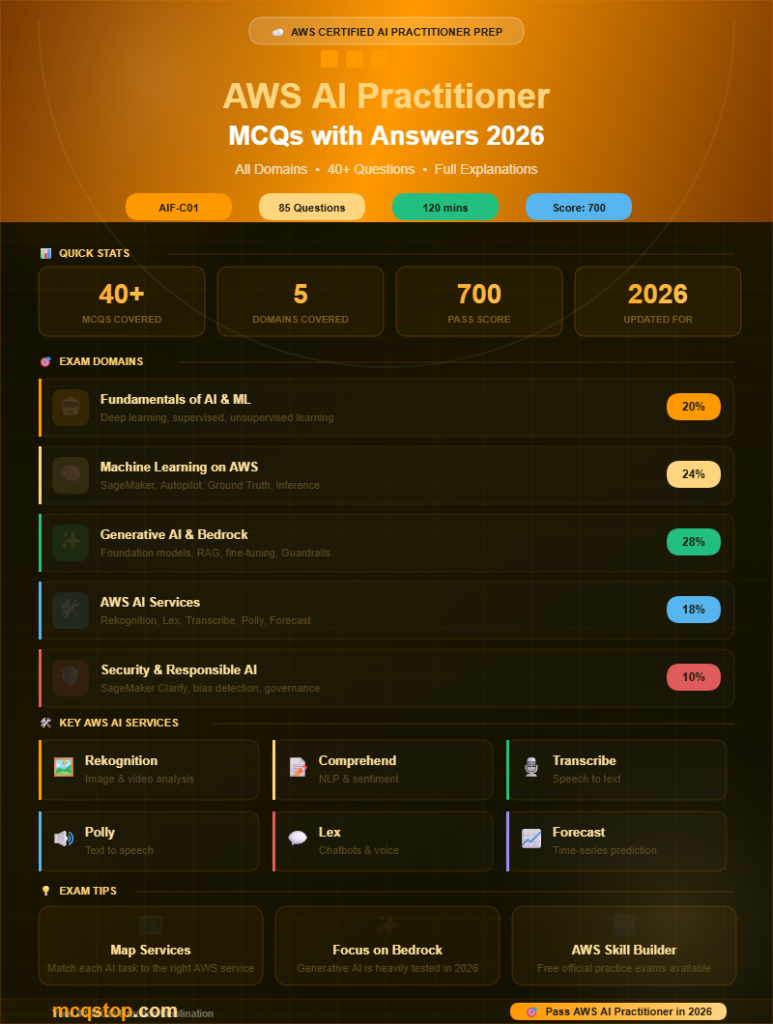
What is the AWS Certified AI Practitioner exam code? The exam code is AIF-C01. It was launched by Amazon Web Services in 2024 and is designed for anyone who wants to demonstrate foundational knowledge of AI, ML, and generative AI on the AWS platform.
How many questions are in the AWS AI Practitioner exam? The exam contains 85 questions and you have 120 minutes to complete it. A passing score of 700 out of 1000 is required. The exam includes multiple-choice and multiple-response question formats.
Is coding required for AWS AI Practitioner? No — the AWS AI Practitioner is a non-technical certification. It does not require any programming or coding knowledge. It focuses on conceptual understanding of AI, ML, and generative AI services and their business applications on AWS.
How much does the AWS AI Practitioner exam cost? The exam costs USD 100. AWS frequently offers free exam vouchers through AWS events, reInvent conferences, and partner programs. Check AWS Training and Certification portal regularly for promotional opportunities.



Leave a Comment