Key Concepts & Definitions
Core ITIL 4 Terminology
Question 01
According to ITIL 4, what is the definition of a “service”?
AA piece of software installed on a server
BA means of enabling value co-creation by facilitating outcomes that customers want to achieve ✅
CA contract between a service provider and a customer
DA team responsible for IT infrastructure
💡 Explanation: ITIL 4 defines a service as “a means of enabling value co-creation by facilitating outcomes that customers want to achieve, without the customer having to manage specific costs and risks.” Key concept: value is co-created between the service provider and the consumer — it’s not delivered one-way. This definition is one of the most tested concepts on the exam.
Question 02
Which of the following are the FOUR dimensions of service management in ITIL 4?
APeople, Process, Products, Partners
BOrganizations & People, Information & Technology, Partners & Suppliers, Value Streams & Processes ✅
CPlan, Build, Deliver, Support
DStrategy, Design, Transition, Operation
💡 Explanation: The four dimensions ensure a holistic approach to service management: (1) Organizations & People — culture, roles, competencies; (2) Information & Technology — data, tools, platforms; (3) Partners & Suppliers — relationships, contracts, outsourcing; (4) Value Streams & Processes — workflows and activities. All four must be considered to effectively deliver services. Option D refers to the old ITIL v3 lifecycle stages.
Question 03
In ITIL 4, what is “utility”?
AThe functionality offered by a product or service to meet a particular need — “what the service does” ✅
BThe assurance that a service will meet agreed requirements — “how the service performs”
CThe cost of delivering a service
DThe agreement between provider and customer
💡 Explanation: Utility is “fitness for purpose” — what the service does. Warranty is “fitness for use” — how well the service performs (availability, capacity, continuity, security). A service needs BOTH utility AND warranty to create value. Think of it like a car: utility is that it drives you places; warranty is that it’s reliable, safe, and available when you need it. This distinction is heavily tested.
2
Service Value System (SVS)
How Everything Works Together
Question 04
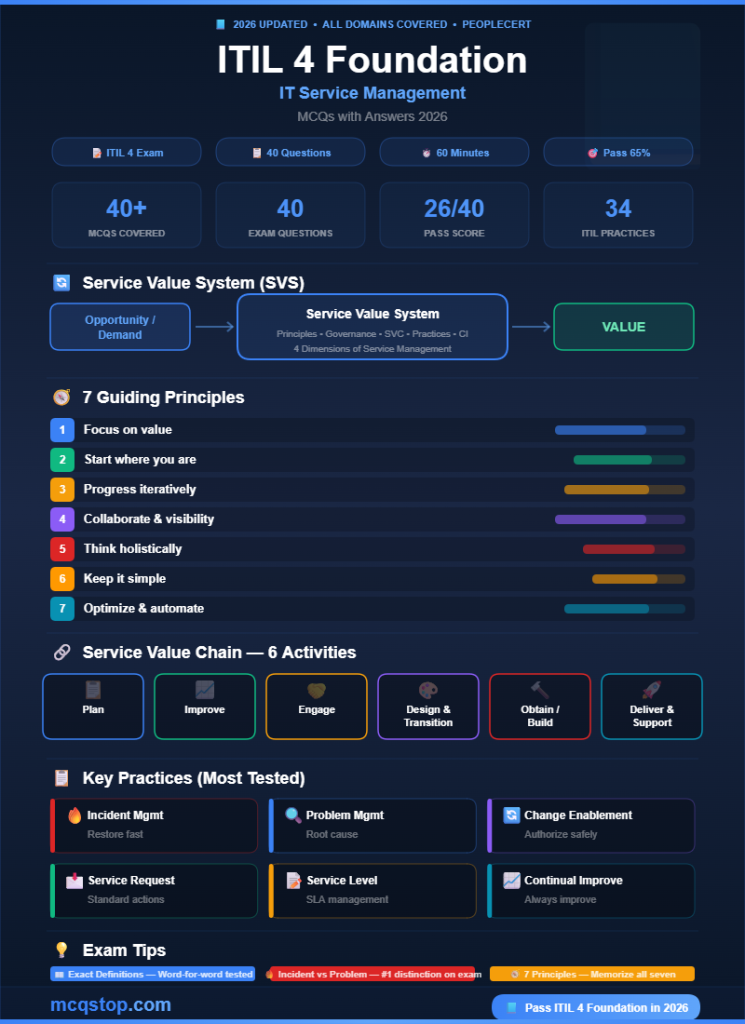
Which FIVE components make up the ITIL 4 Service Value System (SVS)?
AGuiding Principles, Governance, Service Value Chain, Practices, Continual Improvement ✅
BStrategy, Design, Transition, Operation, Improvement
CPlan, Build, Run, Monitor, Optimize
DPeople, Process, Products, Partners, Performance
💡 Explanation: The Service Value System (SVS) describes how all components work together to create value. Its five elements: (1) Guiding Principles — recommendations for all situations; (2) Governance — directing and controlling; (3) Service Value Chain — activities to respond to demand; (4) Practices — organizational resources for work; (5) Continual Improvement — ongoing improvement at all levels. Option B is the old ITIL v3 lifecycle.
Question 05
What is the starting point (input) and the end result (output) of the ITIL Service Value System?
AInput: Budget → Output: Services
BInput: Opportunity/Demand → Output: Value ✅
CInput: Incidents → Output: Resolutions
DInput: Requirements → Output: Products
💡 Explanation: The SVS takes opportunity and demand as inputs and transforms them into value through its five components. Opportunity represents options to add value, and demand represents the need for products and services. The ultimate output is value — co-created between the provider and consumer. This is the “big picture” of ITIL 4 and appears in almost every exam.
3
Guiding Principles
7 Universal Recommendations
Question 06
Which ITIL 4 guiding principle recommends that you should always understand the current state before creating something new?
AFocus on value
BStart where you are ✅
CProgress iteratively with feedback
DKeep it simple and practical
💡 Explanation: “Start where you are” means assessing the current state before making changes. Don’t start from scratch — build on what already exists. Measure and observe to understand what’s working and what can be reused. The 7 guiding principles are: Focus on value, Start where you are, Progress iteratively with feedback, Collaborate and promote visibility, Think and work holistically, Keep it simple and practical, Optimize and automate. Memorize all seven!
Question 07
Which guiding principle states that every activity should contribute to value for stakeholders, either directly or indirectly?
AFocus on value ✅
BThink and work holistically
COptimize and automate
DCollaborate and promote visibility
💡 Explanation: “Focus on value” is the most important guiding principle. Everything the organization does should map back to value for stakeholders — including customers, users, and the organization itself. Understand who the consumer is, what they value, and how the service contributes to their desired outcomes. If an activity doesn’t contribute to value (directly or indirectly), it should be eliminated or changed.
Question 08
Which guiding principle recommends working in small, manageable increments and using feedback to guide future actions?
AKeep it simple and practical
BProgress iteratively with feedback ✅
COptimize and automate
DStart where you are
💡 Explanation: “Progress iteratively with feedback” aligns with Agile and Lean principles. Don’t try to do everything at once — break work into smaller, manageable pieces (iterations) that can be executed and evaluated individually. Use feedback loops to ensure each iteration is aligned with the desired outcome. This principle supports adaptive and responsive service management.
4
Service Value Chain
6 Activities to Create Value
Question 09
Which are the SIX activities of the ITIL 4 Service Value Chain?
APlan, Improve, Engage, Design & Transition, Obtain/Build, Deliver & Support ✅
BStrategy, Design, Build, Test, Deploy, Monitor
CIdentify, Protect, Detect, Respond, Recover
DDiscover, Define, Develop, Deploy, Operate, Support
💡 Explanation: The Service Value Chain (SVC) has six activities that can be combined in any order to create value streams: (1) Plan — shared understanding of direction; (2) Improve — continual improvement of everything; (3) Engage — stakeholder relationships; (4) Design & Transition — ensure services meet expectations; (5) Obtain/Build — ensure components are available; (6) Deliver & Support — deliver and support services. Memorize all six!
Question 10
Which Service Value Chain activity is responsible for ensuring good relationships with stakeholders and understanding their needs?
APlan
BEngage ✅
CDeliver & Support
DImprove
💡 Explanation: The Engage activity provides a good understanding of stakeholder needs, ensures transparency, and maintains good relationships with all stakeholders. It handles service requests, feedback, and interactions. Think of Engage as the “front door” — it manages all interactions between the organization and its customers, users, and partners. It provides input to all other SVC activities.
5
ITIL Practices
Key Practices — Heavily Tested
Question 11
What is the purpose of the Incident Management practice?
ATo identify the root cause of recurring incidents
BTo minimize the negative impact of incidents by restoring normal service operation as quickly as possible ✅
CTo ensure changes are implemented smoothly
DTo manage the lifecycle of all IT assets
💡 Explanation: Incident Management aims to restore normal service operation as quickly as possible and minimize the adverse impact on business operations. An incident is an unplanned interruption or reduction in quality of a service. Key: Incident Management focuses on SPEED of restoration, not finding the root cause — that’s Problem Management. This distinction is the #1 most tested practice concept.
Question 12
What is the purpose of the Problem Management practice?
ATo reduce the likelihood and impact of incidents by identifying actual and potential causes and managing workarounds and known errors ✅
BTo restore normal service as quickly as possible
CTo fulfill user requests in a timely manner
DTo control changes to the IT infrastructure
💡 Explanation: Problem Management identifies the root cause of incidents to prevent them from recurring. A problem is a cause (or potential cause) of one or more incidents. When the root cause is identified, it becomes a known error. Workarounds are temporary solutions until a permanent fix is applied. Remember: Incidents = restore fast, Problems = find root cause, Change = implement fix.
Question 13
Which practice ensures that risks are properly assessed, authorizes changes to proceed, and manages the change schedule?
ARelease Management
BChange Enablement ✅
CDeployment Management
DService Configuration Management
💡 Explanation: Change Enablement (formerly Change Management in ITIL v3) maximizes successful changes by ensuring risks are properly assessed, changes are authorized, and the change schedule is managed. Three change types: Standard (pre-authorized, low-risk), Normal (follows full assessment and authorization), and Emergency (expedited for critical situations). A change authority approves changes based on their type and risk level.
Question 14
Which practice handles pre-defined, pre-agreed service actions that are part of normal service delivery, such as password resets or software installation requests?
AIncident Management
BService Request Management ✅
CProblem Management
DChange Enablement
💡 Explanation: Service Request Management handles requests for standard, pre-defined actions that are part of normal service delivery. Examples: password resets, access requests, information requests, and standard software installations. These are NOT incidents (no disruption) and NOT changes (pre-authorized). Service requests should be automated and fulfilled through a service catalog where possible.
How hard is the ITIL 4 Foundation exam? ITIL 4 Foundation is considered an easy to moderately easy exam. It has 40 multiple-choice questions with a 60-minute time limit. You need 26 correct answers (65%) to pass. There are no performance-based questions — all multiple choice with one correct answer. Most candidates can prepare in 1-3 weeks of dedicated study.
How much does the ITIL 4 Foundation exam cost? The ITIL 4 Foundation exam costs approximately $363 USD when taken through PeopleCert (the official exam body). Training courses from accredited providers typically cost $500–$1,500 and include the exam voucher. The exam can be taken online from home or at a testing center. PeopleCert also offers a Take2 re-sit option for an additional fee.
Is ITIL 4 Foundation worth it in 2026? Yes — ITIL remains the most widely adopted ITSM framework globally, used by over 90% of Fortune 500 companies. It is frequently required or preferred for IT management, service desk, and ITSM roles. ITIL 4 Foundation certified professionals earn an average salary premium of 15-20% over non-certified peers. It also provides a foundation for advanced ITIL certifications (ITIL Managing Professional, ITIL Strategic Leader).
Does the ITIL 4 Foundation certification expire? No — ITIL 4 Foundation does not expire. Once earned, it is valid for life. However, higher-level ITIL certifications (Managing Professional and Strategic Leader designations) require renewal every 3 years through Continuing Professional Development (CPD) points. ITIL Foundation is a permanent, one-time achievement.



Leave a Comment