🌐
Domain 1 — Network Fundamentals
OSI model, TCP/IP, IP addressing, subnetting, and network devices
Question 01
How many layers does the OSI model have and what is the correct order from bottom to top?
A5 layers — Physical, Network, Transport, Session, Application
B7 layers — Physical, Data Link, Network, Transport, Session, Presentation, Application ✅
C4 layers — Network Access, Internet, Transport, Application
D6 layers — Physical, Data Link, Network, Transport, Session, Application
💡 ExplanationThe OSI (Open Systems Interconnection) model has 7 layers. A popular mnemonic to remember them from bottom to top is: “Please Do Not Throw Sausage Pizza Away” — Physical, Data Link, Network, Transport, Session, Presentation, Application.
Question 02
What is the difference between a hub, a switch, and a router?
AThey are all different names for the same networking device
BA hub broadcasts to all ports, a switch forwards frames to specific MAC addresses, and a router routes packets between different networks using IP addresses ✅
CA router connects devices within a LAN while a switch connects multiple networks together
DA hub is used for wireless networks while switches and routers are for wired connections only
💡 ExplanationHubs operate at Layer 1 and flood traffic everywhere — inefficient and largely obsolete. Switches operate at Layer 2 and use MAC address tables to forward frames intelligently. Routers operate at Layer 3 and make forwarding decisions based on IP addresses to connect separate networks.
Question 03
What is subnetting and why is it important in networking?
AA method of replacing old network cables with fiber optic alternatives
BDividing a large IP network into smaller logical sub-networks to improve performance, security, and efficient use of IP address space ✅
CThe process of combining multiple networks into a single large network
DA technique for encrypting all data transmitted across a network
💡 ExplanationSubnetting allows network administrators to break a single IP network into multiple smaller segments. Benefits include reduced broadcast traffic, better security through network isolation, more efficient IP address utilization, and easier troubleshooting. Subnetting math using CIDR notation is heavily tested on CCNA.
Question 04
What is the purpose of the ARP (Address Resolution Protocol)?
ATo assign IP addresses automatically to devices on a network
BTo map a known IP address to its corresponding MAC address so devices can communicate on the same local network ✅
CTo translate domain names like google.com into IP addresses
DTo encrypt data packets before they are transmitted across the internet
💡 ExplanationARP works at Layer 2. When a device knows the IP address of another device on the same subnet but needs its MAC address to send a frame, it broadcasts an ARP request. The target device replies with its MAC address. Results are cached in an ARP table to avoid repeated broadcasts.
🔌
Domain 2 — Switching Technologies
VLANs, trunking, STP, EtherChannel, and Layer 2 security
Question 05
What is a VLAN and why is it used?
AA type of wireless network used in large office buildings
BA Virtual Local Area Network that logically segments a physical network into separate broadcast domains — improving security and reducing unnecessary broadcast traffic ✅
CA protocol used to encrypt data between two remote offices
DA physical cable that connects two different network switches together
💡 ExplanationVLANs allow a single physical switch to function as multiple virtual switches. For example you can place Finance, HR, and IT departments on separate VLANs — they share the same physical infrastructure but cannot communicate with each other without going through a router, significantly improving security.
Question 06
What is the purpose of Spanning Tree Protocol (STP)?
ATo speed up data transmission between switches by using faster cables
BTo prevent Layer 2 switching loops by automatically blocking redundant paths while keeping them available as backup links ✅
CTo encrypt VLAN traffic between switches across a WAN connection
DTo assign IP addresses to devices connected to a switch automatically
💡 ExplanationWithout STP redundant switch links cause broadcast storms — frames loop endlessly flooding the network until it collapses. STP elects a Root Bridge and places redundant ports into a blocking state. If the primary link fails STP activates the blocked backup path automatically.
Question 07
What is a trunk port on a Cisco switch?
AA port that connects to only one specific VLAN and blocks all others
BA switch port configured to carry traffic for multiple VLANs simultaneously between switches using 802.1Q tagging ✅
CA high-speed port used exclusively for connecting servers to the network
DA port that monitors all traffic on a switch for security analysis purposes
💡 ExplanationTrunk ports use IEEE 802.1Q encapsulation to tag frames with a VLAN ID so the receiving switch knows which VLAN each frame belongs to. Trunk links are typically used between switches, and between switches and routers for inter-VLAN routing (Router-on-a-Stick).
🛣️
Domain 3 — IP Connectivity & Routing
Static routing, OSPF, EIGRP, default routes, and routing tables
Question 08
What is the difference between static routing and dynamic routing?
AStatic routing uses manually configured routes that do not change automatically while dynamic routing uses protocols like OSPF to automatically discover and update routes ✅
BStatic routing is always faster than dynamic routing in all scenarios
CDynamic routing requires manual configuration of each route on every router
DStatic routing is only used for wireless networks while dynamic routing is for wired
💡 ExplanationStatic routing works well for small, simple networks where paths rarely change. Dynamic routing protocols like OSPF and EIGRP are essential for large networks — they automatically share routing information between routers and adapt to topology changes like link failures without manual intervention.
Question 09
What does OSPF stand for and what type of routing protocol is it?
AOpen Shortest Path First — a distance-vector routing protocol
BOpen Shortest Path First — a link-state routing protocol that uses Dijkstra’s algorithm to calculate the best path to every network ✅
COptimal Switching Protocol First — a switching protocol for VLAN management
DOpen Security Path Framework — a protocol for encrypting router traffic
💡 ExplanationOSPF is an open-standard link-state Interior Gateway Protocol. Each router builds a complete map (LSDB) of the network topology and runs Dijkstra’s SPF algorithm to find the shortest path to every destination. It converges much faster than distance-vector protocols like RIP.
Question 10
What is NAT (Network Address Translation) and why is it used?
AA protocol that translates domain names into IP addresses for web browsing
BA technique that translates private IP addresses into a public IP address allowing multiple devices to share a single internet connection and conserving IPv4 address space ✅
CA routing protocol used to exchange routing information between autonomous systems
DA security feature that blocks unauthorized traffic from entering a network
💡 ExplanationNAT is typically performed on the router at the edge of a network. Private addresses (10.x, 172.16.x, 192.168.x) cannot be routed on the internet — NAT translates them into a routable public IP. PAT (Port Address Translation) is the most common form, allowing thousands of devices to share one public IP.
📡
Domain 4 — Wireless Networks
Wi-Fi standards, WPA security, access points, and wireless architecture
Question 11
Which wireless security protocol is currently the most secure and recommended for enterprise networks?
AWEP — Wired Equivalent Privacy
BWPA — Wi-Fi Protected Access (original version)
CWPA2 with TKIP encryption
DWPA3 — the latest standard with enhanced encryption and individualized data encryption for each user ✅
💡 ExplanationWEP is completely broken and should never be used. WPA and WPA2-TKIP have known vulnerabilities. WPA2 with AES is still acceptable but WPA3 is the current gold standard. WPA3 uses Simultaneous Authentication of Equals (SAE) which protects against offline dictionary attacks and provides forward secrecy.
Question 12
What is the difference between the 2.4 GHz and 5 GHz Wi-Fi frequency bands?
A2.4 GHz has longer range but lower speeds and more interference while 5 GHz offers higher speeds but shorter range and less congestion ✅
B5 GHz always has longer range than 2.4 GHz in all environments
C2.4 GHz is more secure than 5 GHz because it uses stronger encryption
DBoth frequencies provide identical speed and range in all conditions
💡 Explanation2.4 GHz penetrates walls better and covers more distance but is crowded — sharing spectrum with microwaves, Bluetooth, and baby monitors. 5 GHz has more available channels, much higher throughput, and less interference but the signal weakens faster over distance and through walls.
🛡️
Domain 5 — Network Security Fundamentals
ACLs, AAA, port security, VPNs, and common network threats
Question 13
What is an Access Control List (ACL) in Cisco networking?
AA list of all devices currently connected to a Cisco switch
BA set of rules applied to a router interface that permits or denies traffic based on criteria like source IP, destination IP, and protocol type ✅
CA database that stores all user passwords for network authentication
DA log file that records all failed login attempts on a router
💡 ExplanationACLs are the primary traffic filtering tool on Cisco routers. Standard ACLs filter based on source IP only. Extended ACLs filter based on source IP, destination IP, protocol, and port numbers — providing much more granular control. ACLs are processed top-to-bottom with an implicit deny all at the end.
Question 14
What does AAA stand for in network security and what does it provide?
AAvailability, Adaptability, Accountability — ensuring network uptime
BAuthentication, Authorization, and Accounting — a security framework that verifies who you are, what you can access, and logs what you do ✅
CAutomation, Analytics, and Administration — a network management framework
DAccess, Alerting, and Auditing — a compliance monitoring system
💡 ExplanationAAA is implemented using RADIUS or TACACS+ servers. Authentication confirms identity (username/password). Authorization determines what resources that identity can access. Accounting logs all user actions for compliance and troubleshooting. TACACS+ is typically preferred for network device administration.
⚙️
Domain 6 — Automation & Programmability
SDN, REST APIs, Ansible, Python, and Cisco DNA Center
Question 15
What is Software-Defined Networking (SDN)?
AA type of network that only uses software-based routers with no physical hardware
BAn approach that separates the network control plane from the data plane, centralizing network intelligence in a controller that can be programmed via APIs ✅
CA security framework that uses software to monitor and block network threats
DA method of replacing all physical network cables with wireless connections
💡 ExplanationIn traditional networking the control plane (routing decisions) and data plane (packet forwarding) run on the same device. SDN separates them — a centralized SDN controller makes all decisions and programs multiple network devices simultaneously via APIs, enabling faster deployment and network-wide automation.
Question 16
What is a REST API and how is it used in network automation?
AA physical connector used to link routers to SDN controllers in a data center
BA web-based interface that uses HTTP methods like GET, POST, PUT, and DELETE to allow software to programmatically read and configure network devices ✅
CA Cisco-proprietary protocol used exclusively for configuring Catalyst switches
DA wireless protocol that allows access points to communicate with each other
💡 ExplanationREST APIs use standard HTTP and return data in JSON or XML format. Network engineers use Python scripts with REST APIs to automate repetitive tasks — like configuring 500 switch ports simultaneously, pulling interface statistics, or pushing security policies across the entire network in seconds.
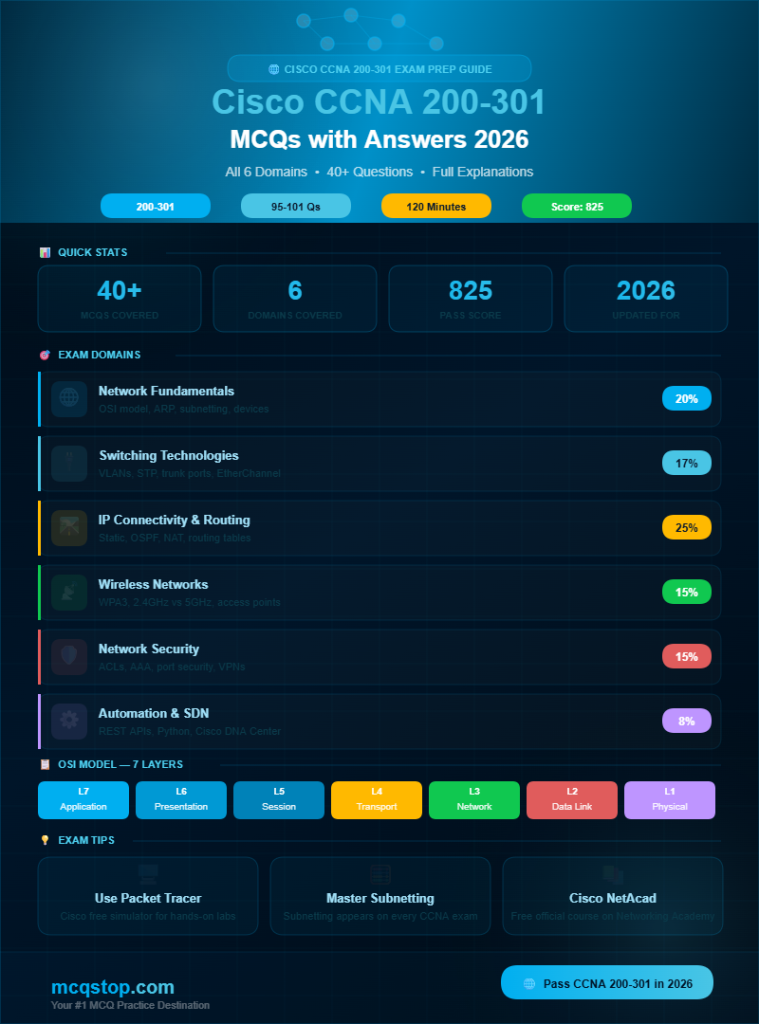
How difficult is the Cisco CCNA exam? The CCNA 200-301 is considered intermediate difficulty. It covers a very broad range of topics from basic networking fundamentals to automation and security. Most candidates spend 3 to 6 months preparing. The key is combining theoretical study with hands-on practice in Cisco Packet Tracer or real hardware.
How many questions are in the CCNA 200-301 exam? The CCNA exam typically contains between 95 to 101 questions across multiple formats including multiple choice, drag-and-drop, fill-in-the-blank, and simulations. You have 120 minutes to complete it and need a score of 825 out of 1000 to pass.
How much does the CCNA exam cost? The CCNA 200-301 exam costs USD 330 globally. It is proctored by Pearson VUE testing centers or online. Cisco occasionally offers discounts through authorized training partners and events — check the Cisco Learning Network for current promotions before booking.
How long is the CCNA certification valid? The Cisco CCNA certification is valid for 3 years. You can recertify by passing any 200-level exam, passing a higher-level exam like CCNP, or earning 30 Continuing Education credits through approved Cisco training activities — without having to retake the full CCNA exam.



Leave a Comment