⚠️
Domain 1 — Threats, Attacks & Mitigations
Malware types, social engineering, attack vectors, and vulnerability management
Question 01
What type of malware encrypts a victim’s files and demands payment for the decryption key?
ASpyware
BAdware
CRansomware ✅
DRootkit
💡 ExplanationRansomware is one of the most damaging forms of malware in 2026. It encrypts the victim’s data and demands a ransom — usually in cryptocurrency — in exchange for the decryption key. Notable examples include WannaCry and REvil. Prevention includes regular backups and endpoint protection.
Question 02
What is a phishing attack?
AAn attack that overwhelms a server with traffic to make it unavailable
BA social engineering attack that uses deceptive emails or messages to trick users into revealing sensitive information or clicking malicious links ✅
CA technique used to intercept encrypted network traffic
DAn attack that exploits buffer overflow vulnerabilities in software
💡 ExplanationPhishing is the most common social engineering attack. Attackers impersonate trusted organizations via email to steal credentials, financial data, or deploy malware. Spear phishing targets specific individuals while whaling targets senior executives.
Question 03
What is a Denial of Service (DoS) attack?
AAn attack that floods a target system with excessive traffic or requests to make it unavailable to legitimate users ✅
BAn attack that steals passwords from a user’s browser history
CAn attack that installs a backdoor on a compromised server
DAn attack that intercepts communication between two parties
💡 ExplanationA DoS attack disrupts services by overwhelming resources. A Distributed DoS (DDoS) uses thousands of compromised machines (a botnet) to amplify the attack. Mitigations include rate limiting, CDN filtering, and DDoS protection services.
Question 04
What is a “zero-day vulnerability”?
AA vulnerability that has been patched within zero days of discovery
BA security flaw that only exists on newly installed systems
CA vulnerability discovered and fixed during initial software testing
DA previously unknown software vulnerability that is actively exploited before the vendor has released a fix ✅
💡 ExplanationZero-day vulnerabilities are extremely dangerous because defenders have zero days to prepare a patch before attackers exploit them. They are highly valuable on underground markets and frequently used in nation-state cyberattacks.
🏗️
Domain 2 — Network Architecture & Security
Firewalls, VPNs, segmentation, zero trust, and secure network design
Question 05
What is the purpose of a firewall in network security?
ATo speed up internet connections for all network users
BTo monitor and control incoming and outgoing network traffic based on predefined security rules ✅
CTo encrypt all data stored on hard drives
DTo manage user passwords across the organization
💡 ExplanationA firewall acts as a security barrier between trusted internal networks and untrusted external networks. It filters traffic based on rules — allowing legitimate traffic while blocking unauthorized connections. Next-generation firewalls (NGFW) also perform deep packet inspection.
Question 06
What is the Zero Trust security model?
AA model that trusts all users inside the corporate network automatically
BA security approach that blocks all internet traffic by default
CA security framework that assumes no user or device should be trusted by default and requires continuous verification for every access request ✅
DA model that removes all passwords from the authentication process
💡 ExplanationZero Trust operates on the principle “never trust, always verify.” Every user, device, and application must be authenticated and authorized before accessing any resource — regardless of whether they are inside or outside the corporate network perimeter.
Question 07
What does a VPN (Virtual Private Network) do?
AIt permanently deletes a user’s browsing history
BIt creates an encrypted tunnel between a user’s device and a remote server, securing data in transit and masking the user’s IP address ✅
CIt blocks all advertisements from appearing on websites
DIt speeds up network connections by caching frequently visited pages
💡 ExplanationVPNs encrypt network traffic between a device and a VPN server, protecting data from eavesdroppers on public networks. Organizations use VPNs to allow remote employees to securely access internal systems as if they were in the office.
🔑
Domain 3 — Cryptography & PKI
Encryption types, hashing, digital certificates, and public key infrastructure
Question 08
What is the key difference between symmetric and asymmetric encryption?
ASymmetric uses one key for both encryption and decryption while asymmetric uses a public key to encrypt and a private key to decrypt ✅
BSymmetric encryption is newer and more secure than asymmetric
CAsymmetric encryption uses the same key for encryption and decryption
DSymmetric encryption only works on text files not binary data
💡 ExplanationSymmetric encryption (e.g. AES) is fast and efficient but requires secure key sharing. Asymmetric encryption (e.g. RSA) uses a key pair — anyone can encrypt with the public key but only the private key holder can decrypt. HTTPS uses asymmetric to exchange symmetric session keys.
Question 09
What is hashing used for in cybersecurity?
ATo encrypt files so they can be recovered with a decryption key
BTo compress large files into smaller ones for faster transmission
CTo convert data into a fixed-length string to verify data integrity — even a tiny change produces a completely different hash value ✅
DTo store user data in a structured database format
💡 ExplanationHashing is a one-way function — it cannot be reversed. It is used to verify file integrity, store passwords securely, and ensure digital signatures are valid. Common hash algorithms include SHA-256 and MD5 (though MD5 is now considered weak).
👤
Domain 4 — Identity & Access Management
Authentication, MFA, authorization models, and privileged access
Question 10
What is Multi-Factor Authentication (MFA)?
AUsing multiple different passwords for a single account
BA security method requiring users to verify identity using two or more different factors — something you know, have, or are ✅
CA system that allows multiple users to share a single account securely
DAn authentication system that uses only biometric data to verify identity
💡 ExplanationMFA dramatically reduces the risk of unauthorized access. The three factors are: something you know (password), something you have (phone/token), and something you are (fingerprint/face). Even if a password is stolen MFA prevents the attacker from logging in.
Question 11
What is the Principle of Least Privilege in access management?
AGiving all employees full administrator access to improve productivity
BGranting users only the minimum level of access required to perform their specific job duties — nothing more ✅
CRestricting all users from accessing any network resources
DAllowing users to determine their own access permissions
💡 ExplanationThe Principle of Least Privilege limits the blast radius of a security breach. If an account is compromised the attacker can only access what that account was permitted to access. It is a foundational concept in access control and a core CompTIA Security+ exam topic.
📋
Domain 5 — Governance, Risk & Compliance
Security policies, risk management, incident response, and compliance frameworks
Question 12
What is the difference between a vulnerability, a threat, and a risk in cybersecurity?
AA vulnerability is a weakness, a threat is something that can exploit that weakness, and a risk is the potential impact if the threat exploits the vulnerability ✅
BA threat and a vulnerability are the same thing described differently
CA risk is always greater than a threat in a security context
DVulnerabilities only exist in software and never in hardware or humans
💡 ExplanationExample: An unpatched web server is a vulnerability. A hacker who knows about it is a threat. The risk is the probability and impact of that hacker successfully exploiting the vulnerability. Understanding this triangle is fundamental to risk management on the exam.
Question 13
What is the first step in an incident response process?
AEradication — removing the threat from all affected systems
BRecovery — restoring systems to normal operation
CPreparation — establishing policies, tools, and a trained team before an incident occurs ✅
DContainment — isolating affected systems to prevent spread
💡 ExplanationThe NIST incident response lifecycle has six phases: Preparation → Identification → Containment → Eradication → Recovery → Lessons Learned. Preparation is first because organizations must have plans, tools, and trained teams ready before an incident happens.
Question 14
What does GDPR stand for and why is it relevant to cybersecurity?
AGeneral Data Processing Rule — a standard for database administration
BGeneral Data Protection Regulation — a European Union law that mandates how organizations collect, store, and protect personal data ✅
CGlobal Digital Privacy Requirement — a US federal cybersecurity standard
DGeneral Device Protection Regulation — hardware security certification
💡 ExplanationGDPR is one of the strictest data protection laws globally. Organizations handling EU citizens’ data must implement strong security controls, report breaches within 72 hours, and face fines up to 4% of global annual revenue for non-compliance — making it a major cybersecurity compliance requirement.
Question 15
What is penetration testing?
ATesting how deeply a firewall can filter network packets
BAn authorized simulated cyberattack on a system to identify and fix security vulnerabilities before real attackers find them ✅
CA test that measures the physical strength of server room doors
DSoftware that tests how many users can access a network simultaneously
💡 ExplanationPenetration testers — also called ethical hackers — use the same tools and techniques as malicious attackers but with permission. Their goal is to find weaknesses before criminals do. Types include black box, white box, and grey box testing based on the level of information provided.
Question 16
What is a Security Operations Center (SOC)?
AA physical room where servers and networking equipment are stored
BA software platform for managing user passwords across an organization
CA compliance certification required for government contractors
DA centralized team that monitors, detects, analyzes, and responds to cybersecurity incidents around the clock ✅
💡 ExplanationA SOC is the nerve center of an organization’s cybersecurity operations. SOC analysts use SIEM tools to monitor logs, alerts, and events 24/7. CompTIA Security+ is widely recognized as the entry-level certification for SOC Analyst roles globally.
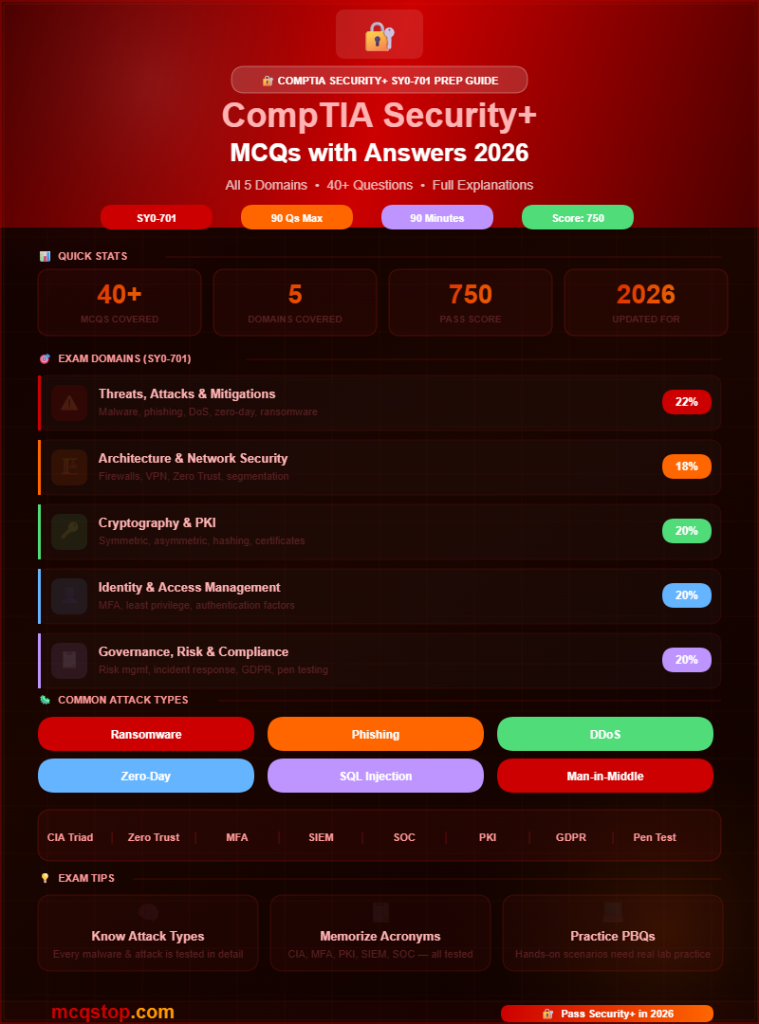
What is the CompTIA Security+ exam code in 2026? The current exam code is SY0-701 which was released in November 2023 and remains the active version in 2026. It covers five domains including threats, architecture, cryptography, identity management, and governance with a passing score of 750 out of 900.
How hard is the CompTIA Security+ exam? Security+ is considered intermediate difficulty. It requires understanding both theoretical concepts and practical application. The exam includes performance-based questions (PBQs) that simulate real security scenarios making consistent practice with MCQs and lab tools essential for success.
What jobs can I get with CompTIA Security+? Security+ opens doors to roles including SOC Analyst, Security Administrator, IT Auditor, Network Security Engineer, Systems Administrator, and Cybersecurity Specialist. The US Department of Defense requires Security+ for all IT positions under DoD Directive 8140.
How long does CompTIA Security+ certification last? CompTIA Security+ certification is valid for 3 years. You can renew it by earning 50 Continuing Education Units (CEUs) through approved activities, passing a higher-level CompTIA exam, or retaking the Security+ exam before expiry.



Leave a Comment