The
Microsoft Azure Data Fundamentals (DP-900) certification is
Microsoft’s entry-level data credential that validates your core knowledge of data concepts, relational and non-relational databases, data analytics, and Azure data services. In 2026 data literacy is one of the most critical skills in every industry — from finance and healthcare to retail and government. Whether you are a business analyst, developer, database administrator, or a student looking to break into the data field — the DP-900 is your fastest credential to demonstrate Azure data knowledge. No coding required. These fully solved MCQs cover all four exam domains to help you pass on your very first attempt.
📋
Domain 1 — Core Data Concepts
Types of data, data storage, data processing, and roles in data
Question 01
What is the difference between structured and unstructured data?
AStructured data is organized in rows and columns like a table while unstructured data has no predefined format such as images, emails, and videos ✅
BStructured data is always stored in the cloud while unstructured data is stored on-premises
CUnstructured data is always smaller in size than structured data
DStructured data cannot be queried using SQL language
💡 ExplanationStructured data fits neatly into relational databases with defined rows and columns — like customer records or sales figures. Unstructured data has no fixed format — including social media posts, videos, audio files, and images. Semi-structured data sits in between, such as JSON and XML files.
Question 02
What is the role of a Data Engineer?
AAnalyzing data to extract business insights and create reports
BDesigning, building, and maintaining data pipelines and infrastructure that collect, store, and process data for analysis ✅
CBuilding machine learning models using training data
DCreating user interface designs for data applications
💡 ExplanationData Engineers build the plumbing of the data world — pipelines, data lakes, and warehouses that move and store data reliably. Data Scientists then use that clean data to build models, while Data Analysts use it to generate reports and business insights.
Question 03
What is the difference between batch processing and stream processing?
ABatch processing is faster than stream processing in all scenarios
BBatch processing handles large volumes of data at scheduled intervals while stream processing analyzes data continuously in real time ✅
CStream processing only works with structured relational data
DBatch processing requires an internet connection to function
💡 ExplanationBatch processing runs at scheduled times — like generating nightly sales reports. Stream processing analyzes data the moment it arrives — like detecting fraud on a credit card transaction within milliseconds. Azure Stream Analytics supports real-time stream processing on Azure.
Question 04
What does OLTP stand for and what is it used for?
AOnline Text Processing — used for natural language understanding
BOffline Transaction Processing — used for end-of-day batch reporting
COnline Transaction Processing — used for managing real-time day-to-day business transactions like orders, payments, and bookings ✅
DOpen Technology Language Protocol — used for API communication
💡 ExplanationOLTP systems are optimized for high-volume, fast insert/update/delete operations — like a bank processing thousands of ATM transactions per second. OLAP (Online Analytical Processing) is the counterpart used for complex analytical queries on historical data in data warehouses.
🗄️
Domain 2 — Relational Data on Azure
SQL concepts, Azure SQL Database, Azure SQL Managed Instance, and normalization
Question 05
What is a primary key in a relational database?
AA column or set of columns that uniquely identifies each row in a database table ✅
BThe first column in every database table by default
CA password that protects sensitive database tables from unauthorized access
DThe column that stores the most important data in a table
💡 ExplanationA primary key enforces uniqueness — no two rows can share the same primary key value. For example a CustomerID column ensures every customer has a distinct identifier. A foreign key in another table references this primary key to create relationships between tables.
Question 06
Which Azure service provides a fully managed relational SQL database in the cloud?
AAzure Blob Storage
BAzure Cosmos DB
CAzure SQL Database ✅
DAzure Data Factory
💡 ExplanationAzure SQL Database is Microsoft’s fully managed PaaS relational database service. It handles patching, backups, and high availability automatically. It supports standard T-SQL queries and is ideal for modern cloud applications that need a scalable relational database without managing infrastructure.
Question 07
What does a SQL JOIN operation do?
ADeletes duplicate rows from two database tables
BCombines rows from two or more tables based on a related column between them ✅
CMerges two databases into a single new database permanently
DCreates a backup copy of a table for disaster recovery
💡 ExplanationA JOIN lets you query data across multiple related tables. INNER JOIN returns only matching rows. LEFT JOIN returns all rows from the left table plus matching rows from the right. Understanding JOIN types is a core SQL skill tested on the DP-900 exam.
Question 08
What are the ACID properties of a relational database transaction?
AAvailability, Consistency, Integrity, Durability
BAtomicity, Consistency, Isolation, Durability ✅
CAccuracy, Completeness, Integrity, Dependability
DAuthentication, Consistency, Isolation, Deployment
💡 ExplanationACID ensures database transactions are reliable. Atomicity means all steps succeed or none do. Consistency ensures the database stays valid after every transaction. Isolation ensures concurrent transactions don’t interfere. Durability means committed data survives system failures.
📦
Domain 3 — Non-Relational Data on Azure
NoSQL types, Azure Cosmos DB, Table Storage, and Blob Storage
Question 09
What is a NoSQL database and when is it preferred over a relational database?
AA database that does not support any type of query language
BA non-tabular database optimized for flexible schemas, high scalability, and unstructured or semi-structured data like documents, key-value pairs, or graphs ✅
CA database that only stores numeric values and financial records
DA database that requires more maintenance than relational databases
💡 ExplanationNoSQL is preferred when data is unstructured or changes frequently in shape, when you need massive horizontal scalability, or when low-latency access to large volumes of data is required. Examples include social media profiles, IoT sensor readings, and product catalogs.
Question 10
What is Azure Cosmos DB?
AA relational SQL database for enterprise transactional workloads
BA file storage service for archiving large binary objects
CA globally distributed, multi-model NoSQL database service that delivers single-digit millisecond response times at any scale ✅
DA data visualization tool for creating interactive business dashboards
💡 ExplanationAzure Cosmos DB supports multiple data models including document, key-value, column-family, and graph — all through a single service. It replicates data across multiple Azure regions automatically, making it ideal for globally distributed applications that need ultra-low latency.
Question 11
Which Azure storage service is best suited for storing large amounts of unstructured data like images, videos, and documents?
AAzure Blob Storage ✅
BAzure SQL Database
CAzure Table Storage
DAzure Queue Storage
💡 ExplanationAzure Blob Storage is Microsoft’s object storage solution for the cloud — ideal for storing massive amounts of unstructured data. It offers different access tiers: Hot for frequently accessed data, Cool for infrequent access, and Archive for long-term backup at the lowest cost.
📊
Domain 4 — Analytics Workloads on Azure
Azure Synapse Analytics, Power BI, Data Factory, and data warehousing
Question 12
What is Azure Synapse Analytics?
AA tool for building and managing virtual networks on Azure
BAn integrated analytics service that combines data warehousing, big data processing, and data integration into a single unified platform ✅
CA machine learning service for training and deploying AI models
DA backup and disaster recovery service for Azure databases
💡 ExplanationAzure Synapse Analytics brings together enterprise data warehousing (formerly SQL Data Warehouse), big data analytics using Apache Spark, and data integration using Azure Data Factory pipelines — all in a single unified workspace experience.
Question 13
What is Microsoft Power BI used for?
ABuilding and deploying web applications on Azure App Service
BCreating interactive reports, dashboards, and data visualizations to help organizations make data-driven business decisions ✅
CManaging user identities and access across Microsoft 365
DProcessing and storing IoT device telemetry data at scale
💡 ExplanationPower BI connects to hundreds of data sources, transforms raw data, and creates stunning interactive visualizations. Business users can explore dashboards on web browsers or the Power BI mobile app without needing any programming knowledge — making it Microsoft’s leading business intelligence tool.
Question 14
What is Azure Data Factory used for?
AManufacturing physical servers for Azure data centers
BA cloud-based ETL and data integration service that orchestrates data movement and transformation across different data stores and services ✅
CA service for building and training deep learning neural networks
DA platform for deploying containerized microservices on Kubernetes
💡 ExplanationAzure Data Factory is Azure’s cloud ETL (Extract, Transform, Load) service. It creates visual data pipelines that collect data from 90+ supported sources, transform it into usable formats, and load it into destinations like Azure Synapse, SQL Database, or data lakes — without writing complex code.
Question 15
What is a data lake and how does it differ from a data warehouse?
AA data lake stores raw data in its native format at scale while a data warehouse stores processed, structured data optimized for querying and reporting ✅
BA data lake is smaller than a data warehouse in storage capacity
CA data warehouse stores all types of unstructured data including videos
DData lakes and data warehouses serve the exact same purpose
💡 ExplanationData lakes store everything raw — structured, semi-structured, and unstructured — and let you determine structure later (schema-on-read). Data warehouses apply strict schema upfront (schema-on-write) and are optimized for fast analytical queries. Azure Data Lake Storage Gen2 and Azure Synapse serve these roles respectively.
Question 16
What does ETL stand for in data engineering?
AEncode, Transfer, Launch
BEncrypt, Tokenize, Load
CExtract, Transform, Load ✅
DEvaluate, Test, Launch
💡 ExplanationETL is the backbone of data pipelines. Extract pulls data from source systems like databases, APIs, or files. Transform cleans, filters, and reshapes the data into the required format. Load writes it into the target destination such as a data warehouse. Azure Data Factory is Azure’s primary ETL service.
What is the DP-900 exam and who is it for? The Microsoft DP-900 Azure Data Fundamentals exam is designed for anyone who wants to demonstrate foundational knowledge of core data concepts and Microsoft Azure data services. It is ideal for data professionals, developers, business analysts, students, and career changers — no coding or technical experience is required.
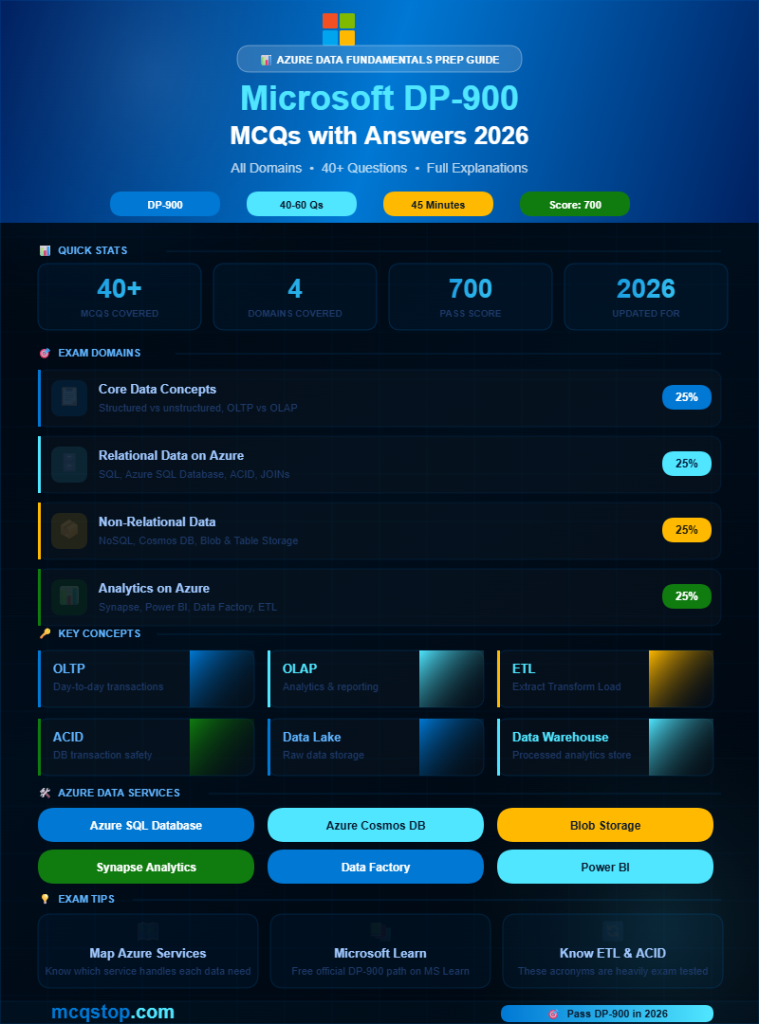
How many questions are in the DP-900 exam? The DP-900 exam typically contains between 40 to 60 questions. You have 45 minutes to complete it and need a passing score of 700 out of 1000. Question formats include multiple choice, multiple select, and drag-and-drop scenarios.
How much does the DP-900 exam cost? The exam costs approximately USD 165. Microsoft regularly offers free exam vouchers through Azure virtual training events, Microsoft Ignite, and partner programs. Check the Microsoft ESI or Microsoft Learn website before booking to find promotional opportunities.
Does the DP-900 certification expire? Microsoft Azure fundamentals certifications including DP-900 do not expire. They remain valid permanently, though Microsoft recommends staying updated with new Azure services and preparing for higher-level certifications like DP-203 (Data Engineer) or DP-300 (Database Administrator) to advance your career.





Leave a Comment