IBM AI Fundamentals MCQs with Answers 2026

IBM AI Fundamentals MCQs with Answers 2026

40+
MCQs Covered
6
Topics Covered
100%
Free Access
2026
Updated For

The IBM AI Fundamentals certification offered through IBM SkillsBuild is one of the most respected free AI credentials available globally in 2026. It covers everything from foundational AI and machine learning concepts to natural language processing, computer vision, and IBM’s own AI tools including Watson. Upon completion you earn a digital badge you can proudly display on LinkedIn. Whether you are a student, professional, or career changer — this certification is a powerful first step into the world of artificial intelligence. Use these fully solved MCQs to master every topic and earn your badge with confidence.

Question 01

Which of the following best describes the goal of Artificial Intelligence?

ATo replace all human workers with machines permanently
BTo create systems that can perform tasks requiring human-like intelligence such as reasoning, learning, and problem solving ✅
CTo build faster computers with more processing power
DTo develop new programming languages for developers
💡 ExplanationArtificial Intelligence is the broad field of computer science focused on building systems capable of performing tasks that normally require human intelligence — such as understanding language, recognizing images, making decisions, and solving complex problems.

Question 02

What is the difference between Narrow AI and General AI?

ANarrow AI performs specific tasks while General AI can perform any intellectual task a human can do ✅
BNarrow AI is more powerful than General AI
CGeneral AI already exists and is used in smartphones today
DNarrow AI requires more data than General AI to function
💡 ExplanationAll AI systems today are Narrow AI — they excel at one specific task like playing chess, translating text, or recognizing images. General AI (AGI) — a system with human-level reasoning across all domains — does not yet exist and remains a long-term research goal.

Question 03

Which of the following is a real-world example of AI being used in healthcare?

AUsing spreadsheets to record patient appointments
BSending automated email reminders to patients
CUsing deep learning models to detect cancer in medical images with high accuracy ✅
DPrinting patient records in a hospital
💡 ExplanationAI is transforming healthcare — deep learning models trained on thousands of X-rays and MRI scans can now detect cancers, diabetic retinopathy, and other conditions as accurately as or better than specialist doctors, enabling earlier diagnosis and better patient outcomes.

Question 04

What are the three main subfields that fall under Artificial Intelligence?

ACoding, databases, and networking
BMachine Learning, Natural Language Processing, and Computer Vision ✅
CCloud computing, cybersecurity, and blockchain
DHTML, CSS, and JavaScript
💡 ExplanationThe three core subfields of AI most tested in the IBM AI Fundamentals certification are Machine Learning (learning from data), Natural Language Processing (understanding human language), and Computer Vision (interpreting images and video).
 

🧠

Topic 2 — Machine Learning Concepts

Algorithms, training, model evaluation, and IBM AutoAI

Question 05

What is the purpose of a “decision tree” algorithm in machine learning?

ATo store data in a hierarchical file system
BTo make decisions by splitting data into branches based on feature values, leading to a final classification or prediction ✅
CTo grow real trees in an environmental simulation program
DTo organize neural network layers into tree structures
💡 ExplanationA decision tree is a supervised ML algorithm that creates a tree-like model of decisions. At each node it asks a question about a feature and branches based on the answer. It is highly interpretable and widely used in fraud detection, medical diagnosis, and customer segmentation.

Question 06

What is clustering in unsupervised machine learning?

AGrouping similar models together for deployment
BSplitting training data into smaller batches for faster processing
CAutomatically grouping data points that share similar characteristics without using predefined labels ✅
DCombining multiple neural networks into a single large model
💡 ExplanationClustering is a core unsupervised learning technique. The algorithm groups similar data points together without human-labeled categories. It is commonly used in customer segmentation, document categorization, and detecting unusual patterns in data.

Question 07

What is IBM AutoAI in IBM Watson Studio?

AAn automated tool that writes Python code for data scientists
BA tool that automatically prepares data, selects algorithms, and builds the best ML pipeline with minimal manual effort ✅
CAn IBM chatbot that answers customer support questions
DA system that automatically deploys applications to IBM Cloud
💡 ExplanationIBM AutoAI is IBM’s automated machine learning tool within Watson Studio. It automatically handles feature engineering, algorithm selection, and hyperparameter tuning — allowing non-experts to build high-quality ML models without writing any code.
 

💬

Topic 3 — Natural Language Processing

How machines understand, interpret, and generate human language

Question 08

What does Natural Language Processing (NLP) enable a computer to do?

ADisplay text on a screen in multiple fonts
BUnderstand, interpret, and generate human language in a meaningful and contextually relevant way ✅
CProcess only structured numerical data in spreadsheets
DConvert images to text using optical character recognition only
💡 ExplanationNLP bridges the gap between human language and computer understanding. It powers applications like virtual assistants, real-time translation, email spam filters, sentiment analysis tools, and chatbots that hold natural conversations.

Question 09

What is “tokenization” in Natural Language Processing?

AA security method used to protect API keys in NLP systems
BThe process of encrypting text data before sending it to an AI model
CBreaking text into smaller units such as words, subwords, or characters so the model can process them individually ✅
DConverting text from one language to another automatically
💡 ExplanationTokenization is the first step in most NLP pipelines. It breaks raw text into tokens — which can be whole words, parts of words, or individual characters — so the model can analyze and understand the structure of language mathematically.
 

👁️

Topic 4 — Computer Vision

How AI sees, understands, and interprets images and video

Question 10

What is computer vision?

ASoftware that corrects vision problems in human eyes
BA field of AI that trains computers to interpret and understand visual information from images and videos ✅
CA type of display screen technology used in AI labs
DA programming interface for controlling camera hardware
💡 ExplanationComputer vision enables machines to see and understand the visual world. It powers face recognition, autonomous vehicles, quality control in manufacturing, medical imaging analysis, and augmented reality applications.

Question 11

What is a Convolutional Neural Network (CNN) primarily used for?

AProcessing time-series data and financial forecasts
BBuilding conversational chatbots and virtual assistants
CProcessing and classifying images and videos by detecting patterns, edges, and features ✅
DGenerating written reports from structured spreadsheet data
💡 ExplanationCNNs are the foundation of modern computer vision. They use convolutional layers to scan images and detect features like edges, shapes, and textures at different levels of abstraction — making them the go-to architecture for image classification, object detection, and face recognition.
 

🔬

Topic 5 — IBM Watson AI Tools

Watson Assistant, Watson Discovery, Watson Studio, and IBM watsonx

Question 12

What is IBM Watson Assistant primarily designed to do?

ATrain machine learning models on tabular data
BBuild and deploy AI-powered chatbots and virtual assistants for businesses ✅
CAnalyze and classify images from a company’s product catalog
DGenerate financial reports from business transaction data
💡 ExplanationIBM Watson Assistant enables businesses to build smart conversational AI assistants without deep coding knowledge. It uses intent recognition, entity extraction, and dialogue management to handle customer queries across websites, mobile apps, and messaging platforms.

Question 13

What is IBM watsonx.ai?

AIBM’s cloud storage service for enterprise data
BA cybersecurity platform for detecting network threats
CIBM’s enterprise-grade AI and data platform for building, training, and deploying foundation models and machine learning solutions ✅
DIBM’s project management tool for agile software development teams
💡 ExplanationIBM watsonx is IBM’s next-generation AI platform launched in 2023. It includes watsonx.ai for building and fine-tuning foundation models, watsonx.data for governed data management, and watsonx.governance for AI risk and compliance management.
 

⚖️

Topic 6 — AI Ethics & Responsible AI

IBM’s AI ethics principles, explainability, fairness, and transparency

Question 14

What does IBM consider the most important principle in AI ethics?

ASpeed — AI systems must always respond as fast as possible
BProfitability — AI must deliver measurable business returns
CTrust — AI systems must be explainable, fair, robust, transparent, and privacy-preserving ✅
DAutomation — AI should automate as many human jobs as possible
💡 ExplanationIBM’s AI ethics framework is built on Trust as its cornerstone. IBM believes AI must be explainable so users understand decisions, fair to avoid discrimination, robust against attacks, transparent in its operations, and privacy-preserving to protect individuals.

Question 15

What does “explainable AI” (XAI) mean?

AAI that can explain itself verbally to users in real time
BAI systems designed so that their decisions and predictions can be understood and interpreted by humans ✅
CAI that only works on problems with simple explanations
DAI that requires human explanation before it can process any input
💡 ExplanationExplainable AI (XAI) is critical in high-stakes domains like healthcare, finance, and legal systems where people need to understand why an AI made a specific decision. IBM’s AI Fairness 360 and Watson OpenScale are tools built to support model explainability and bias detection.

Question 16

According to IBM’s AI ethics framework, who is ultimately responsible for an AI system’s decisions?

AThe AI system itself since it made the decision autonomously
BThe cloud provider hosting the AI model
CThe data scientists who built the training dataset
DThe humans and organizations that design, deploy, and use the AI system ✅
💡 ExplanationIBM firmly believes that AI is a tool and humans are always accountable for its use. The designers who build it, the organizations that deploy it, and the professionals who use it all share responsibility for ensuring AI decisions are fair, ethical, and beneficial to society.
 

🔬 IBM AI Tools Quick Reference

🤖 Watson Assistant
AI chatbots and virtual assistants
🔍 Watson Discovery
AI-powered document search and insights
🧪 Watson Studio
Build and train ML models with AutoAI
🌐 watsonx.ai
Enterprise foundation model platform
📊 Watson OpenScale
AI fairness and bias monitoring
🛡️ watsonx.governance
AI risk and compliance management

💡 Top Tips to Pass IBM AI Fundamentals in 2026

🆓
Free on IBM SkillsBuild
The course and badge are completely free on IBM SkillsBuild
🔬
Know IBM Watson Tools
Match each Watson product to its specific AI use case
⚖️
Focus on AI Ethics
IBM’s ethics principles are heavily tested in the assessment


🎯 Keep Practicing — More MCQs Available!

We update our question bank regularly to match the latest AI certification content

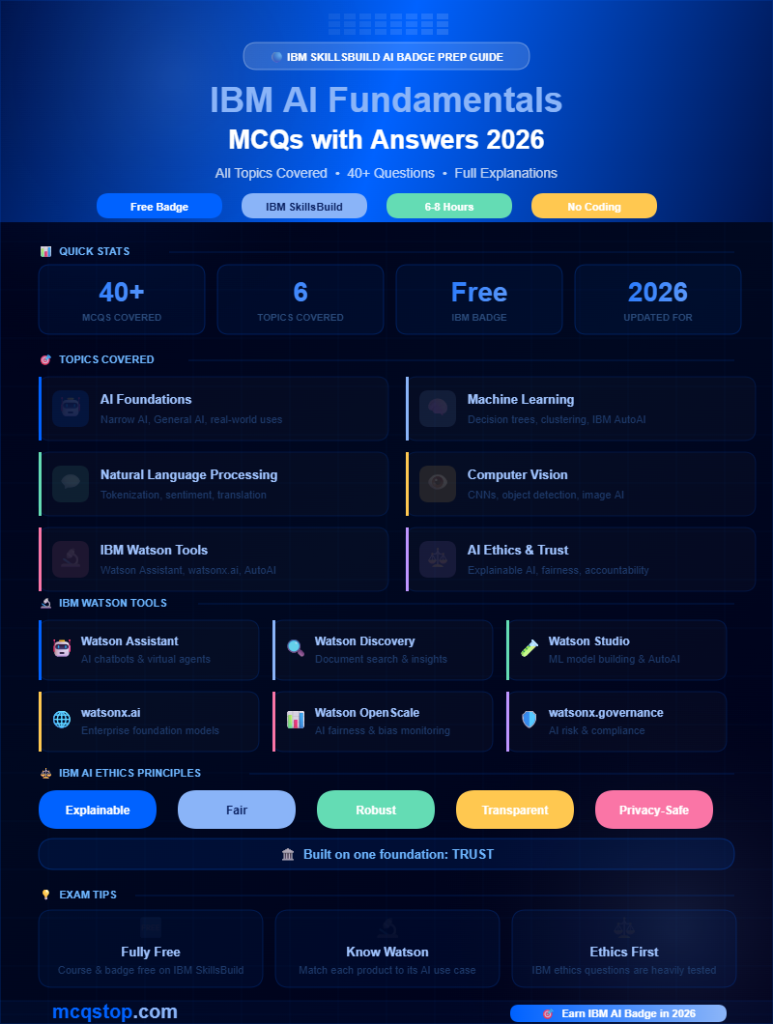
IBM AI Fundamentals MCQs with Answers 2026 – Infographic
Frequently Asked Questions

Is the IBM AI Fundamentals certification free?

Yes — the IBM AI Fundamentals course and digital badge are completely free through IBM SkillsBuild. You simply create a free account, complete the learning modules, pass the assessment, and earn your shareable digital badge instantly.

How long does the IBM AI Fundamentals course take?

The IBM AI Fundamentals course typically takes 6 to 8 hours to complete. It is entirely self-paced so you can spread it across several days or complete it in a single focused session depending on your schedule.

Is the IBM AI badge recognized by employers?

Yes — IBM digital badges are globally recognized Credly-verified credentials. They carry IBM’s brand reputation and are widely accepted by Fortune 500 companies, technology firms, and government organizations as proof of foundational AI knowledge.

Do I need programming skills for IBM AI Fundamentals?

No programming knowledge is required. The IBM AI Fundamentals certification is designed for everyone — including business professionals, students, and career changers — who want to build foundational AI knowledge without writing any code.


About the author

MCQS TOP

Leave a Comment

This website stores cookies on your computer. These cookies are used to provide a more personalized experience and to track your whereabouts around our website in compliance with the European General Data Protection Regulation. If you decide to to opt-out of any future tracking, a cookie will be setup in your browser to remember this choice for one year.

Accept or Deny