Prompt Engineering is one of the most valuable skills you can develop in the AI era. It is the practice of crafting precise, effective instructions to get the best possible results from AI tools like ChatGPT, Claude, and Gemini. Companies worldwide are now hiring Prompt Engineers and requiring AI literacy from all their staff. Whether you are preparing for a certification, a job interview, or simply want to use AI tools more effectively at work — these fully solved MCQs will give you a solid mastery of prompt engineering from basics to advanced techniques.
What prompts are, how they work, and the fundamentals of writing effective prompts
Question 01
What is prompt engineering?
AThe process of building AI software from scratch
BThe practice of designing and refining input instructions to get the best possible outputs from an AI model ✅
CA method for training machine learning models using labeled data
DA programming language specifically designed for AI development
💡 ExplanationPrompt engineering is the skill of crafting clear, structured, and context-rich inputs to guide AI models like ChatGPT toward producing accurate, useful, and relevant outputs.
Question 02
Which of the following is the most effective way to write a prompt for ChatGPT?
AUse one-word prompts for faster responses
BWrite vague prompts so the AI has more creative freedom
CBe specific, provide context, define the role, and state the desired output format ✅
DAlways write prompts in capital letters to emphasize importance
💡 ExplanationEffective prompts include four key elements — specificity about what you want, background context, a defined role for the AI, and the format you expect the response in (e.g. a table, bullet list, or paragraph).
Question 03
What does it mean to assign a “role” to ChatGPT in a prompt?
AGiving the AI a username to log into a system
BTelling the AI to respond as if it were a specific expert, persona, or character to get more focused responses ✅
CSetting the language the AI should respond in
DGiving the AI permission to access the internet
💡 ExplanationRole prompting — for example “Act as a senior marketing expert” — helps ChatGPT adopt the right tone, vocabulary, and depth of knowledge to deliver expert-level responses aligned with your specific need.
Question 04
What is “temperature” in the context of ChatGPT and language models?
AThe physical heat generated by the server running the AI
BThe speed at which the AI generates a response
CA setting that controls how creative or random the AI’s responses are ✅
DThe number of words in the AI’s response
💡 ExplanationTemperature is a parameter between 0 and 2. A low value (0.1–0.3) produces focused, consistent, factual outputs. A high value (0.8–1.5) produces more creative, varied, and imaginative responses. Choose based on your task.
🎯
Topic 2 — Advanced Prompting Techniques
Zero-shot, few-shot, chain-of-thought and other expert strategies
Question 05
What is “zero-shot prompting”?
AAsking the AI to perform a task without providing any examples in the prompt ✅
BGiving the AI zero tokens to generate a response
CUsing a prompt with zero words
DSending a prompt that gets ignored by the AI model
💡 ExplanationZero-shot prompting relies entirely on the AI’s pre-trained knowledge with no examples provided. It works well for straightforward tasks like translation, summarization, or answering factual questions.
Question 06
What is “few-shot prompting”?
AUsing very short prompts to save tokens
BLimiting the AI to answering only a few questions per session
CProviding a small number of examples inside the prompt to show the AI the pattern or format you want ✅
DA technique that uses only a few words in each prompt
💡 ExplanationFew-shot prompting includes 2–5 examples of input-output pairs directly in the prompt. This teaches the AI the exact pattern, format, or tone you expect, dramatically improving output accuracy for complex tasks.
Question 07
What is “Chain-of-Thought” (CoT) prompting?
AConnecting multiple ChatGPT accounts together
BInstructing the AI to reason through a problem step by step before giving a final answer ✅
CWriting a very long prompt with multiple paragraphs
DLinking prompts from different AI tools together
💡 ExplanationChain-of-Thought prompting improves accuracy on complex reasoning tasks by adding phrases like “Let’s think step by step” to your prompt. This forces the AI to break down the problem logically before answering.
Question 08
Which technique involves telling ChatGPT to “think step by step” before answering?
AZero-shot prompting
BFew-shot prompting
CChain-of-Thought (CoT) prompting ✅
DNegative prompting
💡 ExplanationThe phrase “think step by step” is the hallmark trigger of Chain-of-Thought prompting. It has been proven to significantly improve the accuracy of AI responses on math problems, logic puzzles, and multi-step reasoning tasks.
🔗
Topic 3 — Prompt Chaining & Iteration
Multi-step workflows, iterative refinement, and output building
Question 09
What is “prompt chaining”?
ALocking your prompts behind a password for security
BBreaking a complex task into a sequence of smaller prompts where each output feeds into the next prompt ✅
CSending the same prompt to multiple AI tools simultaneously
DCopying and repeating the same prompt multiple times
💡 ExplanationPrompt chaining is ideal for complex, multi-stage tasks. For example: first prompt generates an outline, second prompt expands each section, third prompt edits for tone — each building on the previous output.
Question 10
What should you do when ChatGPT gives an unsatisfactory response?
AAccept the response as the best the AI can do
BClose the session and start a completely new chat
CRepeat the exact same prompt again hoping for a different result
DRefine your prompt by adding more context, constraints, or examples and try again ✅
💡 ExplanationIterative refinement is a core prompting skill. When results miss the mark, add constraints (“keep it under 100 words”), specify format (“respond as a numbered list”), or add examples to guide the AI toward what you actually need.
🛡️
Topic 4 — Safety & Responsible Prompting
Hallucinations, bias, misinformation, and ethical AI use
Question 11
Why should you always fact-check ChatGPT’s responses before using them professionally?
ABecause ChatGPT always gives wrong answers
BBecause ChatGPT can produce hallucinations — confident-sounding but factually incorrect information ✅
CBecause ChatGPT only responds in informal language
DBecause ChatGPT charges extra for professional use responses
💡 ExplanationChatGPT can generate fluent, authoritative-sounding text that is factually incorrect — known as hallucinations. Always verify statistics, dates, citations, and technical claims from trusted primary sources before publishing or presenting.
Question 12
What is a “knowledge cutoff” in ChatGPT?
AThe maximum number of words ChatGPT can generate per response
BThe limit on how many questions a user can ask per day
CThe date after which ChatGPT has no knowledge of events because its training data ends there ✅
DA safety filter that blocks certain types of content
💡 ExplanationChatGPT is trained on data up to a specific cutoff date. It has no awareness of events that happened after that date. Always use web-enabled AI versions or verify with current sources for time-sensitive information.
💼
Topic 5 — ChatGPT for Business & Work
Workplace productivity, content creation, and professional prompting
Question 13
Which of the following is the best prompt for writing a professional email using ChatGPT?
A“Write an email”
B“Email about meeting”
C“Write a professional email to a client rescheduling our Monday meeting to Wednesday 3pm due to a conflict. Keep it under 100 words. Polite and concise tone.” ✅
D“Can you maybe write something about a meeting change if possible please”
💡 ExplanationOption C wins because it specifies the recipient (client), the action (reschedule), specific details (Monday to Wednesday 3pm), a word limit (100 words), and the desired tone (polite and concise). Specificity is everything in professional prompting.
Question 14
What does specifying an output format in your prompt do?
AIt makes the response longer and more detailed
BIt guides the AI to structure its response exactly the way you need it — such as a table, bullet list, JSON, or paragraph ✅
CIt forces the AI to respond only in formal English
DIt reduces the accuracy of the AI’s response
💡 ExplanationAdding format instructions like “respond as a numbered list”, “give output as a JSON object”, or “format as a comparison table” saves enormous editing time by making the AI output immediately usable in your workflow.
🧠
Topic 6 — How ChatGPT Works
GPT architecture, tokens, context windows, and model versions
Question 15
What does “GPT” stand for in ChatGPT?
AGlobal Processing Technology
BGeneral Purpose Transformer
CGenerative Pre-trained Transformer ✅
DGuided Predictive Text
💡 ExplanationGPT stands for Generative Pre-trained Transformer. “Generative” means it creates new content. “Pre-trained” means it was trained on massive datasets before deployment. “Transformer” refers to the neural network architecture that powers it.
Question 16
What is a “token” in the context of ChatGPT?
AA security password used to access the ChatGPT API
BA digital currency used to pay for AI usage
CA physical device that generates login codes
DA small unit of text — roughly 4 characters or 0.75 words — that the model processes as its basic unit of language ✅
💡 ExplanationTokens are the basic units ChatGPT reads and writes. 1000 tokens is roughly 750 words. Understanding tokens helps you work within context window limits and manage costs when using the OpenAI API for professional projects.
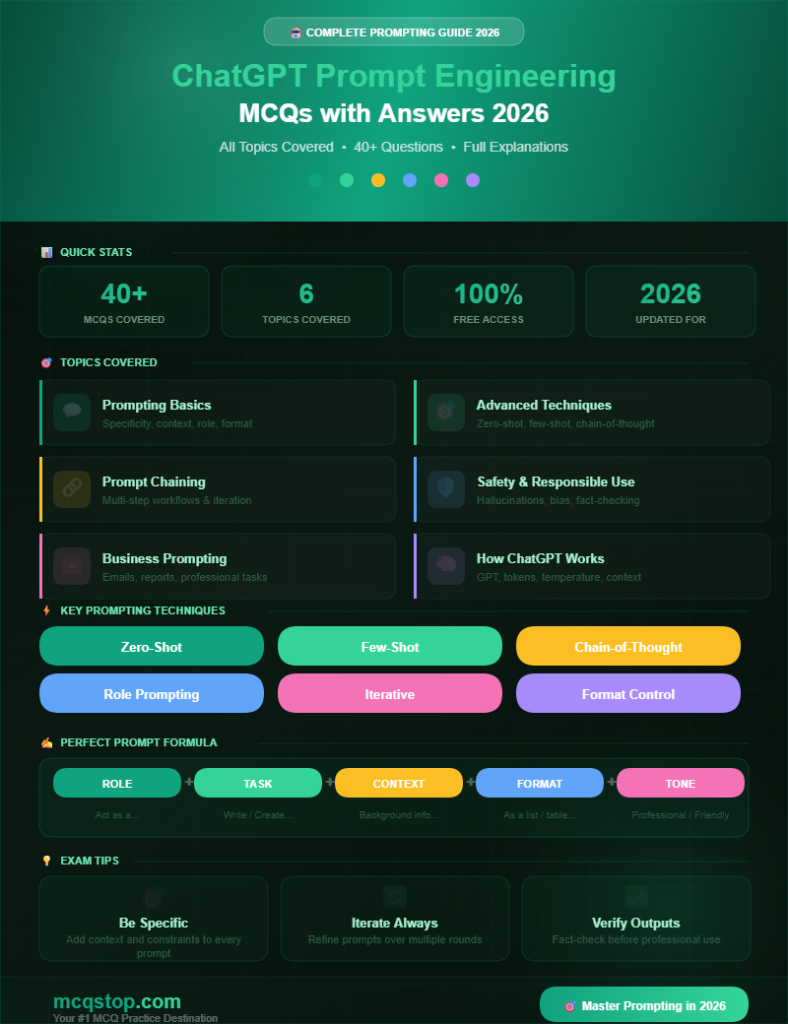
💡 Top Tips to Master Prompt Engineering in 2026
🎯
Be Specific Always
Vague prompts get vague answers — always add context and constraints
🔄
Iterate and Refine
Great prompts are built over multiple rounds of refinement
✅
Always Verify Output
Fact-check every important claim before using it professionally
Frequently Asked Questions
❓ Is there an official ChatGPT Prompt Engineering certification?
OpenAI does not currently offer an official standalone certification. However, platforms like Coursera, DeepLearning.AI, and LinkedIn Learning offer widely recognized prompt engineering courses and certificates that employers value highly in 2026.
❓ What is the difference between ChatGPT-3.5 and GPT-4?
GPT-4 is significantly more capable than GPT-3.5 — it handles more complex reasoning, longer contexts, and multimodal inputs including images. GPT-3.5 is faster and available on the free tier while GPT-4 requires a paid subscription.
❓ Can prompt engineering be used with AI tools other than ChatGPT?
Absolutely. Prompt engineering principles apply universally to all large language models including Google Gemini, Microsoft Copilot, Claude by Anthropic, and Meta Llama. The core techniques — role prompting, few-shot, chain-of-thought — work across all of them.
❓ Is prompt engineering a good career in 2026?
Yes — prompt engineering and AI literacy are among the most in-demand skills globally in 2026. Companies across every industry are seeking professionals who can effectively deploy and manage AI tools to boost productivity and reduce operational costs.
🎯 Keep Practicing — More MCQs Available!
We update our question bank regularly to match the latest AI certifications and industry trends





Leave a Comment