Scrum Theory & Values
Foundation of Scrum Framework
Question 01
Scrum is founded on which underlying theory?
APredictive planning theory
BEmpiricism (empirical process control) ✅
CWaterfall methodology
DSix Sigma process improvement
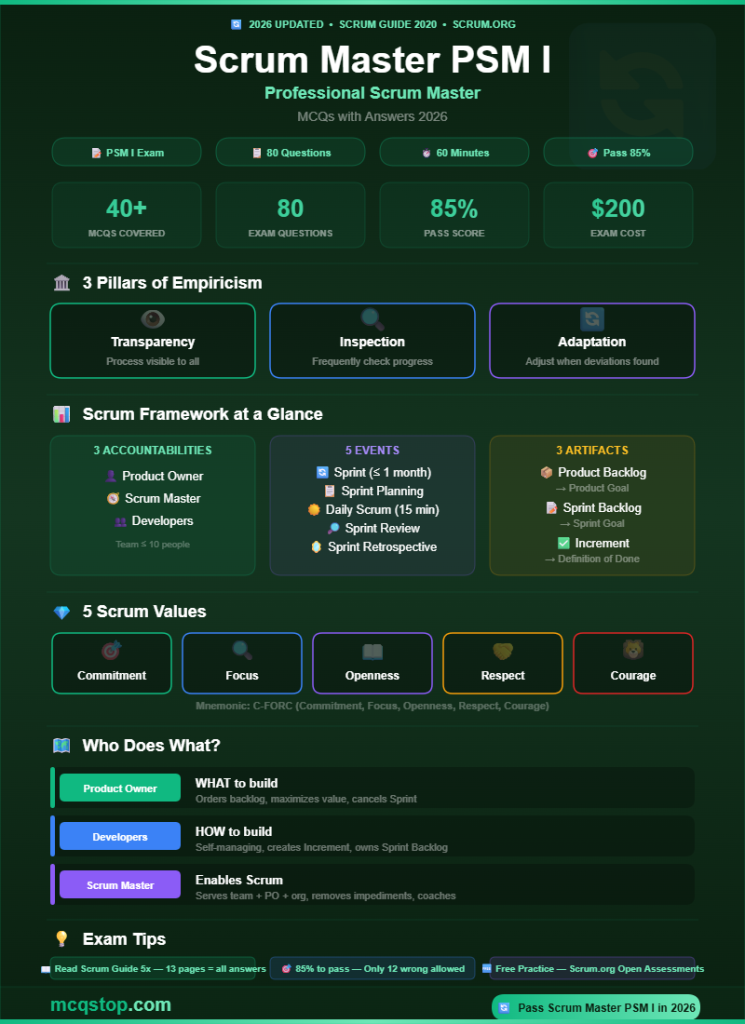
💡 Explanation: Scrum is founded on empiricism and lean thinking. Empiricism asserts that knowledge comes from experience and making decisions based on what is observed. The three pillars of empiricism are: Transparency (the process is visible to all), Inspection (frequently check progress and artifacts), and Adaptation (adjust the process when deviations are detected). These three pillars are heavily tested on PSM I.
Question 02
Which of the following are the FIVE Scrum values?
ACommitment, Focus, Openness, Respect, Courage ✅
BTransparency, Inspection, Adaptation, Respect, Trust
CSpeed, Quality, Communication, Value, Feedback
DPlan, Execute, Review, Adapt, Deliver
💡 Explanation: The five Scrum values are Commitment, Focus, Openness, Respect, and Courage (remember: C-FORC). Commitment — to achieving goals. Focus — on Sprint work. Openness — about work and challenges. Respect — team members as capable individuals. Courage — to do the right thing and work on tough problems. Option B mixes values with the three pillars. These values are directly from the Scrum Guide.
Question 03
What is the maximum recommended size of a Scrum Team according to the Scrum Guide?
A7 people
B10 or fewer people ✅
C15 people
DThere is no size limit
💡 Explanation: The Scrum Guide (2020) states the Scrum Team is “typically 10 or fewer people.” This includes the Scrum Master, Product Owner, and Developers. Smaller teams communicate better and are more productive. If teams grow too large, they should consider reorganizing into multiple cohesive Scrum Teams sharing the same Product Goal, Product Backlog, and Product Owner.
2
Scrum Team Accountabilities
Developers, Product Owner, Scrum Master
Question 04
Who is responsible for ordering the items in the Product Backlog to maximize the value delivered by the Scrum Team?
AThe Scrum Master
BThe Product Owner ✅
CThe Developers
DThe stakeholders
💡 Explanation: The Product Owner is the single person accountable for maximizing the value of the product and managing the Product Backlog. This includes ordering backlog items, ensuring the backlog is transparent and understood, and making clear what the Scrum Team will work on next. The PO is one person, not a committee — they may delegate work but remain accountable. This is one of the most frequently tested concepts.
Question 05
Who decides HOW the work will be done during a Sprint?
AThe Scrum Master
BThe Product Owner
CThe Developers ✅
DThe project manager
💡 Explanation: The Developers are self-managing — they decide how to turn Product Backlog items into Increments of value. No one (not even the Scrum Master or PO) tells the Developers how to do their work. The PO decides WHAT to build (backlog ordering), Developers decide HOW to build it. The Scrum Master serves the team as a facilitator and coach. Note: there is no “project manager” role in Scrum.
Question 06
According to the 2020 Scrum Guide, what is the Scrum Master’s primary accountability?
AAssigning tasks to Developers
BEstablishing Scrum as defined in the Scrum Guide — serving the team, PO, and organization ✅
CManaging the Product Backlog
DReporting Sprint progress to management
💡 Explanation: The Scrum Master is accountable for establishing Scrum as defined in the Scrum Guide. They do this by helping everyone understand Scrum theory and practice, serving the Scrum Team, Product Owner, and the organization. The SM is a true leader who serves — coaching, facilitating, and removing impediments. They do NOT assign tasks, manage the backlog, or report to management.
3
Scrum Events
Sprint, Planning, Daily, Review, Retro
Question 07
What is the maximum length of a Sprint in Scrum?
A2 weeks
B3 weeks
COne calendar month ✅
DThere is no maximum length
💡 Explanation: The Scrum Guide states Sprints are fixed-length events of one month or less. Shorter Sprints can be employed to generate more learning cycles and limit risk. Most teams use 2-week Sprints, but 1, 3, or 4-week Sprints are also valid. The Sprint length is consistent — once decided, it should not change from Sprint to Sprint. A new Sprint starts immediately after the previous Sprint ends.
Question 08
What is the time-box for the Daily Scrum?
A15 minutes ✅
B30 minutes
C1 hour
DAs long as needed
💡 Explanation: The Daily Scrum is a 15-minute event for the Developers (not the whole Scrum Team) held at the same time and place every working day of the Sprint. Its purpose is to inspect progress toward the Sprint Goal and adapt the Sprint Backlog as necessary. The Scrum Master is not required to attend — it’s the Developers’ event. The traditional “three questions” format is optional in the 2020 Scrum Guide.
Question 09
During which Scrum event does the Scrum Team inspect the Increment and adapt the Product Backlog based on stakeholder feedback?
ASprint Planning
BSprint Review ✅
CSprint Retrospective
DDaily Scrum
💡 Explanation: The Sprint Review is held at the end of the Sprint to inspect the Increment and adapt the Product Backlog. The Scrum Team presents what was accomplished and stakeholders provide feedback. It is a working session, NOT a presentation or status report. The Sprint Retrospective (different event) focuses on improving the team’s process. Know the difference — Review = product, Retrospective = process.
4
Scrum Artifacts & Commitments
Backlog, Sprint Backlog, Increment
Question 10
Each Scrum artifact contains a commitment. What is the commitment for the Product Backlog?
ASprint Goal
BProduct Goal ✅
CDefinition of Done
DVelocity
💡 Explanation: The 2020 Scrum Guide introduced commitments for each artifact: Product Backlog → Product Goal (the future state of the product), Sprint Backlog → Sprint Goal (the single objective for the Sprint), Increment → Definition of Done (quality standard). This artifact-commitment mapping is heavily tested on PSM I. Velocity is NOT a Scrum commitment — it’s simply a metric.
Question 11
What is the Definition of Done in Scrum?
AA list of tasks assigned to each Developer
BA formal description of the state of the Increment when it meets the quality measures required for the product ✅
CThe Product Owner’s acceptance criteria
DA burndown chart showing remaining work
💡 Explanation: The Definition of Done (DoD) is a shared understanding of what it means for work to be complete. It creates transparency and ensures the Increment meets quality standards. If the organization doesn’t have a DoD, the Scrum Team must create one. The DoD applies to every Increment — a Product Backlog item is not “Done” until it meets the DoD. It is the commitment for the Increment artifact.
5
Scrum Master in Practice
Scenarios & Situational Questions
Question 12
During the Sprint, a stakeholder asks a Developer to add an urgent feature directly. What should happen?
AThe Developer should add it immediately since it’s urgent
BThe Scrum Master should reject the request
CThe stakeholder should be directed to the Product Owner, who decides on backlog priority ✅
DThe team should hold an emergency meeting to vote
💡 Explanation: Only the Product Owner manages the Product Backlog and sets priorities. Stakeholders should never directly assign work to Developers. The correct flow is: stakeholder → Product Owner → backlog refinement → Sprint Planning. The PO can negotiate scope with Developers during the Sprint, but only the PO can change backlog priorities. This protects the team’s focus and the Sprint Goal.
Question 13
Who has the authority to cancel a Sprint?
AThe Scrum Master
BThe Product Owner ✅
CThe Developers
DThe stakeholders
💡 Explanation: Only the Product Owner has the authority to cancel a Sprint. A Sprint would be cancelled if the Sprint Goal becomes obsolete — for example, due to a major business change, technology shift, or market disruption. Sprint cancellations are rare and consume resources. If cancelled, completed “Done” items are reviewed, and the PO typically re-prioritizes remaining work for the next Sprint.
Question 14
When does a Sprint end in Scrum?
AWhen all Product Backlog items are completed
BWhen the Product Owner decides the work is sufficient
CWhen the predetermined time-box expires ✅
DWhen the team runs out of Sprint Backlog items
💡 Explanation: A Sprint always ends when its time-box expires — whether or not all planned work is completed. Sprints have a fixed duration that cannot be shortened or extended. Incomplete items return to the Product Backlog for re-prioritization. A new Sprint starts immediately after the previous one ends. This time-boxing is fundamental to Scrum’s empirical approach — it creates regular opportunities for inspection and adaptation.





Leave a Comment