
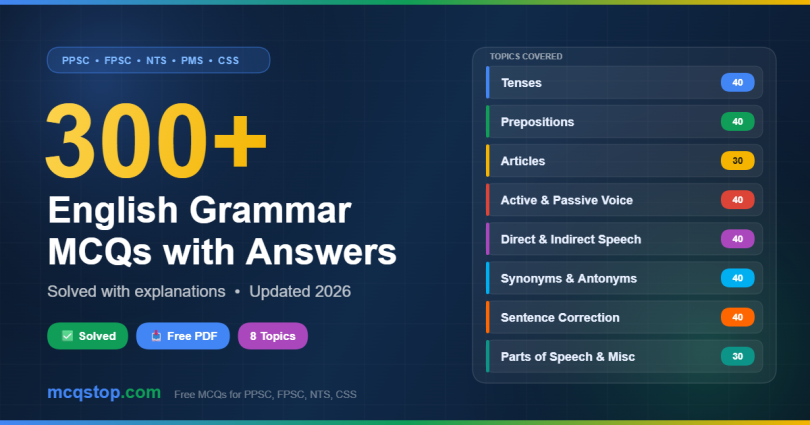
300+ English Grammar MCQs with Answers for PPSC, FPSC, NTS & CSS (2026)
Answers + explanations
PPSC
FPSC
NTS
CSS
Updated Nov 2026
Practice 300+ English grammar MCQs with answers and one-line explanations, grouped by topic exactly as they appear in PPSC, FPSC, NTS, PMS and CSS papers. Each question shows the correct option immediately below it, so you can test yourself first and then check. Download the full set as a free PDF at the end of the page.
Tenses MCQs (1–40)
Tense questions in PPSC and NTS papers usually test the present perfect, past perfect, conditionals and time-clause rules. These 40 cover those patterns.
1. She ______ to school every day.
A. go B. goes C. going D. gone
Answer: B. goes — Third-person singular in the simple present takes -s.
2. I ______ my homework when the teacher entered.
A. do B. did C. have done D. was doing
Answer: D. was doing — Past continuous shows an action in progress when another past action interrupted it.
3. By next June, he ______ his degree.
A. will complete B. completes C. will have completed D. has completed
Answer: C. will have completed — Future perfect shows completion before a future point in time.
4. If I ______ rich, I would buy a house.
A. am B. was C. be D. were
Answer: D. were — Unreal present conditions take “were” for every subject.
5. The train ______ before we reached the station.
A. left B. had left C. has left D. leaves
Answer: B. had left — Past perfect marks the earlier of two past actions.
6. Water ______ at 100°C.
A. boil B. boiled C. boils D. is boiling
Answer: C. boils — Simple present states general facts and scientific truths.
7. She has lived in Lahore ______ 2015.
A. for B. since C. from D. during
Answer: B. since — “Since” goes with a fixed starting point in time.
8. He has been working here ______ five years.
A. since B. from C. at D. for
Answer: D. for — “For” goes with a length of time.
9. I ______ him yesterday.
A. have met B. met C. meet D. had meet
Answer: B. met — “Yesterday” is a finished time, so simple past is required.
10. Look! It ______.
A. rains B. rained C. has rained D. is raining
Answer: D. is raining — “Look!” signals an action happening right now.
11. Neither of the boys ______ present.
A. were B. are C. was D. have been
Answer: C. was — “Neither of” takes a singular verb.
12. I will call you when he ______.
A. will arrive B. arrives C. arrived D. is arrived
Answer: B. arrives — Time clauses use the present tense to refer to the future.
13. I ______ here since morning.
A. am waiting B. waited C. wait D. have been waiting
Answer: D. have been waiting — Present perfect continuous shows an action continuing from the past until now.
14. She ______ for two hours when the guests arrived.
A. cooks B. had been cooking C. has cooked D. was cooked
Answer: B. had been cooking — Past perfect continuous shows duration before a past event.
15. If it rains tomorrow, we ______ the picnic.
A. cancel B. cancelled C. will cancel D. would cancel
Answer: C. will cancel — First conditional: if + present, will + base verb.
16. If he had studied, he ______ the test.
A. would pass B. will pass C. passed D. would have passed
Answer: D. would have passed — Third conditional: if + past perfect, would have + past participle.
17. I wish I ______ taller.
A. am B. were C. will be D. have been
Answer: B. were — “Wish” about an unreal present state takes “were”.
18. It is high time you ______ to bed.
A. go B. will go C. went D. gone
Answer: C. went — “It is high time” is followed by the simple past.
19. He ______ smoke, but he has quit.
A. is used to B. used to C. use to D. was use to
Answer: B. used to — “Used to” shows a past habit that no longer exists.
20. I ______ rather stay home than go out.
A. had B. should C. would D. could
Answer: C. would — “Would rather” expresses preference and takes a base verb.
21. You ______ better consult a doctor.
A. had B. have C. would D. are
Answer: A. had — “Had better” gives strong advice and takes a base verb.
22. I ______ the answer.
A. am knowing B. know C. knowing D. have been knowing
Answer: B. know — Stative verbs like “know” are not used in continuous tenses.
23. The Earth ______ around the Sun.
A. move B. is moved C. moved D. moves
Answer: D. moves — Facts that are always true take the simple present.
24. We ______ each other for ten years.
A. know B. are knowing C. have known D. knew
Answer: C. have known — A stative verb with “for” + duration takes the present perfect.
25. Hardly had he entered ______ the phone rang.
A. than B. while C. when D. then
Answer: C. when — “Hardly had… when” is the fixed pair.
26. No sooner had she left ______ it started raining.
A. than B. when C. then D. that
Answer: A. than — “No sooner… than” is the fixed correlative pair.
27. When I reached the station, the train ______.
A. already left B. has already left C. already leaves D. had already left
Answer: D. had already left — The train left before I arrived, so past perfect is needed.
28. This time next week, I ______ on a beach.
A. will lie B. will be lying C. lie D. am lying
Answer: B. will be lying — Future continuous shows an action in progress at a future moment.
29. I ______ to Murree next month.
A. go B. went C. am going D. have gone
Answer: C. am going — Present continuous expresses a fixed future plan.
30. The meeting ______ at 9 a.m. tomorrow.
A. starts B. started C. has started D. is started
Answer: A. starts — Simple present is used for timetabled future events.
31. Have you ______ your lunch yet?
A. eat B. ate C. eaten D. eating
Answer: C. eaten — Present perfect needs the past participle.
32. I thought that he ______ honest.
A. is B. was C. will be D. has been
Answer: B. was — A past main verb requires a past tense in the clause.
33. We ______ the movie already.
A. see B. saw C. are seeing D. have seen
Answer: D. have seen — “Already” usually signals the present perfect.
34. Just now, I ______ him in the market.
A. have seen B. had seen C. saw D. see
Answer: C. saw — “Just now” refers to a finished moment, so simple past is used.
35. Unless you ______ hard, you will fail.
A. will work B. worked C. are worked D. work
Answer: D. work — “Unless” clauses take the simple present for future meaning.
36. He ______ been to Dubai twice.
A. have B. has C. had D. is
Answer: B. has — “He” takes “has” in the present perfect.
37. She ______ asleep when I called her.
A. is B. were C. was D. has been
Answer: C. was — A singular subject in the past takes “was”.
38. She ______ her keys, so she cannot open the door.
A. lost B. loses C. is losing D. has lost
Answer: D. has lost — Present perfect links a past action to its present result.
39. The child ______ since morning.
A. cries B. cried C. has been crying D. is crying
Answer: C. has been crying — “Since morning” calls for the present perfect continuous.
40. As soon as the bell ______, the students left.
A. rings B. rang C. had ring D. is ringing
Answer: B. rang — Both actions are in the past, so simple past is used.
Prepositions MCQs (41–80)
Preposition questions test fixed word pairs such as “fond of” and “senior to”, plus time and place prepositions. Learn the pairs as units.
41. He is good ______ mathematics.
A. in B. on C. at D. for
Answer: C. at — “Good at” is used for skills and subjects.
42. She is afraid ______ spiders.
A. of B. from C. with D. by
Answer: A. of — “Afraid of” is the correct fixed pair.
43. He will be back ______ a week.
A. since B. for C. from D. in
Answer: D. in — “In” + a period means after that time from now.
44. He was born ______ 1998.
A. on B. at C. in D. by
Answer: C. in — “In” is used with years, months and seasons.
45. The meeting is ______ Monday.
A. in B. on C. at D. by
Answer: B. on — “On” is used with days and dates.
46. I will see you ______ 5 o’clock.
A. at B. on C. in D. by
Answer: A. at — “At” is used with exact clock times.
47. He has been ill ______ three days.
A. since B. from C. for D. at
Answer: C. for — “For” is used with a duration of time.
48. Divide the cake ______ the two children.
A. among B. between C. into D. with
Answer: B. between — “Between” is used for two persons or things.
49. The prize was distributed ______ the students.
A. between B. among C. at D. to
Answer: B. among — “Among” is used for more than two.
50. He is married ______ a doctor.
A. with B. by C. to D. from
Answer: C. to — “Married to” is the correct pair.
51. She is fond ______ music.
A. of B. in C. for D. with
Answer: A. of — “Fond of” is the fixed pair.
52. He insisted ______ going.
A. to B. for C. at D. on
Answer: D. on — “Insist on” is followed by a gerund.
53. I am looking forward ______ meeting you.
A. for B. to C. at D. on
Answer: B. to — “Look forward to” takes a gerund.
54. He died ______ cancer.
A. of B. by C. with D. through
Answer: A. of — “Die of” is used for diseases.
55. The thief was caught ______ the police.
A. from B. with C. by D. through
Answer: C. by — “By” introduces the doer in a passive sentence.
56. He is senior ______ me.
A. than B. to C. from D. over
Answer: B. to — “Senior” and “junior” take “to”, not “than”.
57. She prefers tea ______ coffee.
A. than B. from C. over D. to
Answer: D. to — “Prefer” is followed by “to”, never “than”.
58. He swam ______ the river.
A. through B. across C. along D. at
Answer: B. across — “Across” shows movement from one side to the other.
59. We reached ______ Lahore at noon.
A. to B. at C. in D. no preposition
Answer: D. no preposition — “Reach” is transitive and takes its object directly.
60. He is addicted ______ smoking.
A. to B. with C. for D. in
Answer: A. to — “Addicted to” is followed by a noun or gerund.
61. She is jealous ______ her sister.
A. with B. at C. of D. for
Answer: C. of — “Jealous of” is the correct pair.
62. He was accused ______ theft.
A. for B. of C. with D. about
Answer: B. of — “Accused of” is used for a charge.
63. The cat jumped ______ the wall.
A. at B. in C. by D. over
Answer: D. over — “Over” shows movement above and across an obstacle.
64. I have been waiting ______ you for an hour.
A. for B. to C. at D. on
Answer: A. for — “Wait for” is the correct pattern.
65. He apologised ______ his mistake.
A. of B. at C. for D. on
Answer: C. for — “Apologise for” a fault; “apologise to” a person.
66. He is angry ______ me.
A. with B. on C. to D. for
Answer: A. with — “Angry with” is used for a person.
67. The room is full ______ people.
A. with B. of C. by D. from
Answer: B. of — “Full of” is the fixed pair.
68. He congratulated me ______ my success.
A. for B. at C. with D. on
Answer: D. on — “Congratulate on” is the correct pattern.
69. The teacher is pleased ______ my work.
A. at B. for C. with D. on
Answer: C. with — “Pleased with” is used for things and people.
70. She was surprised ______ the news.
A. at B. of C. on D. for
Answer: A. at — “Surprised at” is the standard pair.
71. He is capable ______ doing it.
A. to B. of C. for D. at
Answer: B. of — “Capable of” is followed by a gerund.
72. I agree ______ you.
A. to B. on C. with D. at
Answer: C. with — “Agree with” a person; “agree to” a proposal.
73. Beware ______ pickpockets.
A. from B. against C. of D. at
Answer: C. of — “Beware of” is the correct pair.
74. He has no objection ______ the plan.
A. to B. on C. for D. against
Answer: A. to — “Objection to” is the fixed pair.
75. She is ashamed ______ her behaviour.
A. from B. of C. at D. for
Answer: B. of — “Ashamed of” is the correct pair.
76. We got ______ the bus at Anarkali.
A. off B. of C. out D. away
Answer: A. off — “Get off” is used for buses, trains and bikes.
77. He is dependent ______ his parents.
A. of B. to C. on D. from
Answer: C. on — “Dependent on” is the correct pair.
78. This shirt is different ______ that one.
A. than B. to C. with D. from
Answer: D. from — “Different from” is the standard form.
79. He is indifferent ______ criticism.
A. at B. to C. for D. with
Answer: B. to — “Indifferent to” is the fixed pair.
80. He lives ______ 25 Mall Road.
A. in B. at C. to D. by
Answer: B. at — “At” is used with a house number and street address.
Articles (a, an, the) MCQs (81–110)
Article questions depend on sound, not spelling, and on knowing when no article is needed. Watch vowel sounds and proper nouns.
81. ______ sun rises in the east.
A. a B. an C. the D. no article
Answer: C. the — “The” is used with unique things like the sun.
82. She is ______ honest girl.
A. a B. an C. the D. no article
Answer: B. an — “Honest” begins with a vowel sound because the h is silent.
83. He bought ______ umbrella.
A. a B. an C. the D. no article
Answer: B. an — “Umbrella” begins with a vowel sound.
84. ______ Pakistan is a beautiful country.
A. a B. an C. the D. no article
Answer: D. no article — Names of countries usually take no article.
85. ______ Indus is the longest river in Pakistan.
A. a B. an C. the D. no article
Answer: C. the — Names of rivers take “the”.
86. He is ______ university student.
A. a B. an C. the D. no article
Answer: A. a — “University” starts with a “yoo” consonant sound.
87. I saw ______ one-eyed man.
A. a B. an C. the D. no article
Answer: A. a — “One” starts with a “w” consonant sound.
88. He waited for ______ hour.
A. a B. an C. the D. no article
Answer: B. an — The h in “hour” is silent, so it starts with a vowel sound.
89. ______ poor are not always unhappy.
A. a B. an C. the D. no article
Answer: C. the — “The” + adjective refers to a whole group of people.
90. Ali is ______ M.A.
A. a B. an C. the D. no article
Answer: B. an — “M” is pronounced “em”, which starts with a vowel sound.
91. Honesty is ______ best policy.
A. a B. an C. the D. no article
Answer: C. the — A superlative takes “the”.
92. She plays ______ piano.
A. a B. an C. the D. no article
Answer: C. the — “The” is used with musical instruments.
93. He plays ______ cricket every evening.
A. a B. an C. the D. no article
Answer: D. no article — Names of games take no article.
94. ______ Himalayas are the highest mountains.
A. a B. an C. the D. no article
Answer: C. the — Mountain ranges take “the”.
95. Please give me ______ glass of water.
A. a B. an C. the D. no article
Answer: A. a — “Glass” is a singular countable noun starting with a consonant sound.
96. He is ______ European.
A. a B. an C. the D. no article
Answer: A. a — “European” starts with a “yoo” consonant sound.
97. What ______ beautiful day!
A. a B. an C. the D. no article
Answer: A. a — Exclamations with “what” take “a” before singular countable nouns.
98. She is ______ most intelligent girl in the class.
A. a B. an C. the D. no article
Answer: C. the — “Most” in a superlative requires “the”.
99. ______ Quran is the holy book of Muslims.
A. a B. an C. the D. no article
Answer: C. the — Names of holy books take “the”.
100. The children go to ______ school at 8 a.m.
A. a B. an C. the D. no article
Answer: D. no article — “School” used for its main purpose takes no article.
101. My father is ______ engineer.
A. a B. an C. the D. no article
Answer: B. an — “Engineer” begins with a vowel sound.
102. ______ Mount Everest is the highest peak in the world.
A. a B. an C. the D. no article
Answer: D. no article — Single mountain peaks take no article.
103. She is ______ unique person.
A. a B. an C. the D. no article
Answer: A. a — “Unique” starts with a “yoo” consonant sound.
104. ______ Ravi flows through Lahore.
A. a B. an C. the D. no article
Answer: C. the — River names take “the”.
105. Gold is ______ precious metal.
A. a B. an C. the D. no article
Answer: A. a — “Precious metal” is a singular countable phrase starting with a consonant sound.
106. He has ______ MBA degree.
A. a B. an C. the D. no article
Answer: B. an — “M” is pronounced “em”, a vowel sound.
107. Once upon ______ time there lived a king.
A. a B. an C. the D. no article
Answer: A. a — “Once upon a time” is a fixed phrase.
108. He is ______ only son of his parents.
A. a B. an C. the D. no article
Answer: C. the — “Only” makes the noun specific, so “the” is used.
109. I read ______ Dawn every morning.
A. a B. an C. the D. no article
Answer: C. the — Newspaper names take “the”.
110. Lahore is ______ old city.
A. a B. an C. the D. no article
Answer: B. an — “Old” begins with a vowel sound.
Next: Active and Passive Voice MCQs →
Active and Passive Voice MCQs (111–150)
Voice questions ask you to convert a sentence while keeping its tense. Identify the tense first, then build the passive with the right form of “be”.
111. Change into passive: “She writes a letter.”
A. A letter is written by her. B. A letter was written by her. C. A letter has written her. D. A letter is being written by her.
Answer: A. A letter is written by her. — Simple present passive uses “is/are + past participle”.
112. Change into passive: “They are building a bridge.”
A. A bridge is built by them. B. A bridge was being built by them. C. A bridge is being built by them. D. A bridge has been built by them.
Answer: C. A bridge is being built by them. — Present continuous passive uses “is/are being + past participle”.
113. Change into passive: “He has finished the work.”
A. The work is finished by him. B. The work has been finished by him. C. The work had been finished by him. D. The work was finished by him.
Answer: B. The work has been finished by him. — Present perfect passive uses “has/have been + past participle”.
114. Change into passive: “The teacher punished the boy.”
A. The boy is punished by the teacher. B. The boy has been punished by the teacher. C. The boy was punished by the teacher. D. The boy punished the teacher.
Answer: C. The boy was punished by the teacher. — Simple past passive uses “was/were + past participle”.
115. Change into passive: “Who wrote this book?”
A. Who was this book written by? B. By whom this book was written? C. By whom was this book written? D. Whom was this book written?
Answer: C. By whom was this book written? — “Who” becomes “By whom” with correct question word order.
116. Change into passive: “Open the door.”
A. The door is opened. B. Let the door be opened. C. The door should open. D. Door be opened by you.
Answer: B. Let the door be opened. — Imperatives become passive with “Let + object + be + past participle”.
117. Change into passive: “I will complete the project.”
A. The project will be completed by me. B. The project is completed by me. C. The project would complete by me. D. The project will have completed by me.
Answer: A. The project will be completed by me. — Future passive uses “will be + past participle”.
118. Change into passive: “She was singing a song.”
A. A song was sung by her. B. A song is being sung by her. C. A song was being sung by her. D. A song had been sung by her.
Answer: C. A song was being sung by her. — Past continuous passive uses “was/were being + past participle”.
119. Change into passive: “Do you know him?”
A. Is he known by you? B. Was he known to you? C. Does he know you? D. Is he known to you?
Answer: D. Is he known to you? — “Know” takes “to” in the passive.
120. Change into passive: “He had cooked the meal.”
A. The meal had been cooked by him. B. The meal has been cooked by him. C. The meal was cooked by him. D. The meal had cooked by him.
Answer: A. The meal had been cooked by him. — Past perfect passive uses “had been + past participle”.
121. Change into active: “The thief was caught by the police.”
A. The police catch the thief. B. The police had caught the thief. C. The thief caught the police. D. The police caught the thief.
Answer: D. The police caught the thief. — Keep the simple past tense when converting back to active.
122. Change into active: “The letter has been posted by Ali.”
A. Ali has posted the letter. B. Ali posted the letter. C. Ali had posted the letter. D. Ali is posting the letter.
Answer: A. Ali has posted the letter. — “Has been posted” converts to “has posted”.
123. Change into passive: “Why did you break the window?”
A. Why the window was broken by you? B. Why was the window broken by you? C. Why did the window break by you? D. Why is the window broken by you?
Answer: B. Why was the window broken by you? — Simple past question uses “was + subject + past participle”.
124. Change into passive: “Everybody loves a good teacher.”
A. A good teacher is loved by everybody. B. A good teacher was loved by everybody. C. Everybody is loved by a good teacher. D. A good teacher loves everybody.
Answer: A. A good teacher is loved by everybody. — Simple present passive keeps the present tense.
125. Change into passive: “Nobody can solve this problem.”
A. This problem can be solved by nobody. B. This problem cannot be solved by anybody. C. This problem is not solved by anybody. D. This problem could not solve.
Answer: B. This problem cannot be solved by anybody. — A negative subject becomes “not… by anybody”.
126. Change into passive: “They made him captain.”
A. He is made captain by them. B. He had made captain by them. C. He was made captain by them. D. Captain was made by them.
Answer: C. He was made captain by them. — The first object becomes the subject; the complement stays.
127. Change into passive: “People say that he is rich.”
A. It is said that he is rich. B. It was said that he is rich. C. He is said rich. D. It says that he is rich.
Answer: A. It is said that he is rich. — Opinion reports use the impersonal “It is said that…”.
128. Change into passive: “She must finish the task.”
A. The task must finish by her. B. The task must have been finished by her. C. The task is finished by her. D. The task must be finished by her.
Answer: D. The task must be finished by her. — Modals take “modal + be + past participle”.
129. Change into passive: “He is writing a novel.”
A. A novel is being written by him. B. A novel is written by him. C. A novel was being written by him. D. A novel has been written by him.
Answer: A. A novel is being written by him. — Present continuous passive uses “is being + past participle”.
130. Change into passive: “The boys played cricket.”
A. Cricket is played by the boys. B. Cricket has been played by the boys. C. Cricket had been played by the boys. D. Cricket was played by the boys.
Answer: D. Cricket was played by the boys. — Simple past passive uses “was + past participle”.
131. Change into passive: “I know her.”
A. She is known to me. B. She is known by me. C. She was known to me. D. She knows me.
Answer: A. She is known to me. — “Know” takes “to” in the passive.
132. Change into active: “The cat was chased by the dog.”
A. The dog chases the cat. B. The dog chased the cat. C. The cat chased the dog. D. The dog had chased the cat.
Answer: B. The dog chased the cat. — Simple past passive becomes simple past active.
133. Change into passive: “Shut the window.”
A. The window is shut. B. The window should shut. C. Let the window be shut. D. Shut be the window.
Answer: C. Let the window be shut. — Commands use “Let + object + be + past participle”.
134. Change into passive: “He gave me a book.”
A. A book is given to me by him. B. I was given a book by him. C. I gave a book by him. D. I am given a book by him.
Answer: B. I was given a book by him. — The indirect object can become the subject of the passive.
135. Change into passive: “Someone has stolen my bike.”
A. My bike is stolen. B. My bike was stolen. C. My bike has been stolen. D. My bike had stolen.
Answer: C. My bike has been stolen. — “By someone” is dropped when the doer is unknown.
136. Change into passive: “The audience welcomed the speaker.”
A. The speaker was welcomed by the audience. B. The speaker is welcomed by the audience. C. The speaker had been welcomed by the audience. D. The speaker welcomed the audience.
Answer: A. The speaker was welcomed by the audience. — Simple past passive.
137. Change into passive: “We should obey our parents.”
A. Our parents should obey us. B. Our parents are obeyed by us. C. Our parents should be obeyed by us. D. Our parents should have obeyed by us.
Answer: C. Our parents should be obeyed by us. — “Should” + “be” + past participle.
138. Change into passive: “She is teaching us grammar.”
A. We are taught grammar by her. B. We were being taught grammar by her. C. Grammar is being taught us by her. D. We are being taught grammar by her.
Answer: D. We are being taught grammar by her. — Present continuous passive with the indirect object as subject.
139. Change into passive: “The mother was kissing the baby.”
A. The baby was kissed by the mother. B. The baby is being kissed by the mother. C. The baby was being kissed by the mother. D. The baby had been kissed by the mother.
Answer: C. The baby was being kissed by the mother. — Past continuous passive.
140. Change into passive: “The police have arrested the robber.”
A. The robber was arrested by the police. B. The robber has been arrested by the police. C. The robber is arrested by the police. D. The robber had been arrested by the police.
Answer: B. The robber has been arrested by the police. — Present perfect passive.
141. “The work will have been completed by Friday.” Which tense and voice is this?
A. Future perfect passive B. Future continuous passive C. Simple future passive D. Present perfect passive
Answer: A. Future perfect passive — “Will have been + past participle” is future perfect passive.
142. In the passive voice, the object of the active sentence becomes the ______.
A. verb B. subject C. adverb D. complement
Answer: B. subject — The receiver of the action moves to subject position.
143. The passive voice is formed using ______.
A. have + base verb B. be + present participle C. a form of be + past participle D. do + past participle
Answer: C. a form of be + past participle — Every passive needs a form of “be” plus the past participle.
144. Change into passive: “He does not like tea.”
A. Tea is not liked by him. B. Tea does not like him. C. Tea was not liked by him. D. Tea is liked not by him.
Answer: A. Tea is not liked by him. — Negative simple present passive: “is/are not + past participle”.
145. Change into passive: “Did she write the essay?”
A. Was the essay wrote by her? B. Is the essay written by her? C. Did the essay written by her? D. Was the essay written by her?
Answer: D. Was the essay written by her? — Simple past question: “Was + object + past participle”.
146. Change into passive: “I cannot do this.”
A. This cannot be done by me. B. This cannot do by me. C. This is not done by me. D. This could not be done by me.
Answer: A. This cannot be done by me. — “Cannot” stays and adds “be + past participle”.
147. Change into passive: “They will not accept the offer.”
A. The offer will not accept by them. B. The offer is not accepted by them. C. The offer would not be accepted by them. D. The offer will not be accepted by them.
Answer: D. The offer will not be accepted by them. — Negative future passive: “will not be + past participle”.
148. Which sentence is in the passive voice?
A. Ali ate the apple. B. The apple was eaten by Ali. C. Ali is eating an apple. D. Ali will eat the apple.
Answer: B. The apple was eaten by Ali. — The subject receives the action.
149. Change into active: “The match was won by Pakistan.”
A. Pakistan wins the match. B. Pakistan has won the match. C. Pakistan won the match. D. Pakistan was winning the match.
Answer: C. Pakistan won the match. — Simple past passive converts to simple past active.
150. Change into active: “A new road is being built by the government.”
A. The government is building a new road. B. The government built a new road. C. The government builds a new road. D. The government has built a new road.
Answer: A. The government is building a new road. — “Is being built” converts to “is building”.
Next: Direct and Indirect Speech MCQs →
Direct and Indirect Speech MCQs (151–190)
Narration questions test tense backshift, pronoun changes, time words and the right reporting verb. Apply the rules in that order.
151. Change into indirect: He said, “I am happy.”
A. He said that he is happy. B. He said that he was happy. C. He said that I was happy. D. He said that he had been happy.
Answer: B. He said that he was happy. — Present simple shifts to past simple after a past reporting verb.
152. Change into indirect: She said, “I will go tomorrow.”
A. She said that she will go tomorrow. B. She said that she would go tomorrow. C. She said that she would go the next day. D. She said that she went the next day.
Answer: C. She said that she would go the next day. — “Will” becomes “would” and “tomorrow” becomes “the next day”.
153. Change into indirect: He said to me, “Where do you live?”
A. He asked me where I lived. B. He asked me where did I live. C. He asked me where do I live. D. He told me where I lived.
Answer: A. He asked me where I lived. — Questions use “asked” and statement word order.
154. Change into indirect: The teacher said, “Honesty is the best policy.”
A. The teacher said that honesty was the best policy. B. The teacher said that honesty had been the best policy. C. The teacher said that honesty is the best policy. D. The teacher said honesty is best.
Answer: C. The teacher said that honesty is the best policy. — Universal truths keep the present tense.
155. Change into indirect: She said, “I have finished my work.”
A. She said that she had finished her work. B. She said that she has finished her work. C. She said that she finished her work. D. She said that she finished my work.
Answer: A. She said that she had finished her work. — Present perfect shifts to past perfect.
156. Change into indirect: He said to her, “Please help me.”
A. He told her that she helps him. B. He asked her to help me. C. He requested her to help him. D. He said her to help him.
Answer: C. He requested her to help him. — “Please” signals a request, so use “requested”.
157. Change into indirect: “Shut the door,” he said to me.
A. He asked me that I shut the door. B. He ordered me to shut the door. C. He said me to shut the door. D. He told that I shut the door.
Answer: B. He ordered me to shut the door. — Commands use “ordered + to + base verb”.
158. Change into indirect: She said, “Alas! I am ruined.”
A. She exclaimed sadly that she was ruined. B. She said that alas she was ruined. C. She said with sorrow that I am ruined. D. She exclaimed that she is ruined.
Answer: A. She exclaimed sadly that she was ruined. — Exclamations use “exclaimed” with the emotion described.
159. Change into indirect: He said, “Wow! What a beautiful scene!”
A. He said that wow what a beautiful scene. B. He exclaimed with joy that it was a very beautiful scene. C. He asked what a beautiful scene it was. D. He told that the scene is beautiful.
Answer: B. He exclaimed with joy that it was a very beautiful scene. — “Wow” shows joy; the exclamation becomes a statement.
160. Change into indirect: “Do you like tea?” she asked him.
A. She asked him that he liked tea. B. She asked him did he like tea. C. She asked him if he liked tea. D. She asked him whether does he like tea.
Answer: C. She asked him if he liked tea. — Yes/no questions use “if” or “whether”.
161. Change into indirect: He said, “I was playing cricket.”
A. He said that he was playing cricket. B. He said that he had been playing cricket. C. He said that he played cricket. D. He said that he is playing cricket.
Answer: B. He said that he had been playing cricket. — Past continuous shifts to past perfect continuous.
162. Change into indirect: “Let us go for a walk,” said Ali.
A. Ali said that let us go for a walk. B. Ali ordered that they go for a walk. C. Ali asked to go for a walk. D. Ali proposed that they should go for a walk.
Answer: D. Ali proposed that they should go for a walk. — “Let us” is a suggestion, reported with “proposed that… should”.
163. Change into indirect: She said, “I can swim.”
A. She said that she can swim. B. She said that she could swim. C. She said that she would swim. D. She said that she had swum.
Answer: B. She said that she could swim. — “Can” becomes “could”.
164. Change into indirect: He said, “I may come.”
A. He said that he might come. B. He said that he may come. C. He said that he would come. D. He said that he must come.
Answer: A. He said that he might come. — “May” becomes “might”.
165. Change into indirect: The mother said, “The sun rises in the east.”
A. The mother said that the sun rose in the east. B. The mother said that the sun had risen in the east. C. The mother said that the sun rises in the east. D. The mother told that sun is rising.
Answer: C. The mother said that the sun rises in the east. — Scientific facts do not change tense.
166. In indirect speech, “today” usually changes to ______.
A. that day B. the next day C. the previous day D. then
Answer: A. that day — “Today” becomes “that day” in reported speech.
167. In indirect speech, “tomorrow” usually changes to ______.
A. that day B. the previous day C. the next day D. then
Answer: C. the next day — “Tomorrow” becomes “the next day” or “the following day”.
168. In indirect speech, “yesterday” usually changes to ______.
A. the next day B. the previous day C. that day D. before
Answer: B. the previous day — “Yesterday” becomes “the previous day” or “the day before”.
169. In indirect speech, “here” usually changes to ______.
A. there B. here C. then D. that
Answer: A. there — “Here” becomes “there” in reported speech.
170. In indirect speech, “now” usually changes to ______.
A. there B. that C. then D. before
Answer: C. then — “Now” becomes “then”.
171. In indirect speech, “this” usually changes to ______.
A. these B. that C. there D. it
Answer: B. that — “This” becomes “that” in reported speech.
172. In indirect speech, “ago” usually changes to ______.
A. before B. back C. earlier today D. since
Answer: A. before — “Two days ago” becomes “two days before”.
173. Change into indirect: She said to him, “Why are you late?”
A. She asked him why was he late. B. She asked him why he was late. C. She told him why he is late. D. She asked him that why he was late.
Answer: B. She asked him why he was late. — Wh-questions keep the wh-word and use statement word order.
174. Change into indirect: He said to them, “Good morning.”
A. He said them good morning. B. He told them good morning. C. He wished them good morning. D. He asked them good morning.
Answer: C. He wished them good morning. — Greetings are reported with “wished”.
175. Change into indirect: She said to me, “May you succeed!”
A. She prayed that I might succeed. B. She said that I may succeed. C. She ordered me to succeed. D. She asked that I succeeded.
Answer: A. She prayed that I might succeed. — Wishes and blessings are reported with “prayed” and “might”.
176. Change into indirect: “Don’t make a noise,” said the teacher.
A. The teacher said that do not make a noise. B. The teacher forbade them to make a noise. C. The teacher asked them not making a noise. D. The teacher told that they don’t make noise.
Answer: B. The teacher forbade them to make a noise. — Negative commands use “forbade” or “ordered… not to”.
177. Change into indirect: He said, “I must go now.”
A. He said that he must go now. B. He said that he should go now. C. He said that he had to go then. D. He said that he would go now.
Answer: C. He said that he had to go then. — “Must” becomes “had to” and “now” becomes “then”.
178. Change into indirect: He said to me, “I will help you.”
A. He told me that he would help me. B. He told me that he will help you. C. He said me that he would help you. D. He told that I would help him.
Answer: A. He told me that he would help me. — “Told” is used with a listener; “you” becomes “me”.
179. Change into indirect: They said, “We are winning.”
A. They said that we were winning. B. They said that they are winning. C. They said that they were winning. D. They said that they had been winning.
Answer: C. They said that they were winning. — Present continuous shifts to past continuous.
180. Change into indirect: She said to me, “What are you doing?”
A. She asked me what I was doing. B. She asked me what was I doing. C. She asked me what I am doing. D. She told me what I was doing.
Answer: A. She asked me what I was doing. — Statement word order and backshift are both required.
181. Change into indirect: He said, “Where is my pen?”
A. He asked where was his pen. B. He asked where his pen is. C. He asked where his pen was. D. He said where his pen was.
Answer: C. He asked where his pen was. — The verb follows the subject and shifts to the past.
182. Change into indirect: The boy said, “I did it.”
A. The boy said that he did it. B. The boy said that he had done it. C. The boy said that I had done it. D. The boy said that he does it.
Answer: B. The boy said that he had done it. — Simple past shifts to past perfect.
183. Change into indirect: He says, “I am busy.”
A. He says that he is busy. B. He says that he was busy. C. He said that he was busy. D. He says that he had been busy.
Answer: A. He says that he is busy. — A present reporting verb needs no tense change.
184. Change into indirect: He said, “It is raining.”
A. He said that it is raining. B. He said that it rained. C. He said that it had rained. D. He said that it was raining.
Answer: D. He said that it was raining. — Present continuous shifts to past continuous.
185. Change into indirect: The teacher said to the students, “Work hard.”
A. The teacher said that they work hard. B. The teacher advised the students to work hard. C. The teacher asked if the students work hard. D. The teacher told the students working hard.
Answer: B. The teacher advised the students to work hard. — A mild command is reported with “advised + to”.
186. Change into indirect: “Can you help me?” he asked her.
A. He asked her that she could help him. B. He asked her can she help him. C. He asked her if she could help him. D. He asked her if she can help me.
Answer: C. He asked her if she could help him. — Yes/no question: “if” + backshift + pronoun change.
187. Change into indirect: She said, “I saw him yesterday.”
A. She said that she saw him yesterday. B. She said that she had seen him the previous day. C. She said that she has seen him the day before. D. She said that I saw him the next day.
Answer: B. She said that she had seen him the previous day. — Past perfect and “the previous day” are both required.
188. Change into indirect: He said to me, “Bravo! You have won.”
A. He applauded me, saying that I had won. B. He said bravo that I had won. C. He told me that you have won. D. He asked me if I had won.
Answer: A. He applauded me, saying that I had won. — “Bravo” shows applause, and “you” becomes “I”.
189. Which reporting verb best suits a sentence of command?
A. asked B. exclaimed C. ordered D. prayed
Answer: C. ordered — Commands are reported with “ordered” or “commanded”.
190. Change into indirect: He said, “I have no money.”
A. He said that he has no money. B. He said that he had no money. C. He said that I had no money. D. He said that he did not have a money.
Answer: B. He said that he had no money. — Present simple “have” shifts to past “had”.
Next: Synonyms and Antonyms MCQs →
Synonyms and Antonyms MCQs (191–230)
Vocabulary questions in competitive exams reward word families. These 40 are different words from our main vocabulary page: 20 synonyms first, then 20 antonyms.
191. Synonym of “Abandon”:
A. Keep B. Protect C. Claim D. Desert
Answer: D. Desert — To abandon means to leave behind completely.
192. Synonym of “Candid”:
A. Secretive B. Frank C. Rude D. Shy
Answer: B. Frank — A candid person speaks honestly and openly.
193. Synonym of “Diligent”:
A. Careless B. Lazy C. Weak D. Hardworking
Answer: D. Hardworking — Diligent means showing careful and persistent effort.
194. Synonym of “Elated”:
A. Depressed B. Angry C. Overjoyed D. Tired
Answer: C. Overjoyed — Elated means extremely happy and proud.
195. Synonym of “Frugal”:
A. Wasteful B. Rich C. Greedy D. Thrifty
Answer: D. Thrifty — Frugal means careful about spending money.
196. Synonym of “Hostile”:
A. Friendly B. Helpful C. Unfriendly D. Calm
Answer: C. Unfriendly — Hostile describes an opposing or aggressive attitude.
197. Synonym of “Meagre”:
A. Abundant B. Fresh C. Heavy D. Scanty
Answer: D. Scanty — Meagre means small in quantity and inadequate.
198. Synonym of “Obstinate”:
A. Flexible B. Gentle C. Stubborn D. Weak
Answer: C. Stubborn — Obstinate means refusing to change one’s opinion.
199. Synonym of “Prudent”:
A. Reckless B. Careless C. Foolish D. Wise
Answer: D. Wise — Prudent means acting with care and good judgment.
200. Synonym of “Rebuke”:
A. Praise B. Scold C. Reward D. Ignore
Answer: B. Scold — To rebuke is to criticise someone sharply.
201. Synonym of “Serene”:
A. Noisy B. Angry C. Calm D. Busy
Answer: C. Calm — Serene means peaceful and untroubled.
202. Synonym of “Tedious”:
A. Exciting B. Quick C. Easy D. Boring
Answer: D. Boring — Tedious means long, slow and tiresome.
203. Synonym of “Vivid”:
A. Dull B. Faint C. Vibrant D. Vague
Answer: C. Vibrant — Vivid means bright, strong and full of life.
204. Synonym of “Eminent”:
A. Unknown B. Distinguished C. Ordinary D. Humble
Answer: B. Distinguished — Eminent means famous and respected in a field.
205. Synonym of “Fragile”:
A. Strong B. Heavy C. Solid D. Delicate
Answer: D. Delicate — Fragile means easily broken or damaged.
206. Synonym of “Genuine”:
A. Fake B. Authentic C. Cheap D. False
Answer: B. Authentic — Genuine means real and not an imitation.
207. Synonym of “Humble”:
A. Proud B. Rich C. Modest D. Loud
Answer: C. Modest — Humble means not proud or boastful.
208. Synonym of “Inevitable”:
A. Avoidable B. Doubtful C. Rare D. Unavoidable
Answer: D. Unavoidable — Inevitable means certain to happen.
209. Synonym of “Lucid”:
A. Confusing B. Dark C. Complex D. Clear
Answer: D. Clear — Lucid means easy to understand or clearly expressed.
210. Synonym of “Reluctant”:
A. Eager B. Ready C. Unwilling D. Keen
Answer: C. Unwilling — Reluctant means hesitant to do something.
211. Antonym of “Ancient”:
A. Old B. Modern C. Historic D. Classic
Answer: B. Modern — Ancient means very old; modern means of the present time.
212. Antonym of “Arrogant”:
A. Proud B. Rude C. Strong D. Humble
Answer: D. Humble — Arrogant means overly proud; humble means modest.
213. Antonym of “Barren”:
A. Dry B. Fertile C. Empty D. Poor
Answer: B. Fertile — Barren land cannot grow crops; fertile land can.
214. Antonym of “Brave”:
A. Bold B. Strong C. Fearless D. Cowardly
Answer: D. Cowardly — A coward lacks courage; a brave person has it.
215. Antonym of “Generous”:
A. Kind B. Stingy C. Wealthy D. Honest
Answer: B. Stingy — Stingy means unwilling to give or spend.
216. Antonym of “Expand”:
A. Grow B. Stretch C. Contract D. Spread
Answer: C. Contract — To expand is to grow bigger; to contract is to shrink.
217. Antonym of “Victory”:
A. Defeat B. Success C. Triumph D. Gain
Answer: A. Defeat — Victory means winning; defeat means losing.
218. Antonym of “Temporary”:
A. Brief B. Permanent C. Short D. Quick
Answer: B. Permanent — Temporary lasts a short time; permanent lasts indefinitely.
219. Antonym of “Scarce”:
A. Rare B. Little C. Limited D. Abundant
Answer: D. Abundant — Scarce means in short supply; abundant means plentiful.
220. Antonym of “Optimist”:
A. Pessimist B. Realist C. Idealist D. Dreamer
Answer: A. Pessimist — An optimist expects good outcomes; a pessimist expects bad ones.
221. Antonym of “Transparent”:
A. Clear B. Thin C. Opaque D. Bright
Answer: C. Opaque — Transparent lets light through; opaque does not.
222. Antonym of “Accept”:
A. Reject B. Admit C. Receive D. Agree
Answer: A. Reject — To accept is to take; to reject is to refuse.
223. Antonym of “Ascend”:
A. Climb B. Rise C. Mount D. Descend
Answer: D. Descend — Ascend means to go up; descend means to go down.
224. Antonym of “Hasty”:
A. Quick B. Cautious C. Rash D. Eager
Answer: B. Cautious — Hasty means done too quickly; cautious means careful.
225. Antonym of “Voluntary”:
A. Optional B. Free C. Compulsory D. Willing
Answer: C. Compulsory — Voluntary is by choice; compulsory is required.
226. Antonym of “Hatred”:
A. Anger B. Dislike C. Envy D. Love
Answer: D. Love — Hatred is intense dislike; love is its opposite.
227. Antonym of “Cheap”:
A. Costly B. Free C. Low D. Common
Answer: A. Costly — Cheap means low in price; costly means high in price.
228. Antonym of “Shallow”:
A. Narrow B. Deep C. Wide D. Flat
Answer: B. Deep — Shallow means not deep; deep is the direct opposite.
229. Antonym of “Rapid”:
A. Swift B. Quick C. Fast D. Slow
Answer: D. Slow — Rapid means fast; slow is the opposite.
230. Antonym of “Guilty”:
A. Innocent B. Blamed C. Wrong D. Sorry
Answer: A. Innocent — Guilty means responsible for a wrong; innocent means not responsible.
Want more vocabulary practice? See our full Synonyms and Antonyms MCQs page.
Next: Sentence Correction and Error Spotting MCQs →
Sentence Correction and Error Spotting MCQs (231–270)
In each question, find the part of the sentence that contains the error. If the sentence is correct, choose “No error”. Subject–verb agreement is the most tested rule.
231. Find the error: “Each of the students have submitted the assignment.”
A. Each of B. have submitted C. the assignment D. No error
Answer: B. have submitted — “Each” is singular, so the verb should be “has submitted”.
232. Find the error: “The furniture are very expensive.”
A. The furniture B. are C. very expensive D. No error
Answer: B. are — “Furniture” is uncountable and takes the singular verb “is”.
233. Find the error: “He gave me many advices.”
A. He gave me B. many advices C. No error D. He gave
Answer: B. many advices — “Advice” is uncountable; use “much advice” or “a lot of advice”.
234. Find the error: “She is more cleverer than her sister.”
A. She is B. more cleverer C. than her sister D. No error
Answer: B. more cleverer — Never use “more” with an adjective already in comparative form.
235. Find the error: “I have been knowing him for years.”
A. I have been knowing B. him C. for years D. No error
Answer: A. I have been knowing — “Know” is stative, so use “have known”.
236. Find the error: “Neither Ali nor his brothers is coming.”
A. Neither Ali B. nor his brothers C. is coming D. No error
Answer: C. is coming — The verb agrees with the nearer subject “brothers”, so use “are”.
237. Find the error: “Hardly he had left when the phone rang.”
A. Hardly he had left B. when C. the phone rang D. No error
Answer: A. Hardly he had left — After “Hardly”, the auxiliary comes first: “Hardly had he left”.
238. Find the error: “One of my friends are a doctor.”
A. One of my friends B. are C. a doctor D. No error
Answer: B. are — “One” is the subject, so the verb must be “is”.
239. Find the error: “The number of students are increasing.”
A. The number of students B. are C. increasing D. No error
Answer: B. are — “The number of” takes a singular verb; “A number of” takes plural.
240. Find the error: “Between you and I, this is a secret.”
A. Between B. you and I C. this is a secret D. No error
Answer: B. you and I — A preposition takes the object form: “you and me”.
241. Find the error: “Me and my friend went to the market.”
A. Me and my friend B. went C. to the market D. No error
Answer: A. Me and my friend — A subject needs the subject form: “My friend and I”.
242. Find the error: “She said me that she was ill.”
A. She said me B. that C. she was ill D. No error
Answer: A. She said me — “Say” does not take a direct listener; use “told me”.
243. Find the error: “He did not came yesterday.”
A. He did not B. came C. yesterday D. No error
Answer: B. came — After “did not”, the base form “come” is used.
244. Find the error: “I am agree with you.”
A. I am agree B. with you C. No error D. I am
Answer: A. I am agree — “Agree” is a verb, so say “I agree”.
245. Find the error: “The teacher, along with the students, are coming.”
A. The teacher B. along with the students C. are coming D. No error
Answer: C. are coming — “Along with” does not change the subject; the verb should be “is”.
246. Find the error: “Mathematics are my favourite subject.”
A. Mathematics B. are C. my favourite subject D. No error
Answer: B. are — Subject names ending in -ics take a singular verb.
247. Find the error: “He is the best of all other boys.”
A. He is B. the best C. of all other boys D. No error
Answer: C. of all other boys — A superlative compares with the whole group: “of all the boys”.
248. Find the error: “The committee has announced its decision.”
A. The committee B. has announced C. its decision D. No error
Answer: D. No error — A committee acting as one unit takes a singular verb and “its”.
249. Find the error: “Two years is a long time.”
A. Two years B. is C. a long time D. No error
Answer: D. No error — A period of time is treated as one unit, so a singular verb is correct.
250. Find the error: “She is one of the best student in the class.”
A. She is B. one of the best student C. in the class D. No error
Answer: B. one of the best student — “One of the” needs a plural noun: “best students”.
251. Find the error: “If I would have known, I would have helped.”
A. If I would have known B. I would have helped C. No error D. If I
Answer: A. If I would have known — Use the past perfect in the if-clause: “If I had known”.
252. Find the error: “He is working here since 2019.”
A. He is working B. here C. since 2019 D. No error
Answer: A. He is working — “Since” needs the present perfect continuous: “has been working”.
253. Find the error: “The scenery of Hunza are beautiful.”
A. The scenery B. of Hunza C. are beautiful D. No error
Answer: C. are beautiful — “Scenery” is uncountable and takes “is”.
254. Find the error: “I want that you should go.”
A. I want B. that you should go C. No error D. I want that
Answer: B. that you should go — “Want” takes an object + infinitive: “I want you to go”.
255. Find the error: “She cannot but to laugh.”
A. She cannot B. but to laugh C. No error D. She
Answer: B. but to laugh — “Cannot but” is followed by a bare verb: “cannot but laugh”.
256. Find the error: “I enjoyed on the trip.”
A. I enjoyed B. on the trip C. No error D. I
Answer: B. on the trip — “Enjoy” is transitive and needs no preposition.
257. Find the error: “He explained me the problem.”
A. He explained me B. the problem C. No error D. He
Answer: A. He explained me — Use “explained the problem to me”.
258. Find the error: “The police has arrested the thief.”
A. The police B. has arrested C. the thief D. No error
Answer: B. has arrested — “Police” is always plural, so use “have arrested”.
259. Find the error: “A large number of people was present.”
A. A large number of B. people C. was present D. No error
Answer: C. was present — “A large number of” takes a plural verb: “were present”.
260. Find the error: “Many a student have failed.”
A. Many a student B. have failed C. No error D. Many
Answer: B. have failed — “Many a” is followed by a singular noun and singular verb: “has failed”.
261. Find the error: “He as well as his brothers are honest.”
A. He as well as B. his brothers C. are honest D. No error
Answer: C. are honest — The verb agrees with the first subject “He”, so use “is”.
262. Find the error: “Each boy and each girl were given a prize.”
A. Each boy and each girl B. were given C. a prize D. No error
Answer: B. were given — “Each… and each” is singular, so use “was given”.
263. Find the error: “No sooner he came than she left.”
A. No sooner he came B. than C. she left D. No error
Answer: A. No sooner he came — Invert after “No sooner”: “No sooner had he come”.
264. Find the error: “It is time we leave.”
A. It is time B. we leave C. No error D. It is
Answer: B. we leave — “It is time” is followed by the past form: “we left”.
265. Find the error: “He is not only intelligent but also he is hardworking.”
A. He is not only B. intelligent C. but also he is hardworking D. No error
Answer: C. but also he is hardworking — Keep parallel structure: “but also hardworking”.
266. Find the error: “The reason is because he was late.”
A. The reason is B. because C. he was late D. No error
Answer: B. because — Use “that” after “The reason is”.
267. Find the error: “Despite of the rain, we went out.”
A. Despite of B. the rain C. we went out D. No error
Answer: A. Despite of — “Despite” is never followed by “of”; use “Despite the rain” or “In spite of”.
268. Find the error: “The boy whom I thought was honest cheated me.”
A. The boy whom B. I thought C. was honest cheated me D. No error
Answer: A. The boy whom — “Who” is the subject of “was honest”, so “whom” is wrong.
269. Find the error: “Gold and silver are precious metal.”
A. Gold and silver B. are C. precious metal D. No error
Answer: C. precious metal — A plural subject needs a plural complement: “precious metals”.
270. Find the error: “He was too much tired to walk.”
A. He was B. too much tired C. to walk D. No error
Answer: B. too much tired — Say “too tired to walk”; “too much” is not used before adjectives.
Next: Parts of Speech and Miscellaneous MCQs →
Parts of Speech and Miscellaneous MCQs (271–300)
This section covers parts of speech, plurals, collective nouns, spellings, idioms and one-word substitutions that appear in the final part of many English papers.
271. “Quickly” is a/an ______.
A. adjective B. noun C. verb D. adverb
Answer: D. adverb — Words ending in -ly that describe how an action is done are adverbs.
272. Identify the adjective: “The tall boy won the race.”
A. tall B. boy C. won D. race
Answer: A. tall — “Tall” describes the noun “boy”.
273. Find the abstract noun: “Honesty is the best policy.”
A. is B. best C. Honesty D. the
Answer: C. Honesty — Abstract nouns name qualities or ideas you cannot touch.
274. What is the plural of “child”?
A. childs B. childes C. children D. childrens
Answer: C. children — “Child” has an irregular plural.
275. What is the plural of “criterion”?
A. criterions B. criteria C. criterias D. criteriums
Answer: B. criteria — Words ending in -on of Greek origin often form plurals with -a.
276. What is the plural of “analysis”?
A. analysises B. analysis C. analyses D. analysies
Answer: C. analyses — Nouns ending in -is change to -es in the plural.
277. What is the plural of “mother-in-law”?
A. mother-in-laws B. mothers-in-law C. mothers-in-laws D. mother-in-law
Answer: B. mothers-in-law — In compound nouns the main word takes the plural.
278. What is the comparative degree of “good”?
A. gooder B. best C. more good D. better
Answer: D. better — “Good” has the irregular forms good–better–best.
279. What is the superlative degree of “little” (meaning small in amount)?
A. littlest B. least C. lesser D. most little
Answer: B. least — The irregular forms are little–less–least.
280. A group of ships is called a ______.
A. fleet B. flock C. herd D. pack
Answer: A. fleet — “Fleet” is the collective noun for ships.
281. A group of sheep is called a ______.
A. fleet B. pack C. flock D. swarm
Answer: C. flock — “Flock” is used for sheep, birds and goats.
282. A bouquet of ______.
A. books B. flowers C. stars D. soldiers
Answer: B. flowers — A bouquet is a bunch of flowers.
283. Which of these is a conjunction?
A. Quickly B. Although C. Beautiful D. Under
Answer: B. Although — A conjunction joins clauses; “although” introduces a contrast.
284. In “Oh! What a surprise!”, the word “Oh” is a/an ______.
A. noun B. verb C. interjection D. adverb
Answer: C. interjection — Interjections express sudden feeling.
285. Choose the reflexive pronoun.
A. her B. herself C. she D. hers
Answer: B. herself — Reflexive pronouns end in -self or -selves.
286. Choose the correct spelling.
A. Accomodation B. Accommodation C. Acommodation D. Acomodation
Answer: B. Accommodation — It has double c and double m.
287. Which word is spelled correctly?
A. Embarass B. Embarrass C. Embarras D. Embarasss
Answer: B. Embarrass — It has double r and double s.
288. Pick the correctly spelled word.
A. Neccessary B. Necesary C. Necessary D. Neccesary
Answer: C. Necessary — One c and double s.
289. Select the option with the correct spelling.
A. Occurence B. Ocurrence C. Occurrence D. Occurrance
Answer: C. Occurrence — Double c and double r, ending in -ence.
290. Meaning of the idiom “to beat about the bush”:
A. To avoid the main point B. To hunt animals C. To clear a garden D. To fight bravely
Answer: A. To avoid the main point — It means to talk around a subject without getting to it.
291. Meaning of the idiom “a blessing in disguise”:
A. A hidden danger B. A religious gift C. A costume D. Something good that seemed bad at first
Answer: D. Something good that seemed bad at first — The benefit only becomes clear later.
292. Meaning of the idiom “to bite the bullet”:
A. To face an unpleasant task bravely B. To eat quickly C. To fire a gun D. To refuse help
Answer: A. To face an unpleasant task bravely — It means to endure something difficult.
293. Meaning of the idiom “once in a blue moon”:
A. At night B. Very rarely C. Every month D. Very often
Answer: B. Very rarely — A blue moon is an uncommon event.
294. One word for “a person who loves books”:
A. Bibliophile B. Philatelist C. Linguist D. Misogynist
Answer: A. Bibliophile — “Biblio” means book and “phile” means lover.
295. One word for “an extreme fear of heights”:
A. Claustrophobia B. Hydrophobia C. Acrophobia D. Xenophobia
Answer: C. Acrophobia — “Acro” means high.
296. One word for “a person who walks in sleep”:
A. Insomniac B. Somnambulist C. Pedestrian D. Narcoleptic
Answer: B. Somnambulist — It comes from Latin “somnus” (sleep) and “ambulare” (walk).
297. One word for “government by a few people”:
A. Democracy B. Monarchy C. Oligarchy D. Autocracy
Answer: C. Oligarchy — “Oligo” means few and “archy” means rule.
298. In “He decided to give up smoking”, the phrasal verb “give up” means ______.
A. begin B. increase C. continue D. stop
Answer: D. stop — “Give up” means to quit a habit or effort.
299. In “the children’s books”, the apostrophe shows ______.
A. possession B. contraction C. plural D. quotation
Answer: A. possession — An apostrophe + s shows that something belongs to someone.
300. Complete the proverb: “A stitch in time saves ______.”
A. two B. five C. nine D. ten
Answer: C. nine — Fixing a small problem early prevents bigger work later.
Next: Frequently asked questions →
English Grammar MCQs – FAQ
📥 Download all 300+ MCQs as PDF (free)
More MCQs for PPSC, FPSC and NTS
- 600 Computer MCQs with Answers (PDF)
- Synonyms and Antonyms MCQs
- Analytical Reasoning MCQs
- General Knowledge MCQs
- Pakistan Studies MCQs
Last updated: 4 November 2026 – first published with 300 solved questions.
Found a wrong answer? Leave a comment below and tell us the question number. Corrections go into the next update.


Leave a Comment