
Answers + explanations
PPSC
FPSC
NTS
CSS
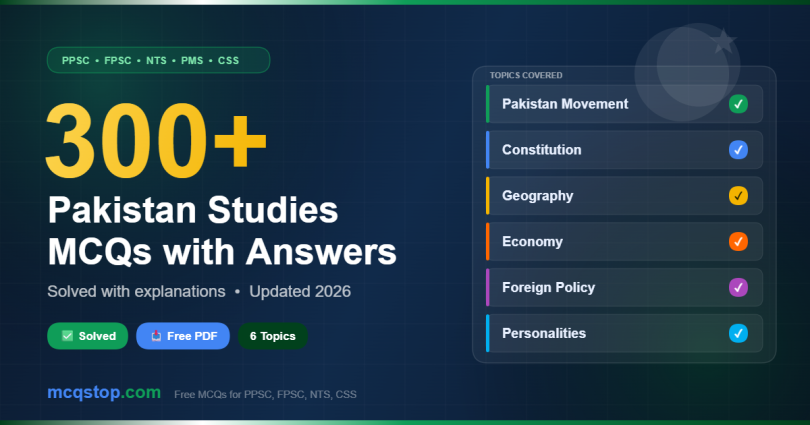
Practice 314 Pakistan Studies MCQs with answers and one-line explanations, grouped by topic exactly as they appear in PPSC, FPSC, NTS, PMS and CSS papers: the Pakistan Movement, constitutional history, geography, economy, foreign policy, personalities, rulers and national facts. Each question shows the correct option immediately below it, so you can test yourself first and then check. Download the full set as a free PDF at the end of the page.
Pakistan Movement and Ideology MCQs (1–38)
Questions on Sir Syed, the Muslim League, the Lahore Resolution and the road to 1947 are asked in every PPSC, FPSC and NTS paper. These cover the dates and personalities that repeat most.
1. Who founded the Muhammadan Anglo-Oriental (MAO) College at Aligarh?
A. Allama Iqbal B. Sir Syed Ahmad Khan C. Nawab Salimullah D. Maulana Hali
Answer: B. Sir Syed Ahmad Khan — Sir Syed founded MAO College in 1875; it became Aligarh Muslim University in 1920.
2. The War of Independence against the British took place in:
A. 1757 B. 1857 C. 1885 D. 1906
Answer: B. 1857 — The 1857 uprising is counted as the first war of independence in the subcontinent.
3. The All India Muslim League was founded in which city?
A. Lahore B. Delhi C. Dhaka D. Aligarh
Answer: C. Dhaka — It was founded on 30 December 1906 at Dhaka, during the annual Muhammadan Educational Conference.
4. The Simla Deputation of 1906 was led by:
A. Sir Syed Ahmad Khan B. Sir Aga Khan III C. Nawab Mohsin-ul-Mulk D. Quaid-e-Azam
Answer: B. Sir Aga Khan III — Sir Aga Khan III led the 35-member deputation to Viceroy Lord Minto demanding separate electorates.
5. Separate electorates for Muslims were first granted under:
A. Minto-Morley Reforms 1909 B. Montagu-Chelmsford Reforms 1919 C. Government of India Act 1935 D. Lucknow Pact 1916
Answer: A. Minto-Morley Reforms 1909 — The Indian Councils Act 1909 (Minto-Morley Reforms) accepted the Simla Deputation demand.
6. The partition of Bengal took place in:
A. 1901 B. 1905 C. 1911 D. 1919
Answer: B. 1905 — Lord Curzon partitioned Bengal in 1905; it was annulled in 1911 under Hindu pressure.
7. The Lucknow Pact between the Muslim League and Congress was signed in:
A. 1909 B. 1916 C. 1919 D. 1928
Answer: B. 1916 — In 1916 Congress accepted separate electorates for Muslims; Jinnah was the architect of the pact.
8. The Khilafat Movement was started to protect:
A. Muslim trade B. The Ottoman Caliphate C. Urdu language D. Separate electorates
Answer: B. The Ottoman Caliphate — It ran from 1919 to 1924 to preserve the Ottoman Caliphate after World War I.
9. Who presented the Fourteen Points in 1929?
A. Allama Iqbal B. Liaquat Ali Khan C. Quaid-e-Azam D. Sir Aga Khan
Answer: C. Quaid-e-Azam — Jinnah’s Fourteen Points were the Muslim reply to the Nehru Report of 1928.
10. Allama Iqbal delivered his famous Allahabad Address in:
A. 1928 B. 1930 C. 1933 D. 1940
Answer: B. 1930 — In December 1930 Iqbal proposed a separate Muslim state in north-west India.
11. The name ‘Pakistan’ was coined by:
A. Allama Iqbal B. Chaudhry Rahmat Ali C. Quaid-e-Azam D. Sir Syed
Answer: B. Chaudhry Rahmat Ali — Chaudhry Rahmat Ali used it in his 1933 pamphlet ‘Now or Never’ at Cambridge.
12. The Round Table Conferences were held in London between:
A. 1927–1929 B. 1930–1932 C. 1935–1937 D. 1940–1942
Answer: B. 1930–1932 — Three conferences were held from 1930 to 1932 to discuss constitutional reforms.
13. The Government of India Act was passed in:
A. 1919 B. 1929 C. 1935 D. 1942
Answer: C. 1935 — The 1935 Act introduced provincial autonomy and became the basis of Pakistan’s interim constitution.
14. The Muslim League observed the ‘Day of Deliverance’ on:
A. 23 March 1940 B. 22 December 1939 C. 14 August 1947 D. 16 August 1946
Answer: B. 22 December 1939 — It marked the resignation of Congress ministries after their 1937–39 rule.
15. The Pirpur Report (1938) documented:
A. Economic conditions of Muslims B. Congress ministries’ treatment of Muslims C. Education reforms D. Partition plan
Answer: B. Congress ministries’ treatment of Muslims — Raja of Pirpur’s committee recorded grievances of Muslims under Congress provincial rule.
16. The Lahore Resolution was passed on:
A. 23 March 1940 B. 14 August 1947 C. 3 June 1947 D. 12 March 1949
Answer: A. 23 March 1940 — Passed at Minto Park, Lahore; it is commemorated every year as Pakistan Day.
17. Who moved the Lahore Resolution in 1940?
A. Liaquat Ali Khan B. A. K. Fazlul Haq C. Sir Sikandar Hayat D. Khawaja Nazimuddin
Answer: B. A. K. Fazlul Haq — A. K. Fazlul Haq, Chief Minister of Bengal, moved it; Chaudhry Khaliquzzaman seconded it.
18. The Lahore Resolution was later called the Pakistan Resolution by:
A. Muslim League B. Congress C. Hindu press D. British Government
Answer: C. Hindu press — Hindu newspapers mockingly called it the Pakistan Resolution and the name stuck.
19. The Cripps Mission came to India in:
A. 1940 B. 1942 C. 1945 D. 1946
Answer: B. 1942 — Sir Stafford Cripps offered dominion status after the war; both parties rejected it.
20. The Cabinet Mission Plan was announced in:
A. 1945 B. 1946 C. 1947 D. 1944
Answer: B. 1946 — The 1946 plan proposed a three-tier federation; it was first accepted, then rejected.
21. The Muslim League observed Direct Action Day on:
A. 16 August 1946 B. 23 March 1946 C. 3 June 1947 D. 14 August 1946
Answer: A. 16 August 1946 — Called after the Cabinet Mission Plan failed; it led to the Calcutta riots.
22. The 3rd June Plan of 1947 was announced by:
A. Lord Wavell B. Lord Mountbatten C. Clement Attlee D. Lord Linlithgow
Answer: B. Lord Mountbatten — Mountbatten announced the partition plan on 3 June 1947.
23. The Indian Independence Act was passed by the British Parliament on:
A. 3 June 1947 B. 18 July 1947 C. 14 August 1947 D. 15 August 1947
Answer: B. 18 July 1947 — It received royal assent on 18 July 1947 and created two dominions.
24. The Radcliffe Award demarcating the boundary was announced on:
A. 14 August 1947 B. 15 August 1947 C. 17 August 1947 D. 20 August 1947
Answer: C. 17 August 1947 — It was published two days after independence and gave Gurdaspur to India.
25. Pakistan came into existence on:
A. 14 August 1947 B. 15 August 1947 C. 23 March 1947 D. 27 Ramadan 1366 AH
Answer: A. 14 August 1947 — 14 August 1947 corresponded to 27 Ramadan 1366 AH.
26. The Two-Nation Theory holds that:
A. Hindus and Muslims are one nation B. Muslims are a separate nation C. India should remain united D. Bengal should be partitioned
Answer: B. Muslims are a separate nation — Sir Syed first expressed it; Jinnah made it the basis of the Pakistan demand.
27. Sir Syed Ahmad Khan wrote ‘Asbab-e-Baghawat-e-Hind’ about:
A. Muslim education B. Causes of the 1857 revolt C. Urdu-Hindi controversy D. Partition of Bengal
Answer: B. Causes of the 1857 revolt — Written in 1859, it explained the causes of the 1857 uprising to the British.
28. The Urdu-Hindi controversy began in:
A. 1857 B. 1867 C. 1885 D. 1906
Answer: B. 1867 — In 1867 Hindus of Banaras demanded Hindi in Devanagari replace Urdu in courts.
29. The Indian National Congress was founded in:
A. 1875 B. 1885 C. 1905 D. 1906
Answer: B. 1885 — Founded in 1885 by A. O. Hume in Bombay.
30. Which Viceroy annulled the partition of Bengal?
A. Lord Curzon B. Lord Minto C. Lord Hardinge D. Lord Chelmsford
Answer: C. Lord Hardinge — Lord Hardinge announced the annulment at the Delhi Durbar of 1911.
31. The first president of the All India Muslim League was:
A. Nawab Salimullah B. Sir Aga Khan III C. Nawab Viqar-ul-Mulk D. Sir Syed
Answer: B. Sir Aga Khan III — Sir Aga Khan III served as the League’s first president (1906–1913).
32. Quaid-e-Azam joined the Muslim League in:
A. 1906 B. 1913 C. 1916 D. 1920
Answer: B. 1913 — He joined in 1913 while remaining a Congress member until 1920.
33. Who gave Jinnah the title ‘Ambassador of Hindu-Muslim Unity’?
A. Gandhi B. Sarojini Naidu C. Gokhale D. Nehru
Answer: B. Sarojini Naidu — Sarojini Naidu used the phrase after the Lucknow Pact of 1916.
34. The Nehru Report was presented in:
A. 1926 B. 1928 C. 1929 D. 1930
Answer: B. 1928 — It rejected separate electorates, prompting Jinnah’s Fourteen Points.
35. The Communal Award was announced by Ramsay MacDonald in:
A. 1930 B. 1932 C. 1935 D. 1937
Answer: B. 1932 — The 1932 award retained separate electorates for Muslims and other minorities.
36. In the 1945–46 elections the Muslim League won:
A. All Muslim seats in the Central Assembly B. Half of the Muslim seats C. Only Punjab seats D. No seats
Answer: A. All Muslim seats in the Central Assembly — It won all 30 Muslim seats in the Central Legislative Assembly, proving its claim to represent Muslims.
37. The Sylhet referendum of 1947 decided that Sylhet would join:
A. India B. East Bengal (Pakistan) C. Assam D. Burma
Answer: B. East Bengal (Pakistan) — A majority voted to join East Bengal.
38. The Quaid-e-Azam’s famous 11 August 1947 speech was delivered to:
A. Muslim League Council B. Constituent Assembly of Pakistan C. Public in Karachi D. Radio Pakistan
Answer: B. Constituent Assembly of Pakistan — He outlined religious freedom and equal citizenship as first President of the Constituent Assembly.
Next: Constitutional History of Pakistan MCQs →
Constitutional History of Pakistan MCQs (39–78)
The 1956, 1962 and 1973 Constitutions, the key Articles and the major amendments. The 18th Amendment and Articles 6, 25-A and 58(2)(b) are the most repeated.
39. The first Constituent Assembly of Pakistan was dissolved in:
A. 1951 B. 1953 C. 1954 D. 1956
Answer: C. 1954 — Governor-General Ghulam Muhammad dissolved it in October 1954.
40. The Objectives Resolution was passed on:
A. 14 August 1947 B. 12 March 1949 C. 23 March 1956 D. 10 April 1973
Answer: B. 12 March 1949 — Moved by Liaquat Ali Khan, it set Islamic principles as the basis of the constitution.
41. Pakistan’s first Constitution was adopted on:
A. 14 August 1947 B. 23 March 1956 C. 1 March 1962 D. 14 August 1973
Answer: B. 23 March 1956 — The 1956 Constitution declared Pakistan an Islamic Republic.
42. Under the 1956 Constitution Pakistan became:
A. A dominion B. An Islamic Republic C. A presidential state D. A monarchy
Answer: B. An Islamic Republic — It ended dominion status; Iskander Mirza became the first President.
43. The 1956 Constitution was abrogated in:
A. 1957 B. 1958 C. 1962 D. 1969
Answer: B. 1958 — President Iskander Mirza abrogated it on 7 October 1958 and imposed martial law.
44. The 1962 Constitution introduced which form of government?
A. Parliamentary B. Presidential C. Monarchy D. Confederation
Answer: B. Presidential — Ayub Khan’s constitution concentrated power in the President.
45. The 1962 Constitution came into force on:
A. 1 March 1962 B. 8 June 1962 C. 23 March 1962 D. 14 August 1962
Answer: A. 1 March 1962 — It was promulgated on 1 March 1962 and ended with Ayub’s resignation in 1969.
46. The 1973 Constitution was passed by the National Assembly on:
A. 10 April 1973 B. 14 August 1973 C. 23 March 1973 D. 12 March 1973
Answer: A. 10 April 1973 — Passed on 10 April 1973 and enforced on 14 August 1973.
47. The 1973 Constitution came into force on:
A. 10 April 1973 B. 14 August 1973 C. 1 July 1973 D. 23 March 1974
Answer: B. 14 August 1973 — Zulfikar Ali Bhutto became Prime Minister the same day.
48. Which part of the 1973 Constitution deals with Fundamental Rights?
A. Part I B. Part II C. Part III D. Part IV
Answer: B. Part II — Part II, Chapter 1 (Articles 8–28) lists the Fundamental Rights.
49. Article 6 of the Constitution deals with:
A. Freedom of speech B. High treason C. Right to education D. Equality of citizens
Answer: B. High treason — Abrogating or subverting the Constitution is high treason under Article 6.
50. Article 25-A of the Constitution guarantees:
A. Right to fair trial B. Free and compulsory education for children aged 5–16 C. Freedom of religion D. Right to information
Answer: B. Free and compulsory education for children aged 5–16 — Inserted by the 18th Amendment in 2010.
51. Which Article declares Urdu the national language?
A. Article 2 B. Article 28 C. Article 251 D. Article 255
Answer: C. Article 251 — Article 251 also allows provinces to promote their own languages.
52. Which Article declares Islam the state religion?
A. Article 1 B. Article 2 C. Article 2A D. Article 31
Answer: B. Article 2 — Article 2: Islam shall be the State religion of Pakistan.
53. The Objectives Resolution became a substantive part of the Constitution through:
A. Article 1 B. Article 2A C. Article 6 D. Article 227
Answer: B. Article 2A — Inserted by the 8th Amendment (1985) as Article 2A.
54. The 8th Amendment (1985) is known for inserting:
A. Article 25-A B. Article 58(2)(b) C. Article 62 only D. Article 184
Answer: B. Article 58(2)(b) — Article 58(2)(b) allowed the President to dissolve the National Assembly.
55. Article 58(2)(b) was repealed by which amendment?
A. 13th Amendment 1997 B. 17th Amendment 2003 C. 18th Amendment 2010 D. 8th Amendment 1985
Answer: A. 13th Amendment 1997 — Repealed in 1997, restored by the 17th in 2003, and finally removed by the 18th in 2010.
56. The 18th Amendment was passed in:
A. 2008 B. 2009 C. 2010 D. 2011
Answer: C. 2010 — Passed in April 2010; it renamed NWFP as Khyber Pakhtunkhwa and abolished the Concurrent List.
57. The 18th Amendment renamed NWFP as:
A. Pakhtunistan B. Khyber Pakhtunkhwa C. Sarhad D. Afghania
Answer: B. Khyber Pakhtunkhwa — The change took effect on 19 April 2010.
58. Which amendment merged FATA into Khyber Pakhtunkhwa?
A. 21st B. 24th C. 25th D. 26th
Answer: C. 25th — The 25th Amendment (May 2018) merged the tribal areas into KP.
59. The President of Pakistan is elected by:
A. Direct vote of the people B. National Assembly only C. Electoral College of Parliament and provincial assemblies D. Senate only
Answer: C. Electoral College of Parliament and provincial assemblies — Both houses of Parliament and the four provincial assemblies form the Electoral College.
60. The term of the President of Pakistan is:
A. 4 years B. 5 years C. 6 years D. 7 years
Answer: B. 5 years — Five years, with a maximum of two terms.
61. The minimum age to become President of Pakistan is:
A. 35 years B. 40 years C. 45 years D. 50 years
Answer: C. 45 years — Article 41 requires a Muslim of at least 45 years qualified to be an MNA.
62. The minimum age to become a member of the National Assembly is:
A. 21 years B. 25 years C. 30 years D. 35 years
Answer: B. 25 years — 25 for the National Assembly; 30 for the Senate.
63. The minimum age for a Senator is:
A. 25 years B. 30 years C. 35 years D. 40 years
Answer: B. 30 years — Article 62 sets 30 years for the Senate.
64. The upper house of Pakistan’s Parliament is the:
A. National Assembly B. Senate C. Majlis-e-Shoora D. Council of Islamic Ideology
Answer: B. Senate — The Senate gives equal representation to the provinces.
65. The term of a Senator is:
A. 3 years B. 4 years C. 5 years D. 6 years
Answer: D. 6 years — Half of the members retire every three years.
66. The Prime Minister is elected by:
A. The President B. The Senate C. The National Assembly D. Direct vote
Answer: C. The National Assembly — Article 91: elected by majority of the total membership of the National Assembly.
67. The Speaker of the National Assembly is elected by:
A. The President B. Members of the National Assembly C. The Senate D. The Supreme Court
Answer: B. Members of the National Assembly — Elected by MNAs through secret ballot at the first sitting.
68. Who administers the oath to the Prime Minister?
A. Chief Justice B. Speaker C. President D. Chairman Senate
Answer: C. President — The President administers the oath to the Prime Minister.
69. The Council of Islamic Ideology was established under the Constitution of:
A. 1956 B. 1962 C. 1973 D. None
Answer: B. 1962 — First set up in 1962 as the Advisory Council of Islamic Ideology; retained in 1973 (Article 228).
70. Under which Article can the President dissolve the National Assembly on the advice of the Prime Minister?
A. Article 48 B. Article 58(1) C. Article 91 D. Article 101
Answer: B. Article 58(1) — Article 58(1) allows dissolution on the PM’s advice.
71. The Federal Shariat Court was established in:
A. 1973 B. 1979 C. 1980 D. 1985
Answer: C. 1980 — Set up in 1980 by General Zia-ul-Haq to examine laws against Islamic injunctions.
72. The National Finance Commission (NFC) is formed under which Article?
A. Article 140-A B. Article 160 C. Article 161 D. Article 184
Answer: B. Article 160 — Article 160 provides for distribution of revenues between the federation and provinces.
73. The Council of Common Interests (CCI) is formed under which Article?
A. Article 153 B. Article 160 C. Article 184 D. Article 199
Answer: A. Article 153 — Article 153; the Prime Minister is its chairman.
74. The Supreme Court’s original jurisdiction in public-interest cases is under Article:
A. 184(3) B. 185 C. 199 D. 203
Answer: A. 184(3) — Article 184(3) allows the Supreme Court to hear matters of public importance involving fundamental rights.
75. The number of general seats in the National Assembly of Pakistan is:
A. 242 B. 266 C. 272 D. 342
Answer: B. 266 — After the 25th Amendment: 266 general, 60 women, 10 non-Muslim, total 336.
76. The total strength of the National Assembly is:
A. 300 B. 336 C. 342 D. 350
Answer: B. 336 — 336 seats since FATA’s merger reduced the earlier 342.
77. How many members does the Senate of Pakistan have after the FATA seats were abolished?
A. 100 B. 104 C. 96 D. 110
Answer: C. 96 — The Senate has 96 members since 2024, after the 12 FATA seats lapsed.
78. Pakistan is a federal republic with how many provinces?
A. 3 B. 4 C. 5 D. 6
Answer: B. 4 — Punjab, Sindh, Khyber Pakhtunkhwa and Balochistan, plus Islamabad Capital Territory.
Next: Geography of Pakistan MCQs →
Geography of Pakistan MCQs (79–119)
Provinces, rivers, dams, mountains, passes and deserts. Dam-river pairs and highest/longest/largest questions appear in almost every paper.
79. The total area of Pakistan is approximately:
A. 650,000 sq km B. 796,096 sq km C. 881,913 sq km D. 1,000,000 sq km
Answer: B. 796,096 sq km — 796,096 sq km excluding Gilgit-Baltistan and Azad Kashmir; 881,913 sq km including them.
80. The largest province of Pakistan by area is:
A. Punjab B. Sindh C. Khyber Pakhtunkhwa D. Balochistan
Answer: D. Balochistan — Balochistan covers about 44% of the country’s area.
81. The most populous province of Pakistan is:
A. Punjab B. Sindh C. KP D. Balochistan
Answer: A. Punjab — Punjab has over half of Pakistan’s population.
82. The smallest province by area is:
A. Sindh B. Khyber Pakhtunkhwa C. Punjab D. Balochistan
Answer: B. Khyber Pakhtunkhwa — KP is the smallest of the four provinces by area.
83. K2 is the ______ highest mountain in the world.
A. First B. Second C. Third D. Fourth
Answer: B. Second — K2 (8,611 m) is second only to Mount Everest.
84. K2 is located in which mountain range?
A. Himalayas B. Hindu Kush C. Karakoram D. Suleiman
Answer: C. Karakoram — K2, also called Mount Godwin-Austen, is in the Karakoram range in Gilgit-Baltistan.
85. Nanga Parbat is located in which range?
A. Karakoram B. Himalayas C. Hindu Kush D. Pamir
Answer: B. Himalayas — Nanga Parbat (8,126 m) is the western anchor of the Himalayas; called the ‘Killer Mountain’.
86. Tirich Mir is the highest peak of which range?
A. Karakoram B. Himalayas C. Hindu Kush D. Suleiman
Answer: C. Hindu Kush — Tirich Mir (7,708 m) is in Chitral, Khyber Pakhtunkhwa.
87. The longest river of Pakistan is:
A. Jhelum B. Chenab C. Indus D. Ravi
Answer: C. Indus — The Indus is about 3,180 km long and rises in Tibet.
88. The Indus River originates from:
A. Afghanistan B. Tibet (China) C. Kashmir D. Chitral
Answer: B. Tibet (China) — It rises near Lake Mansarovar in Tibet and enters Pakistan through Gilgit-Baltistan.
89. The Indus River falls into the:
A. Bay of Bengal B. Arabian Sea C. Persian Gulf D. Red Sea
Answer: B. Arabian Sea — It empties into the Arabian Sea near Thatta, Sindh.
90. Tarbela Dam is built on which river?
A. Jhelum B. Indus C. Chenab D. Kabul
Answer: B. Indus — Tarbela, completed in 1976, is the world’s largest earth-filled dam.
91. Mangla Dam is built on which river?
A. Indus B. Jhelum C. Chenab D. Ravi
Answer: B. Jhelum — Completed in 1967 in Mirpur, Azad Kashmir.
92. Warsak Dam is built on the:
A. Swat River B. Kabul River C. Kunhar River D. Indus River
Answer: B. Kabul River — Warsak Dam near Peshawar was completed in 1960.
93. The Diamer-Bhasha Dam is being built on the:
A. Indus B. Jhelum C. Swat D. Chenab
Answer: A. Indus — It is located in Gilgit-Baltistan and KP on the Indus.
94. Mohmand Dam is being constructed on the:
A. Kabul River B. Swat River C. Kurram River D. Panjkora River
Answer: B. Swat River — It lies on the Swat River in Mohmand district, KP.
95. The Thar Desert is located in:
A. Punjab B. Sindh C. Balochistan D. KP
Answer: B. Sindh — Thar in Sindh is part of the Great Indian Desert.
96. The Cholistan Desert is located in:
A. Sindh B. Punjab C. Balochistan D. KP
Answer: B. Punjab — Cholistan lies in southern Punjab near Bahawalpur.
97. The Kharan Desert is located in:
A. Punjab B. Sindh C. Balochistan D. GB
Answer: C. Balochistan — Kharan in western Balochistan; the 1998 nuclear tests were nearby in Chagai.
98. Gwadar Port is located in:
A. Sindh B. Balochistan C. KP D. Punjab
Answer: B. Balochistan — Gwadar on the Arabian Sea is the end point of CPEC.
99. Pakistan’s coastline is approximately:
A. 700 km B. 1,046 km C. 1,500 km D. 2,000 km
Answer: B. 1,046 km — About 1,046 km along the Arabian Sea in Sindh and Balochistan.
100. The highest pass of Pakistan is:
A. Khyber Pass B. Bolan Pass C. Khunjerab Pass D. Lowari Pass
Answer: C. Khunjerab Pass — Khunjerab (4,693 m) connects Pakistan to China on the Karakoram Highway.
101. The Khyber Pass connects Pakistan with:
A. China B. Iran C. Afghanistan D. India
Answer: C. Afghanistan — It links Peshawar with Jalalabad in Afghanistan.
102. The Bolan Pass is located in:
A. KP B. Balochistan C. Punjab D. GB
Answer: B. Balochistan — It connects Quetta with Sibi in Balochistan.
103. The Durand Line is the border between Pakistan and:
A. India B. Iran C. China D. Afghanistan
Answer: D. Afghanistan — Drawn in 1893 by Sir Mortimer Durand; about 2,640 km long.
104. Islamabad became the capital of Pakistan in:
A. 1958 B. 1960 C. 1967 D. 1970
Answer: C. 1967 — Construction began in 1961; Islamabad formally replaced Rawalpindi as capital in 1967.
105. The first capital of Pakistan was:
A. Lahore B. Karachi C. Rawalpindi D. Dhaka
Answer: B. Karachi — Karachi was the capital from 1947 until the move to Rawalpindi (interim) in 1959.
106. The Siachen Glacier lies in which range?
A. Himalayas B. Hindu Kush C. Karakoram D. Pamir
Answer: C. Karakoram — At about 76 km it is the longest glacier outside the polar regions.
107. Lake Saiful Muluk is located in:
A. Swat B. Kaghan Valley C. Chitral D. Skardu
Answer: B. Kaghan Valley — It lies near Naran in the Kaghan Valley, KP.
108. The largest natural lake of Pakistan is:
A. Keenjhar B. Manchar C. Hanna D. Satpara
Answer: B. Manchar — Manchar Lake in Sindh (Jamshoro district) is the largest freshwater lake.
109. The Khewra Salt Mine is located in:
A. Chakwal B. Jhelum C. Mianwali D. Attock
Answer: B. Jhelum — Khewra, in Jhelum district, is the second-largest salt mine in the world.
110. The Deosai Plains are located in:
A. Chitral B. Gilgit-Baltistan C. Swat D. Azad Kashmir
Answer: B. Gilgit-Baltistan — Deosai, near Skardu, is one of the highest plateaus in the world.
111. Which river is known as the ‘lifeline of Pakistan’?
A. Jhelum B. Chenab C. Indus D. Sutlej
Answer: C. Indus — The Indus irrigates most of Pakistan’s farmland.
112. The Indus Waters Treaty was signed in:
A. 1948 B. 1955 C. 1960 D. 1965
Answer: C. 1960 — Signed by Ayub Khan and Nehru in Karachi on 19 September 1960 with World Bank mediation.
113. Under the Indus Waters Treaty, which rivers were given to India?
A. Indus, Jhelum, Chenab B. Ravi, Beas, Sutlej C. Kabul, Swat, Kunhar D. Indus, Ravi, Sutlej
Answer: B. Ravi, Beas, Sutlej — The three eastern rivers went to India; the three western rivers to Pakistan.
114. How many rivers give Punjab its name?
A. Three B. Four C. Five D. Six
Answer: C. Five — Punjab means ‘land of five rivers’: Jhelum, Chenab, Ravi, Sutlej and Beas.
115. Pakistan shares its border with how many countries?
A. Three B. Four C. Five D. Six
Answer: B. Four — Afghanistan, Iran, China and India.
116. The Wakhan Corridor separates Pakistan from:
A. Iran B. Tajikistan C. China D. Uzbekistan
Answer: B. Tajikistan — The narrow Afghan strip separates Pakistan from Tajikistan.
117. The Hub Dam supplies water to:
A. Lahore B. Karachi C. Quetta D. Peshawar
Answer: B. Karachi — Built on the Hub River at the Sindh-Balochistan border, it supplies Karachi.
118. The highest rainfall in Pakistan is recorded in:
A. Quetta B. Murree C. Karachi D. Jacobabad
Answer: B. Murree — Murree in the Pir Panjal foothills receives the heaviest rainfall.
119. Jacobabad is famous for:
A. Highest rainfall B. Hottest temperatures C. Coal mines D. Salt mines
Answer: B. Hottest temperatures — Jacobabad in Sindh is among the hottest places in Pakistan.
Next: Economy and Resources of Pakistan MCQs →
Economy and Resources of Pakistan MCQs (120–159)
Crops, minerals, industry, CPEC, regulators and the big economic dates. CPEC and the State Bank are asked most often.
120. The State Bank of Pakistan was established on:
A. 14 August 1947 B. 1 July 1948 C. 1 January 1949 D. 23 March 1956
Answer: B. 1 July 1948 — Inaugurated by Quaid-e-Azam on 1 July 1948 in Karachi.
121. The currency of Pakistan is:
A. Taka B. Rupee C. Dinar D. Rial
Answer: B. Rupee — The Pakistani rupee (PKR) replaced Indian currency in 1948.
122. Pakistan’s first Five-Year Plan covered the period:
A. 1950–55 B. 1955–60 C. 1960–65 D. 1965–70
Answer: B. 1955–60 — The first plan ran from 1955 to 1960.
123. The largest cash crop of Pakistan is:
A. Wheat B. Cotton C. Rice D. Sugarcane
Answer: B. Cotton — Cotton is the main cash crop and raw material for textiles, the biggest export sector.
124. The major food crop of Pakistan is:
A. Rice B. Maize C. Wheat D. Millet
Answer: C. Wheat — Wheat is the staple and the largest crop by area.
125. Which province produces the most wheat?
A. Sindh B. Punjab C. KP D. Balochistan
Answer: B. Punjab — Punjab grows roughly three-quarters of Pakistan’s wheat.
126. Basmati rice is mainly grown in:
A. Sindh B. Punjab C. Balochistan D. KP
Answer: B. Punjab — The Kalar tract of Punjab (Sialkot, Gujranwala, Sheikhupura) is the Basmati belt.
127. Natural gas was discovered at Sui in:
A. 1948 B. 1952 C. 1955 D. 1960
Answer: B. 1952 — The Sui gas field in Balochistan was discovered in 1952.
128. The Saindak project in Balochistan produces:
A. Coal B. Copper and gold C. Oil D. Natural gas
Answer: B. Copper and gold — Saindak in Chagai district; developed with Chinese cooperation.
129. The Reko Diq deposit is famous for:
A. Coal B. Copper and gold C. Marble D. Iron
Answer: B. Copper and gold — Reko Diq in Chagai is one of the largest copper-gold deposits in the world.
130. Thar coal reserves are located in:
A. Punjab B. Sindh C. Balochistan D. KP
Answer: B. Sindh — Thar in Sindh holds some of the world’s largest lignite coal reserves.
131. Pakistan Steel Mills is located in:
A. Lahore B. Karachi C. Faisalabad D. Taxila
Answer: B. Karachi — At Bin Qasim, Karachi; built with Soviet assistance and commissioned in 1985.
132. The largest industry of Pakistan is:
A. Cement B. Textile C. Sugar D. Fertiliser
Answer: B. Textile — Textiles account for the largest share of exports and industrial employment.
133. Faisalabad is known as the:
A. City of Gardens B. Manchester of Pakistan C. City of Lights D. City of Saints
Answer: B. Manchester of Pakistan — Because of its textile industry.
134. Pakistan’s largest trading partner in recent years has been:
A. USA B. China C. UK D. Saudi Arabia
Answer: B. China — China is the largest source of imports; the USA is the largest export destination.
135. CPEC stands for:
A. China-Pakistan Economic Council B. China-Pakistan Economic Corridor C. Central Pakistan Energy Corridor D. China-Pakistan Export Centre
Answer: B. China-Pakistan Economic Corridor — Launched in April 2015 during President Xi Jinping’s visit.
136. CPEC connects Gwadar with which Chinese city?
A. Beijing B. Shanghai C. Kashgar D. Urumqi
Answer: C. Kashgar — Kashgar in Xinjiang is the northern end of the corridor.
137. CPEC is part of China’s:
A. Silk Road Fund B. Belt and Road Initiative C. Asian Development Plan D. Shanghai Pact
Answer: B. Belt and Road Initiative — It is the flagship project of the Belt and Road Initiative.
138. Pakistan joined the International Monetary Fund (IMF) in:
A. 1947 B. 1950 C. 1955 D. 1960
Answer: B. 1950 — Pakistan became a member on 11 July 1950.
139. The Karachi Stock Exchange was renamed Pakistan Stock Exchange in:
A. 2010 B. 2014 C. 2016 D. 2018
Answer: C. 2016 — The Karachi, Lahore and Islamabad exchanges merged in January 2016.
140. The fiscal year in Pakistan runs from:
A. 1 January to 31 December B. 1 April to 31 March C. 1 July to 30 June D. 1 October to 30 September
Answer: C. 1 July to 30 June — The federal budget is presented in June for the year starting 1 July.
141. The first nuclear power plant of Pakistan was:
A. Chashma-1 B. KANUPP C. Chashma-2 D. K-2
Answer: B. KANUPP — KANUPP in Karachi started operation in 1972 with Canadian help.
142. The Tarbela Dam’s main purpose besides irrigation is:
A. Fishing B. Hydroelectric power C. Navigation D. Flood tourism
Answer: B. Hydroelectric power — It is Pakistan’s largest hydropower producer.
143. The Indus Basin Irrigation System is the ______ in the world.
A. Oldest B. Largest contiguous C. Deepest D. Shortest
Answer: B. Largest contiguous — It is the largest contiguous irrigation system in the world.
144. Pakistan’s main export item is:
A. Rice B. Textiles and garments C. Leather D. Sports goods
Answer: B. Textiles and garments — Textiles make up around 60% of export earnings.
145. Sialkot is famous for:
A. Textiles B. Sports goods and surgical instruments C. Cement D. Carpets
Answer: B. Sports goods and surgical instruments — It exports footballs and surgical instruments worldwide.
146. Which city is called the ‘Economic hub’ of Pakistan?
A. Lahore B. Islamabad C. Karachi D. Faisalabad
Answer: C. Karachi — Karachi handles most of the country’s trade and tax revenue.
147. The Karakoram Highway connects Pakistan with:
A. Iran B. Afghanistan C. China D. India
Answer: C. China — It runs from Hasan Abdal to Kashgar via the Khunjerab Pass; completed in 1978.
148. Pakistan International Airlines (PIA) was established in:
A. 1947 B. 1951 C. 1955 D. 1960
Answer: C. 1955 — PIA was formed in 1955 after merging Orient Airways.
149. Pakistan Railways headquarters is located in:
A. Karachi B. Lahore C. Rawalpindi D. Islamabad
Answer: B. Lahore — Lahore has been the railway headquarters since British times.
150. The Benazir Income Support Programme (BISP) was launched in:
A. 2005 B. 2008 C. 2010 D. 2013
Answer: B. 2008 — Started in 2008 as a cash-transfer scheme for poor families.
151. The largest source of foreign exchange after exports is:
A. Foreign aid B. Workers’ remittances C. Tourism D. Privatisation
Answer: B. Workers’ remittances — Remittances from overseas Pakistanis exceed US$30 billion a year.
152. Mangla Dam mainly irrigates which province?
A. Sindh B. Punjab C. KP D. Balochistan
Answer: B. Punjab — Its canals serve the Punjab plains.
153. Pakistan’s main agricultural exports include:
A. Tea and coffee B. Rice and fruit C. Rubber and cocoa D. Wool and silk
Answer: B. Rice and fruit — Rice (especially Basmati) and citrus/mango are major exports.
154. The Port Qasim is located near:
A. Gwadar B. Karachi C. Pasni D. Ormara
Answer: B. Karachi — Port Muhammad Bin Qasim lies east of Karachi; opened in 1980.
155. Which organisation regulates electricity tariffs in Pakistan?
A. WAPDA B. NEPRA C. OGRA D. PEMRA
Answer: B. NEPRA — NEPRA (National Electric Power Regulatory Authority), established in 1997.
156. Which organisation regulates oil and gas in Pakistan?
A. NEPRA B. OGRA C. SECP D. PTA
Answer: B. OGRA — The Oil and Gas Regulatory Authority was set up in 2002.
157. WAPDA was established in:
A. 1947 B. 1958 C. 1962 D. 1970
Answer: B. 1958 — The Water and Power Development Authority was created in 1958.
158. Pakistan’s first census after independence was held in:
A. 1947 B. 1951 C. 1961 D. 1972
Answer: B. 1951 — The first census was in 1951; the latest, the first digital census, was in 2023.
159. According to the 2023 census, Pakistan’s population is about:
A. 180 million B. 207 million C. 241 million D. 260 million
Answer: C. 241 million — The 2023 digital census recorded about 241.5 million people.
Next: Foreign Policy and International Relations MCQs →
Foreign Policy and International Relations MCQs (160–197)
Pakistan’s membership of international bodies, treaties with India and the nuclear programme. Treaty years and signatories are the usual questions.
160. Pakistan became a member of the United Nations on:
A. 14 August 1947 B. 30 September 1947 C. 1 January 1948 D. 23 March 1948
Answer: B. 30 September 1947 — Admitted as the 56th member of the UN.
161. Pakistan joined the Commonwealth in:
A. 1947 B. 1950 C. 1956 D. 1989
Answer: A. 1947 — Joined in 1947, left in 1972 over Bangladesh’s recognition, and rejoined in 1989.
162. Pakistan left the Commonwealth in 1972 because:
A. Of the 1971 war B. Other members recognised Bangladesh C. Of the Indus dispute D. Of nuclear policy
Answer: B. Other members recognised Bangladesh — Pakistan rejoined in 1989 under Benazir Bhutto.
163. SEATO was formed in:
A. 1954 B. 1955 C. 1960 D. 1965
Answer: A. 1954 — The South-East Asia Treaty Organisation, signed in Manila in 1954; Pakistan left in 1973.
164. The Baghdad Pact (later CENTO) was signed in:
A. 1954 B. 1955 C. 1958 D. 1960
Answer: B. 1955 — Signed in 1955; renamed CENTO after Iraq left in 1959.
165. Pakistan is a founding member of:
A. ASEAN B. OIC C. NATO D. EU
Answer: B. OIC — The Organisation of Islamic Cooperation was founded in 1969 at Rabat.
166. The second OIC summit was held in Lahore in:
A. 1969 B. 1972 C. 1974 D. 1976
Answer: C. 1974 — Hosted by Zulfikar Ali Bhutto in February 1974.
167. SAARC was founded in:
A. 1980 B. 1983 C. 1985 D. 1990
Answer: C. 1985 — Founded at Dhaka on 8 December 1985 with seven members; Afghanistan joined in 2007.
168. The headquarters of SAARC is in:
A. Islamabad B. New Delhi C. Kathmandu D. Dhaka
Answer: C. Kathmandu — The secretariat has been in Kathmandu, Nepal, since 1987.
169. The Regional Cooperation for Development (RCD) of 1964 later became:
A. SAARC B. ECO C. OIC D. CENTO
Answer: B. ECO — RCD (Pakistan, Iran, Turkey) became the Economic Cooperation Organisation in 1985.
170. Pakistan became a full member of the Shanghai Cooperation Organisation in:
A. 2005 B. 2015 C. 2017 D. 2019
Answer: C. 2017 — Pakistan and India were admitted as full members in June 2017 at Astana.
171. Pakistan joined the Non-Aligned Movement in:
A. 1961 B. 1972 C. 1979 D. 1985
Answer: C. 1979 — Pakistan joined at the Havana summit in 1979.
172. The Tashkent Declaration was signed between Pakistan and India in:
A. 1965 B. 1966 C. 1971 D. 1972
Answer: B. 1966 — Signed on 10 January 1966 by Ayub Khan and Lal Bahadur Shastri after the 1965 war.
173. The Simla Agreement was signed in:
A. 1971 B. 1972 C. 1973 D. 1974
Answer: B. 1972 — Signed on 2 July 1972 by Zulfikar Ali Bhutto and Indira Gandhi.
174. The Lahore Declaration of 1999 was signed by:
A. Nawaz Sharif and Vajpayee B. Musharraf and Vajpayee C. Benazir and Rajiv Gandhi D. Zia and Rajiv Gandhi
Answer: A. Nawaz Sharif and Vajpayee — Signed on 21 February 1999 during Vajpayee’s bus visit to Lahore.
175. The Kargil conflict took place in:
A. 1998 B. 1999 C. 2000 D. 2001
Answer: B. 1999 — Fighting in the Kargil sector of Kashmir lasted from May to July 1999.
176. Pakistan conducted its nuclear tests on:
A. 11 May 1998 B. 28 May 1998 C. 30 May 1998 D. 6 September 1998
Answer: B. 28 May 1998 — Five tests at Chagai on 28 May 1998, now marked as Youm-e-Takbir.
177. Pakistan’s nuclear tests were conducted in which district?
A. Kharan B. Chagai C. Khuzdar D. Quetta
Answer: B. Chagai — At Ras Koh hills in Chagai, Balochistan.
178. Who is called the father of Pakistan’s nuclear programme?
A. Dr Abdus Salam B. Dr Abdul Qadeer Khan C. Dr Samar Mubarakmand D. Munir Ahmad Khan
Answer: B. Dr Abdul Qadeer Khan — Dr A. Q. Khan headed the Kahuta uranium-enrichment programme.
179. Pakistan recognised the People’s Republic of China in:
A. 1949 B. 1950 C. 1951 D. 1955
Answer: B. 1950 — Pakistan was among the first countries to recognise China, in January 1950.
180. The Pakistan-China boundary agreement was signed in:
A. 1960 B. 1963 C. 1965 D. 1970
Answer: B. 1963 — Signed on 2 March 1963.
181. The first Indo-Pak war over Kashmir was fought in:
A. 1947–48 B. 1965 C. 1971 D. 1999
Answer: A. 1947–48 — It ended with a UN-brokered ceasefire on 1 January 1949.
182. The UN Security Council resolution calling for a plebiscite in Kashmir was passed in:
A. 1947 B. 1948 C. 1949 D. 1957
Answer: B. 1948 — Resolution 47 of 21 April 1948 called for a free and impartial plebiscite.
183. The 1965 war between Pakistan and India began on:
A. 6 August B. 6 September C. 16 September D. 23 September
Answer: B. 6 September — India attacked across the international border on 6 September 1965; a ceasefire came on 23 September.
184. Dhaka fell and East Pakistan became Bangladesh on:
A. 3 December 1971 B. 16 December 1971 C. 2 July 1972 D. 26 March 1971
Answer: B. 16 December 1971 — The Pakistan Army surrendered in Dhaka on 16 December 1971.
185. Pakistan recognised Bangladesh in:
A. 1972 B. 1973 C. 1974 D. 1976
Answer: C. 1974 — Recognised in February 1974, just before the Lahore OIC summit.
186. The Geneva Accords on Afghanistan were signed in:
A. 1985 B. 1988 C. 1989 D. 1992
Answer: B. 1988 — Signed on 14 April 1988, leading to Soviet withdrawal from Afghanistan.
187. Pakistan is a signatory to which nuclear treaty?
A. NPT B. CTBT C. Neither NPT nor CTBT D. Both
Answer: C. Neither NPT nor CTBT — Pakistan has signed neither the NPT nor the CTBT.
188. Who served as Pakistan’s permanent representative to the United Nations from 1954 to 1958?
A. Zafarullah Khan B. Patras Bokhari C. Agha Shahi D. Sahibzada Yaqub
Answer: B. Patras Bokhari — Patras Bokhari served as permanent representative from 1954 to 1958.
189. Who was Pakistan’s first Foreign Minister?
A. Liaquat Ali Khan B. Sir Zafarullah Khan C. Feroz Khan Noon D. Zulfikar Ali Bhutto
Answer: B. Sir Zafarullah Khan — Sir Muhammad Zafarullah Khan served from 1947 to 1954.
190. The ‘Shanghai Five’ that became the SCO did not originally include:
A. China B. Russia C. Pakistan D. Kazakhstan
Answer: C. Pakistan — The SCO was founded in 2001 by China, Russia, Kazakhstan, Kyrgyzstan, Tajikistan and Uzbekistan.
191. Pakistan’s longest-serving ally in defence cooperation since the 1960s is:
A. Russia B. China C. France D. Germany
Answer: B. China — Joint projects include the JF-17 Thunder and the Karakoram Highway.
192. The Iran-Pakistan gas pipeline is also called the:
A. Peace Pipeline B. Silk Pipeline C. TAPI D. CPEC line
Answer: A. Peace Pipeline — Agreed in 2013; TAPI is the separate Turkmenistan-Afghanistan-Pakistan-India pipeline.
193. Which country mediated the Indus Waters Treaty?
A. USA B. UN C. World Bank D. Britain
Answer: C. World Bank — The World Bank brokered the treaty after nine years of talks.
194. Pakistan joined the Asian Infrastructure Investment Bank (AIIB) as a:
A. Observer B. Founding member C. Borrower only D. Non-member
Answer: B. Founding member — Pakistan was a founding member when AIIB opened in 2015–16.
195. The Line of Control (LoC) in Kashmir was established by the:
A. Tashkent Declaration B. Simla Agreement C. Karachi Agreement 1949 D. Lahore Declaration
Answer: B. Simla Agreement — The 1949 ceasefire line was renamed the Line of Control under the 1972 Simla Agreement.
196. Pakistan became a Major Non-NATO Ally of the United States in:
A. 2001 B. 2002 C. 2004 D. 2008
Answer: C. 2004 — Designated in June 2004.
197. The Strait of Hormuz is important for Pakistan because:
A. It borders Sindh B. Most of its oil imports pass through it C. It is part of CPEC D. It connects to India
Answer: B. Most of its oil imports pass through it — Gulf oil for Pakistan transits the Strait of Hormuz to Karachi and Gwadar.
Next: Important Personalities MCQs →
Important Personalities MCQs (198–236)
Founders, leaders, scientists, poets and sportspeople. Birth and death dates of the Quaid and Iqbal are asked in nearly every test.
198. Quaid-e-Azam Muhammad Ali Jinnah was born on:
A. 25 December 1876 B. 25 December 1875 C. 9 November 1877 D. 11 September 1876
Answer: A. 25 December 1876 — Born in Karachi on 25 December 1876.
199. Quaid-e-Azam died on:
A. 11 September 1948 B. 14 August 1948 C. 25 December 1948 D. 16 October 1951
Answer: A. 11 September 1948 — He died in Karachi on 11 September 1948 and is buried at Mazar-e-Quaid.
200. Allama Iqbal was born in:
A. Lahore B. Sialkot C. Delhi D. Amritsar
Answer: B. Sialkot — Born on 9 November 1877 in Sialkot.
201. Allama Iqbal died on:
A. 21 April 1938 B. 9 November 1938 C. 21 April 1940 D. 25 December 1938
Answer: A. 21 April 1938 — He died in Lahore and is buried beside the Badshahi Mosque.
202. Sir Syed Ahmad Khan was born in:
A. 1817 B. 1820 C. 1835 D. 1857
Answer: A. 1817 — Born in Delhi on 17 October 1817; died in Aligarh in 1898.
203. Liaquat Ali Khan was assassinated in:
A. Karachi, 1951 B. Rawalpindi, 1951 C. Lahore, 1953 D. Peshawar, 1950
Answer: B. Rawalpindi, 1951 — Shot at Company Bagh (now Liaquat Bagh), Rawalpindi, on 16 October 1951.
204. Liaquat Ali Khan is known by the title:
A. Quaid-e-Millat B. Madar-e-Millat C. Quaid-e-Awam D. Shaheed-e-Millat
Answer: D. Shaheed-e-Millat — Called Shaheed-e-Millat (martyr of the nation) after his assassination; also Quaid-e-Millat.
205. Fatima Jinnah is known as:
A. Madar-e-Millat B. Quaid-e-Millat C. Khatoon-e-Pakistan D. Both A and C
Answer: D. Both A and C — Mother of the Nation; she contested the 1965 presidential election against Ayub Khan.
206. Who was the first Pakistani to win the Nobel Prize?
A. Dr Abdul Qadeer Khan B. Dr Abdus Salam C. Malala Yousafzai D. Dr Atta-ur-Rahman
Answer: B. Dr Abdus Salam — Dr Abdus Salam won the Nobel Prize in Physics in 1979.
207. Malala Yousafzai won the Nobel Peace Prize in:
A. 2012 B. 2013 C. 2014 D. 2015
Answer: C. 2014 — She shared the 2014 prize with Kailash Satyarthi, becoming its youngest laureate.
208. Who wrote the national anthem of Pakistan?
A. Allama Iqbal B. Hafeez Jalandhari C. Faiz Ahmed Faiz D. Ahmed Faraz
Answer: B. Hafeez Jalandhari — Hafeez Jalandhari wrote the lyrics; the music is by Ahmed G. Chagla.
209. The music of Pakistan’s national anthem was composed by:
A. Hafeez Jalandhari B. Ahmed G. Chagla C. Nisar Bazmi D. Sohail Rana
Answer: B. Ahmed G. Chagla — The tune was composed in 1949; the anthem was officially adopted in 1954.
210. The national flag of Pakistan was designed by:
A. Liaquat Ali Khan B. Amiruddin Kidwai C. Chaudhry Rahmat Ali D. Hafeez Jalandhari
Answer: B. Amiruddin Kidwai — Adopted by the Constituent Assembly on 11 August 1947.
211. The ‘Quaid-e-Awam’ title refers to:
A. Liaquat Ali Khan B. Zulfikar Ali Bhutto C. Ayub Khan D. Nawaz Sharif
Answer: B. Zulfikar Ali Bhutto — Zulfikar Ali Bhutto, founder of the Pakistan Peoples Party in 1967.
212. Zulfikar Ali Bhutto was executed on:
A. 4 April 1979 B. 5 July 1977 C. 17 August 1988 D. 20 December 1971
Answer: A. 4 April 1979 — Hanged in Rawalpindi jail after the Nawab Muhammad Ahmed Khan murder case.
213. Benazir Bhutto first became Prime Minister in:
A. 1985 B. 1988 C. 1990 D. 1993
Answer: B. 1988 — In December 1988 she became the first woman to head a government in a Muslim-majority country.
214. Benazir Bhutto was assassinated in:
A. Karachi, 2007 B. Rawalpindi, 2007 C. Lahore, 2008 D. Islamabad, 2007
Answer: B. Rawalpindi, 2007 — Killed at Liaquat Bagh, Rawalpindi, on 27 December 2007.
215. General Zia-ul-Haq died in a plane crash near:
A. Multan B. Bahawalpur C. Rahim Yar Khan D. Sargodha
Answer: B. Bahawalpur — His C-130 crashed near Bahawalpur on 17 August 1988.
216. Who was Pakistan’s first Chief Justice?
A. Justice Munir B. Sir Abdul Rashid C. Justice Cornelius D. Justice Hamoodur Rahman
Answer: B. Sir Abdul Rashid — Sir Abdul Rashid served as first Chief Justice of the Federal Court (1949–1954).
217. Who was the first Commander-in-Chief of the Pakistan Army?
A. Ayub Khan B. General Frank Messervy C. General Douglas Gracey D. General Yahya Khan
Answer: B. General Frank Messervy — General Sir Frank Messervy (1947–48), followed by General Gracey (1948–51).
218. The first Pakistani Commander-in-Chief of the Army was:
A. Ayub Khan B. Musa Khan C. Yahya Khan D. Tikka Khan
Answer: A. Ayub Khan — Ayub Khan took over in January 1951 and later became the first Field Marshal.
219. Dr Abdus Salam’s Nobel Prize was in which field?
A. Chemistry B. Physics C. Medicine D. Peace
Answer: B. Physics — For the electroweak unification theory, shared with Glashow and Weinberg.
220. Dr Ruth Pfau is remembered for her work on:
A. Polio B. Leprosy C. Tuberculosis D. Malaria
Answer: B. Leprosy — The German-born nun devoted her life to leprosy patients in Pakistan from 1960.
221. Abdul Sattar Edhi founded:
A. Shaukat Khanum Hospital B. Edhi Foundation C. SIUT D. Aga Khan Hospital
Answer: B. Edhi Foundation — The Edhi Foundation runs the world’s largest volunteer ambulance network.
222. Which Pakistani poet is called ‘Shair-e-Mashriq’?
A. Faiz Ahmed Faiz B. Allama Iqbal C. Mir Taqi Mir D. Ahmed Faraz
Answer: B. Allama Iqbal — Iqbal is the Poet of the East and the national poet of Pakistan.
223. Faiz Ahmed Faiz received which international award in 1962?
A. Nobel Prize B. Lenin Peace Prize C. Pulitzer Prize D. Booker Prize
Answer: B. Lenin Peace Prize — Faiz was awarded the Soviet Lenin Peace Prize.
224. The first Pakistani to climb Mount Everest was:
A. Nazir Sabir B. Samina Baig C. Ashraf Aman D. Hassan Sadpara
Answer: A. Nazir Sabir — Nazir Sabir reached the summit in 2000.
225. The first Pakistani woman to climb Mount Everest was:
A. Naila Kiani B. Samina Baig C. Uzma Yousaf D. Amina Baig
Answer: B. Samina Baig — Samina Baig summited on 19 May 2013.
226. Sharmeen Obaid-Chinoy is known for winning:
A. Nobel Prize B. Academy Awards (Oscars) C. Booker Prize D. Grammy Awards
Answer: B. Academy Awards (Oscars) — She won Oscars for documentaries in 2012 and 2016.
227. Jahangir Khan is a legend of which sport?
A. Hockey B. Cricket C. Squash D. Boxing
Answer: C. Squash — He won the British Open ten times and stayed unbeaten for over five years.
228. Pakistan won the Cricket World Cup in 1992 under the captaincy of:
A. Javed Miandad B. Imran Khan C. Wasim Akram D. Inzamam-ul-Haq
Answer: B. Imran Khan — Pakistan beat England in the final at Melbourne on 25 March 1992.
229. Pakistan won the ICC T20 World Cup in:
A. 2007 B. 2009 C. 2017 D. 2021
Answer: B. 2009 — Pakistan beat Sri Lanka in the 2009 final at Lord’s under Younis Khan.
230. Pakistan won the ICC Champions Trophy in:
A. 2009 B. 2013 C. 2017 D. 2021
Answer: C. 2017 — Pakistan beat India at The Oval in June 2017 under Sarfaraz Ahmed.
231. Who is known as the ‘Lion of Punjab’ in Pakistan Movement history?
A. Sir Sikandar Hayat B. Sir Fazl-e-Hussain C. Nawab of Mamdot D. Mian Iftikharuddin
Answer: A. Sir Sikandar Hayat — Sir Sikandar Hayat Khan, Punjab Premier, signed the Sikandar-Jinnah Pact of 1937.
232. Chaudhry Rahmat Ali is buried in:
A. Lahore B. Karachi C. Cambridge, England D. Delhi
Answer: C. Cambridge, England — He died in Cambridge in 1951 and is buried there.
233. Begum Rana Liaquat Ali Khan was the first woman:
A. Prime Minister B. Governor of a province C. Speaker D. Chief Justice
Answer: B. Governor of a province — She served as Governor of Sindh (1973–1976).
234. The first woman Speaker of the National Assembly was:
A. Fehmida Mirza B. Benazir Bhutto C. Hina Rabbani Khar D. Sherry Rehman
Answer: A. Fehmida Mirza — Dr Fehmida Mirza was elected Speaker in 2008.
235. Arfa Karim is remembered as:
A. The youngest Microsoft Certified Professional B. A mountaineer C. A Nobel laureate D. A cricketer
Answer: A. The youngest Microsoft Certified Professional — She became a Microsoft Certified Professional at age nine in 2004.
236. Mazar-e-Quaid is located in:
A. Lahore B. Karachi C. Islamabad D. Rawalpindi
Answer: B. Karachi — The Quaid’s mausoleum in Karachi was completed in 1970.
Next: Governors-General, Presidents and Prime Ministers MCQs →
Governors-General, Presidents and Prime Ministers MCQs (237–274)
Who ruled when, martial laws, dismissals and firsts. Sequence questions on the early Governors-General and Prime Ministers are favourites.
237. The first Governor-General of Pakistan was:
A. Liaquat Ali Khan B. Quaid-e-Azam C. Khawaja Nazimuddin D. Ghulam Muhammad
Answer: B. Quaid-e-Azam — Jinnah served from 14 August 1947 until his death on 11 September 1948.
238. The first Prime Minister of Pakistan was:
A. Khawaja Nazimuddin B. Liaquat Ali Khan C. Muhammad Ali Bogra D. Chaudhry Muhammad Ali
Answer: B. Liaquat Ali Khan — Liaquat Ali Khan served from 1947 until his assassination in 1951.
239. The second Governor-General of Pakistan was:
A. Ghulam Muhammad B. Khawaja Nazimuddin C. Iskander Mirza D. Liaquat Ali Khan
Answer: B. Khawaja Nazimuddin — Khawaja Nazimuddin succeeded Jinnah in 1948 and later became Prime Minister in 1951.
240. Who dissolved the first Constituent Assembly in 1954?
A. Khawaja Nazimuddin B. Ghulam Muhammad C. Iskander Mirza D. Ayub Khan
Answer: B. Ghulam Muhammad — Governor-General Ghulam Muhammad dissolved it; the Federal Court upheld the action.
241. The last Governor-General and first President of Pakistan was:
A. Ghulam Muhammad B. Iskander Mirza C. Ayub Khan D. Khawaja Nazimuddin
Answer: B. Iskander Mirza — Iskander Mirza became President when the 1956 Constitution took effect.
242. The first martial law in Pakistan was imposed on:
A. 7 October 1958 B. 27 October 1958 C. 25 March 1969 D. 5 July 1977
Answer: A. 7 October 1958 — Iskander Mirza imposed it; Ayub Khan removed Mirza on 27 October 1958.
243. Who was the first Field Marshal of Pakistan?
A. Yahya Khan B. Ayub Khan C. Musa Khan D. Zia-ul-Haq
Answer: B. Ayub Khan — Ayub Khan promoted himself to Field Marshal in 1959.
244. The ‘Decade of Development’ refers to the rule of:
A. Zia-ul-Haq B. Ayub Khan C. Musharraf D. Bhutto
Answer: B. Ayub Khan — Ayub’s rule (1958–1969) was marked by industrial and agricultural growth.
245. Ayub Khan handed over power to Yahya Khan in:
A. 1968 B. 1969 C. 1970 D. 1971
Answer: B. 1969 — Ayub resigned on 25 March 1969 and Yahya imposed the second martial law.
246. Pakistan’s first general elections on adult franchise were held in:
A. 1956 B. 1962 C. 1970 D. 1977
Answer: C. 1970 — Held in December 1970; the Awami League won a majority.
247. Who became President of Pakistan after the 1971 war?
A. Yahya Khan B. Zulfikar Ali Bhutto C. Fazal Ilahi Chaudhry D. Nurul Amin
Answer: B. Zulfikar Ali Bhutto — Bhutto became President and Chief Martial Law Administrator on 20 December 1971.
248. Zulfikar Ali Bhutto became Prime Minister on:
A. 20 December 1971 B. 14 August 1973 C. 10 April 1973 D. 5 July 1977
Answer: B. 14 August 1973 — When the 1973 Constitution came into force.
249. The third martial law was imposed by:
A. Yahya Khan B. Zia-ul-Haq C. Ayub Khan D. Musharraf
Answer: B. Zia-ul-Haq — General Zia-ul-Haq took power on 5 July 1977 (‘Operation Fair Play’).
250. The 1985 elections under Zia were held on a:
A. Party basis B. Non-party basis C. Presidential basis D. Proportional basis
Answer: B. Non-party basis — Political parties were barred; Muhammad Khan Junejo became Prime Minister.
251. Who was Prime Minister under Zia-ul-Haq from 1985 to 1988?
A. Nawaz Sharif B. Muhammad Khan Junejo C. Benazir Bhutto D. Ghulam Mustafa Jatoi
Answer: B. Muhammad Khan Junejo — Junejo’s government was dismissed in May 1988.
252. The first woman Prime Minister of the Muslim world was:
A. Khaleda Zia B. Benazir Bhutto C. Tansu Ciller D. Megawati
Answer: B. Benazir Bhutto — Benazir Bhutto took office in December 1988.
253. Nawaz Sharif has been Prime Minister how many times?
A. Once B. Twice C. Three times D. Four times
Answer: C. Three times — 1990–93, 1997–99 and 2013–17.
254. General Pervez Musharraf took power on:
A. 12 October 1999 B. 12 October 1998 C. 5 July 1999 D. 3 November 2007
Answer: A. 12 October 1999 — He removed Nawaz Sharif in a bloodless coup.
255. Musharraf declared a state of emergency on:
A. 12 October 1999 B. 3 November 2007 C. 27 December 2007 D. 18 August 2008
Answer: B. 3 November 2007 — He suspended the Constitution and removed judges on 3 November 2007.
256. Who became President after Musharraf resigned in 2008?
A. Nawaz Sharif B. Asif Ali Zardari C. Yousaf Raza Gillani D. Mamnoon Hussain
Answer: B. Asif Ali Zardari — Zardari was elected President in September 2008.
257. Yousaf Raza Gillani was disqualified as Prime Minister in 2012 by the:
A. President B. Supreme Court C. National Assembly D. Election Commission
Answer: B. Supreme Court — Convicted of contempt of court for not writing to Swiss authorities.
258. Which Prime Minister was disqualified by the Supreme Court in the Panama Papers case in 2017?
A. Yousaf Raza Gillani B. Nawaz Sharif C. Shahid Khaqan Abbasi D. Imran Khan
Answer: B. Nawaz Sharif — Nawaz Sharif was disqualified on 28 July 2017 under Article 62(1)(f).
259. Imran Khan became Prime Minister in:
A. 2013 B. 2017 C. 2018 D. 2022
Answer: C. 2018 — Sworn in on 18 August 2018 after the July 2018 general election.
260. The first Prime Minister removed through a no-confidence vote was:
A. Nawaz Sharif B. Imran Khan C. Benazir Bhutto D. Shaukat Aziz
Answer: B. Imran Khan — Imran Khan lost the vote on 10 April 2022.
261. Who became Prime Minister after Imran Khan’s removal in April 2022?
A. Shehbaz Sharif B. Nawaz Sharif C. Bilawal Bhutto D. Asif Zardari
Answer: A. Shehbaz Sharif — Shehbaz Sharif was elected PM on 11 April 2022.
262. Who became President of Pakistan in March 2024?
A. Arif Alvi B. Asif Ali Zardari C. Mamnoon Hussain D. Shehbaz Sharif
Answer: B. Asif Ali Zardari — Zardari was elected for a second term on 9 March 2024.
263. The first woman Chief Minister of a Pakistani province is:
A. Benazir Bhutto B. Maryam Nawaz C. Fehmida Mirza D. Hina Rabbani Khar
Answer: B. Maryam Nawaz — Maryam Nawaz became Chief Minister of Punjab in February 2024.
264. Which Governor-General had the title ‘Sir’?
A. Khawaja Nazimuddin B. Ghulam Muhammad C. Both A and B D. Neither
Answer: C. Both A and B — Both Sir Khawaja Nazimuddin and Sir Ghulam Muhammad were knighted.
265. Who was Prime Minister when the 1956 Constitution was adopted?
A. Muhammad Ali Bogra B. Chaudhry Muhammad Ali C. H. S. Suhrawardy D. Feroz Khan Noon
Answer: B. Chaudhry Muhammad Ali — Chaudhry Muhammad Ali piloted the 1956 Constitution.
266. The One Unit scheme merging West Pakistan’s provinces was introduced in:
A. 1954 B. 1955 C. 1956 D. 1958
Answer: B. 1955 — One Unit took effect on 14 October 1955 and was dissolved on 1 July 1970.
267. The Bogra Formula (1953) proposed:
A. A presidential system B. A bicameral legislature with parity C. Separation of East Pakistan D. A one-party system
Answer: B. A bicameral legislature with parity — Muhammad Ali Bogra proposed parity between East and West Pakistan.
268. Sheikh Mujibur Rahman’s Six Points were presented in:
A. 1962 B. 1966 C. 1970 D. 1971
Answer: B. 1966 — Announced in February 1966 at Lahore, demanding provincial autonomy.
269. The ‘Agartala Conspiracy Case’ was filed against:
A. Z. A. Bhutto B. Sheikh Mujibur Rahman C. Maulana Bhashani D. Fatima Jinnah
Answer: B. Sheikh Mujibur Rahman — Filed in 1968; withdrawn in 1969 after public protest.
270. Operation Searchlight was launched in East Pakistan on:
A. 25 March 1971 B. 26 March 1971 C. 3 December 1971 D. 16 December 1971
Answer: A. 25 March 1971 — The military action began on the night of 25 March 1971.
271. The Hamoodur Rahman Commission investigated:
A. The 1965 war B. The 1971 East Pakistan debacle C. Bhutto’s execution D. Zia’s plane crash
Answer: B. The 1971 East Pakistan debacle — Headed by Chief Justice Hamoodur Rahman; its report was declassified in 2000.
272. Who was the Chief Martial Law Administrator in 1969?
A. Ayub Khan B. Yahya Khan C. Tikka Khan D. Zia-ul-Haq
Answer: B. Yahya Khan — General Yahya Khan imposed martial law on 25 March 1969.
273. Which President of Pakistan was a former Chief Justice?
A. Fazal Ilahi Chaudhry B. Rafiq Tarar C. Wasim Sajjad D. Mamnoon Hussain
Answer: B. Rafiq Tarar — Rafiq Tarar, a former Supreme Court judge, was President from 1998 to 2001.
274. The Prime Minister who served the shortest tenure was:
A. I. I. Chundrigar B. Feroz Khan Noon C. Nurul Amin D. Muhammad Ali Bogra
Answer: C. Nurul Amin — Nurul Amin was PM for 13 days in December 1971.
Next: National Symbols, Days, Firsts and Facts MCQs →
National Symbols, Days, Firsts and Facts MCQs (275–314)
National symbols, important days, awards, heritage sites and first-ever facts. Quick marks if memorised.
275. The national language of Pakistan is:
A. Punjabi B. Urdu C. English D. Sindhi
Answer: B. Urdu — Urdu is the national language; English is the official language.
276. The national game of Pakistan is:
A. Cricket B. Field hockey C. Squash D. Kabaddi
Answer: B. Field hockey — Pakistan has won the hockey World Cup four times, more than any other country.
277. The national animal of Pakistan is:
A. Lion B. Markhor C. Snow leopard D. Ibex
Answer: B. Markhor — The markhor is a wild goat found in the northern mountains.
278. The national bird of Pakistan is:
A. Peacock B. Chukar partridge C. Falcon D. Shaheen
Answer: B. Chukar partridge — The chukar (chakor) is the national bird; the shaheen falcon is a symbol used by the Air Force.
279. The national flower of Pakistan is:
A. Rose B. Jasmine C. Lotus D. Tulip
Answer: B. Jasmine — Jasmine (chambeli) is the national flower.
280. The national tree of Pakistan is:
A. Deodar B. Oak C. Banyan D. Pine
Answer: A. Deodar — The deodar cedar grows in the northern forests.
281. The national fruit of Pakistan is:
A. Guava B. Mango C. Orange D. Apple
Answer: B. Mango — Pakistan is among the world’s top mango producers.
282. The national mosque of Pakistan is:
A. Badshahi Mosque B. Faisal Mosque C. Shah Jahan Mosque D. Wazir Khan Mosque
Answer: B. Faisal Mosque — Faisal Mosque in Islamabad, funded by Saudi Arabia, was completed in 1986.
283. The national monument Minar-e-Pakistan is in:
A. Karachi B. Lahore C. Islamabad D. Rawalpindi
Answer: B. Lahore — Built at Minto Park (now Iqbal Park) where the Lahore Resolution was passed.
284. The national dress of Pakistan is:
A. Sherwani B. Shalwar kameez C. Kurta pajama D. Achkan
Answer: B. Shalwar kameez — Shalwar kameez is the national dress for men and women.
285. The national poet of Pakistan is:
A. Faiz Ahmed Faiz B. Allama Iqbal C. Hafeez Jalandhari D. Ahmed Faraz
Answer: B. Allama Iqbal — Iqbal, whose vision inspired the Pakistan Movement.
286. The national anthem of Pakistan was officially adopted in:
A. 1947 B. 1949 C. 1954 D. 1956
Answer: C. 1954 — The anthem was adopted in August 1954.
287. Pakistan’s Independence Day is celebrated on:
A. 23 March B. 14 August C. 6 September D. 25 December
Answer: B. 14 August — 14 August 1947 marks the creation of Pakistan.
288. Pakistan Day is celebrated on:
A. 14 August B. 23 March C. 6 September D. 11 August
Answer: B. 23 March — It marks the Lahore Resolution (1940) and the first Constitution (1956).
289. Defence Day is celebrated on:
A. 6 September B. 7 September C. 8 September D. 16 December
Answer: A. 6 September — It commemorates the 1965 war; 7 September is Air Force Day and 8 September Navy Day.
290. Iqbal Day is observed on:
A. 21 April B. 9 November C. 25 December D. 14 August
Answer: B. 9 November — Allama Iqbal’s birthday.
291. Quaid-e-Azam Day is observed on:
A. 11 September B. 25 December C. 14 August D. 23 March
Answer: B. 25 December — The Quaid’s birthday.
292. Youm-e-Takbir is celebrated on:
A. 28 May B. 11 May C. 6 September D. 23 March
Answer: A. 28 May — It marks the 1998 nuclear tests.
293. Kashmir Solidarity Day is observed on:
A. 5 February B. 27 October C. 13 July D. 5 August
Answer: A. 5 February — Observed every year since 1990.
294. The first Pakistani satellite, Badr-1, was launched in:
A. 1985 B. 1990 C. 1995 D. 2001
Answer: B. 1990 — Launched on 16 July 1990 from China.
295. SUPARCO, Pakistan’s space agency, was founded in:
A. 1947 B. 1961 C. 1970 D. 1981
Answer: B. 1961 — Founded in 1961 under Dr Abdus Salam’s guidance.
296. Pakistan Television (PTV) started transmission in:
A. 1960 B. 1964 C. 1967 D. 1970
Answer: B. 1964 — First broadcast from Lahore on 26 November 1964.
297. Radio Pakistan started broadcasting on:
A. 14 August 1947 B. 15 August 1947 C. 1 January 1948 D. 23 March 1948
Answer: A. 14 August 1947 — Radio Pakistan was born with the country, announcing independence from Lahore and Peshawar.
298. The highest civil award of Pakistan is:
A. Hilal-e-Imtiaz B. Nishan-e-Pakistan C. Sitara-e-Imtiaz D. Tamgha-e-Imtiaz
Answer: B. Nishan-e-Pakistan — Nishan-e-Pakistan is the highest civil award.
299. The highest military award of Pakistan is:
A. Hilal-e-Jurat B. Nishan-e-Haider C. Sitara-e-Jurat D. Tamgha-e-Jurat
Answer: B. Nishan-e-Haider — Nishan-e-Haider has been awarded eleven times, mostly posthumously.
300. The first recipient of Nishan-e-Haider was:
A. Major Aziz Bhatti B. Captain Sarwar C. Rashid Minhas D. Major Tufail
Answer: B. Captain Sarwar — Captain Muhammad Sarwar Shaheed, in the 1948 Kashmir war.
301. The only Pakistan Air Force officer to receive Nishan-e-Haider is:
A. Rashid Minhas B. M. M. Alam C. Sarfaraz Rafiqui D. Cecil Chaudhry
Answer: A. Rashid Minhas — Pilot Officer Rashid Minhas, in 1971; he was also the youngest recipient.
302. The largest city of Pakistan by population is:
A. Lahore B. Karachi C. Faisalabad D. Islamabad
Answer: B. Karachi — Karachi has over 20 million people.
303. The provincial capital of Khyber Pakhtunkhwa is:
A. Abbottabad B. Peshawar C. Mardan D. Swat
Answer: B. Peshawar — Peshawar, one of the oldest living cities in South Asia.
304. The capital of Gilgit-Baltistan is:
A. Skardu B. Gilgit C. Hunza D. Chilas
Answer: B. Gilgit — Gilgit-Baltistan received its present name and status in 2009.
305. The capital of Azad Jammu and Kashmir is:
A. Mirpur B. Muzaffarabad C. Rawalakot D. Kotli
Answer: B. Muzaffarabad — Muzaffarabad on the Jhelum and Neelum rivers.
306. Balochistan became a separate province in:
A. 1947 B. 1955 C. 1970 D. 1973
Answer: C. 1970 — When One Unit was dissolved on 1 July 1970.
307. Mohenjo-Daro, the Indus Valley site, is located in:
A. Punjab B. Sindh C. KP D. Balochistan
Answer: B. Sindh — In Larkana district, Sindh; a UNESCO World Heritage Site since 1980.
308. Taxila, the ancient Gandhara centre, is near:
A. Lahore B. Islamabad C. Peshawar D. Multan
Answer: B. Islamabad — About 35 km from Islamabad; a UNESCO site.
309. Harappa is located in which district?
A. Multan B. Sahiwal C. Okara D. Bahawalpur
Answer: B. Sahiwal — Harappa in Sahiwal district, Punjab, was the first Indus Valley site discovered.
310. The Badshahi Mosque in Lahore was built by:
A. Shah Jahan B. Aurangzeb C. Akbar D. Jahangir
Answer: B. Aurangzeb — Completed in 1673 under Emperor Aurangzeb.
311. The Lahore Fort and Shalimar Gardens were declared UNESCO World Heritage Sites in:
A. 1980 B. 1981 C. 1985 D. 1997
Answer: B. 1981 — Both were inscribed in 1981.
312. The oldest university of Pakistan is:
A. Karachi University B. University of the Punjab C. Peshawar University D. Sindh University
Answer: B. University of the Punjab — The University of the Punjab, Lahore, was founded in 1882.
313. Pakistan’s first newspaper after independence under state ownership, ‘Pakistan Times’, was based in:
A. Karachi B. Lahore C. Rawalpindi D. Dhaka
Answer: B. Lahore — Founded in Lahore in 1947 by Mian Iftikharuddin.
314. Pakistan’s first digital census was held in:
A. 2017 B. 2021 C. 2023 D. 2024
Answer: C. 2023 — The 7th census, conducted in 2023, was the first digital one.
Next: Frequently asked questions →
📥 Download all 314 MCQs as PDF (free)
More MCQs for PPSC, FPSC and NTS
Pakistan Studies MCQs – FAQ
Each answer is checked against standard Pakistan Studies references and official sources such as the Constitution text and the Pakistan Bureau of Statistics. Facts that change over time, such as office-holders and population, carry the date in the explanation. If you find an error, use the comment box and it will be corrected in the next update.
Yes. The full set of 314 questions with answers and explanations is available as a free PDF from the download button at the top and bottom of this page. No sign-up is needed. Download the PDF.
A typical PPSC or NTS general paper carries 10–20 Pakistan Studies questions out of 100, mixed with current affairs and general knowledge. CSS has a separate 100-mark Pakistan Affairs paper with a 20-mark objective section. The Constitution MCQs are the most asked in both.
The Pakistan Movement (Lahore Resolution, Sir Syed, Muslim League), constitutional history (1956, 1962, 1973 Constitutions and the 18th Amendment), geography (dams, rivers, highest peaks) and national symbols make up most Pakistan Studies questions. Start with the Pakistan Movement MCQs and work down.



[…] with free MCQs: FPSC One Paper MCQs · 300+ Pakistan Studies MCQs · 600 Computer MCQs […]